

























































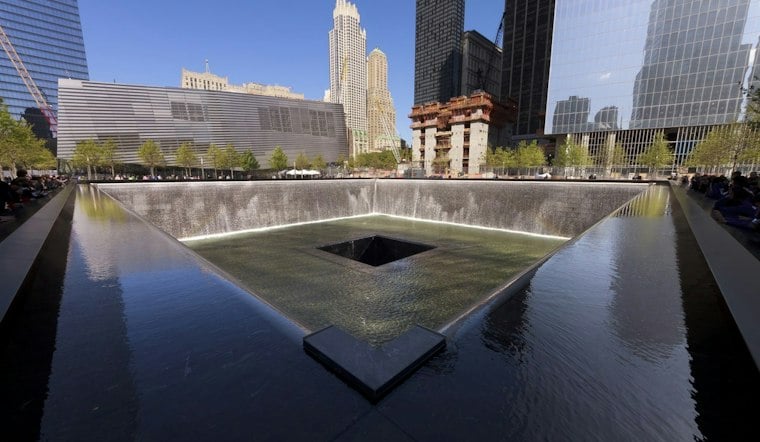
A growing record of an unfinished history
The National September 11 Memorial & Museum's permanent collection now holds more than 82,000 physical and digital artifacts, according to the National September 11 Memorial & Museum. Long before the museum opened in 2014, thousands of structural and personal artifacts recovered from Ground Zero were preserved and cataloged inside JFK International Airport's Hangar 17, where the Port Authority began cataloging them in 2002.
Nearly 25 years after the September 11 attacks, families of victims are still handing over deeply personal artifacts to the institution. A boarding pass that somehow survived the collapse of the World Trade Center, a purse pulled from rooftop debris, the frontal shield off a battalion chief's helmet, and a pair of shoes are among the objects now tied to that continuing history.
The donations carry extra weight because so much about September 11 remains unresolved. Nearly 25 years after the attack, the NYC Office of Chief Medical Examiner continues DNA testing on unrecovered remains, with about 40% of World Trade Center victims having had no remains identified, according to the Associated Press. According to the New York City Office of Chief Medical Examiner, its Department of Forensic Biology lab continues testing related to missing persons, unidentified remains and the ongoing effort to identify World Trade Center victims. A New York City Council document dated March 29, 2017, said the OCME Forensic Biology Laboratory was the first public forensic laboratory in the United States to implement High Sensitivity DNA testing. For families who never received a body, a purse, a boarding pass, or a pair of shoes can stand in for a closure that DNA science still hasn't delivered.
The consequences extend beyond the debris
The health toll, meanwhile, keeps expanding well past Ground Zero itself. The federal World Trade Center Health Program now enrolls more than 145,000 responders and survivors nationwide, with nearly 57,000 responders and survivors certified to have a 9/11-related cancer, according to Citizens for the Extension of the James Zadroga Act. Since its reactivation under the Zadroga Act, the September 11th Victim Compensation Fund has issued more than $18.38 billion in awards to over 76,000 injured responders, survivors, and family representatives.
In 2024, the museum opened Dust: Illness and Advocacy After 9/11.
That kind of posthumous donation reflects a grim, ongoing reality for FDNY families. In September 2023, the department confirmed that 343 members had died from 9/11-related illnesses, matching the exact number of firefighters and EMTs killed on the day of the attacks, according to CBS New York. More than 12,000 FDNY firefighters, EMTs, and paramedics have been diagnosed with at least one World Trade Center-certified illness, and over 2,500 have been forced into early disability retirement because of exposure injuries, per Newsday.
Objects that preserve separate parts of the story
John Keohane's shoes connect the collection to the search for victims in the immediate aftermath. Keohane worked at One Liberty Plaza and helped evacuate dozens of coworkers before he was separated from his domestic partner, Mike, during the chaos, the New York Post's account states. The 41-year-old was killed by falling debris from the South Tower's collapse, and his body was found in the wreckage three days after the attack. Father Andrew Cieszkowski performed last rites for Keohane at Our Lady of Victory, and Keohane's sister, Darlene Keohane, said the priest's response helped the family learn where her brother was.
Darlene Keohane has since donated her brother's shoes to the museum, adding another deeply personal item to a collection built almost entirely from loss. Families have donated hundreds of artifacts connected to September 11 to the institution, according to the report.
Jacqueline “June” Norton was booked on American Airlines Flight 11, which departed Boston's Logan International Airport for Los Angeles on September 11, 2001, carrying 92 passengers and crew members before hijackers flew it into the World Trade Center's North Tower, according to the New York Post. Norton and her husband Robert had planned to travel to Santa Barbara four days later for the wedding of Jason Seymour, her son. A month after her death, Seymour received his mother's recovered boarding pass, and this year he loaned her purse to the museum as well.
Seymour called the boarding pass's survival extraordinary, per the same account. The purse itself held her cellphone, a Tiffany pen, a newspaper clipping with a poem about tolerance, her wallet, and other personal belongings and boarding passes, according to the report. Seymour suspects the Port Authority of New York and New Jersey may have found the purse on a nearby rooftop, though that detail remains only a suspicion attributed to him rather than a confirmed finding.
Brian O'Flaherty, an FDNY battalion chief who served with the 9th Battalion crew, ran toward the disaster like other firefighters that day, his wife Karin O'Flaherty said, the article notes. When the South Tower collapsed, the 9th Battalion crew rushed into the Marriott hotel concourse, and the collapse killed several of O'Flaherty's fellow firefighters while severely injuring many other survivors. O'Flaherty himself was injured when concrete struck him during the collapse.
His helmet was found in the debris after the World Trade Center buildings came down, and O'Flaherty later gave that helmet to another firefighter, the outlet reports. He carried survivor's guilt for the rest of his life and died from a 9/11-related illness in 2022. His family has since donated the frontal shield from his FDNY helmet to the museum, reuniting it there with the very helmet he once gave away.
A public collection with a continuing role
The Tenement Museum notes that 146 young garment workers died in the Triangle Waist Company fire on March 25, 1911, an earlier New York mass-casualty event that also became the subject of public remembrance. New York University reported that a permanent memorial to the workers who died in the 1911 Triangle Shirtwaist Factory fire was dedicated at the historic site on October 11, 2023.
The museum opened in May 2014. The collection includes artifacts such as O'Flaherty's helmet shield, and the museum's collection materials also reference donated 9/11 items.




