

























































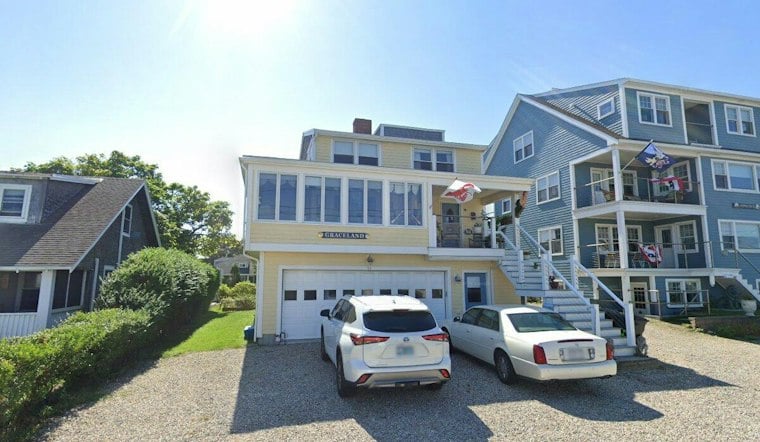
Kevin Gill was hoping to finish waterproofing the siding on his oceanfront Scituate home before the weekend, with renters set to arrive for a wedding. Instead, he is watching the forecast and bracing for a nor'easter, worried about the same kind of ocean damage that forces him to repaint two sides of his house every two years. Making matters worse, the federal money meant to shore up the seawall protecting his neighborhood has been frozen by FEMA.
Gill's property sits just inches from a stretch of Scituate seawall that was recently rebuilt deeper and thicker, according to CBS Boston. But a second phase of that project, which would extend protection to his property, now hangs in limbo. Gill said the work may not happen until 2028, per the same report, after FEMA froze funds designated for Massachusetts coastal communities to repair storm-damaged seawalls.
When waves hit the seawall near Gill's home, they can rise 60 to 80 feet, and a northeast wind drives that spray directly into his house, CBS Boston reports. With a nor'easter expected to hit Massachusetts this weekend, the timing of the funding freeze has left coastal homeowners like Gill anxious about what comes next.
Storms From More Than a Decade Ago Trigger the Freeze
FEMA has justified the funding cancellations by denying what are known as period-of-performance extensions for projects tied to coastal damage from Hurricane Sandy in 2012 and severe winter storms in February 2013, January 2015 and March 2018, according to Boston Orange. Those are strict federal deadlines, and when design and permitting stretch on for years, municipalities are required to seek extensions to keep the money flowing.
Scituate Town Administrator Jim Boudreau said the town's seawalls are not in imminent danger of collapse, though they do need repair work, per CBS Boston. He described the permitting process for coastal construction as extremely difficult, and FEMA has said simply that the projects were taking too long.
Massachusetts Emergency Management Agency Director Dawn Brantley has said coastal infrastructure projects face lengthy pre-construction delays precisely because they require complex engineering, environmental impact studies, and multi-agency state and federal permitting, the same Boston Orange report notes. In Scituate alone, the cancellation targets $2.89 million designated for seawalls, stone barriers, and beach access points across Surfside Road, First Cliff, Second Cliff, Third Cliff, Minot Beach, and Glades Beach, according to Boston Orange.
Millions Frozen Across the North and South Shores
The financial hit stretches well beyond Scituate. In Rockport, the decision eliminated $2.76 million in federal Public Assistance funding for a $4.1 million project to repair the nearly 100-year-old Long Beach seawall, damaged in a March 2018 severe winter storm, according to CNHI. Rockport Town Meeting had already approved the local municipal matching funds required for that project, per the same report.
Other coastal communities across the state were also hit, per Boston Orange's reporting: $595,118 in Quincy for Hough's Neck seawalls, $485,102 in Hull for Crescent Beach seawalls, $383,182 in Gloucester for Cressy Beach barriers, and $71,500 in Nahant, along with unallocated amounts in Marshfield along Ocean Street and Foster Avenue. Marshfield and Rockport are both named among the towns affected by the freeze, according to CBS Boston, and in total, FEMA will not fund about $30 million of the projects, per the same station's report.
Healey Demands FEMA Reverse the Decision
Governor Maura Healey formally demanded on July 30 that FEMA reverse its cancellation of more than $7 million in disaster recovery funding for coastal infrastructure across Massachusetts municipalities, according to the Massachusetts governor's office. Healey said the federal funding cuts are hurting communities' ability to prepare for severe weather, per CBS Boston, and wrote to FEMA's administrator asking the agency to reconsider its denial of period-of-performance extensions for the affected projects.
That federal disaster recovery funding was intended to protect homes, businesses, roads, utilities and public spaces from coastal erosion, flooding and future storms, per the CBS Boston report. Massachusetts communities had active projects underway repairing damage from Hurricane Sandy and the subsequent severe winter storms when the extensions were denied.
State officials have warned that FEMA's policy could force municipalities to repay federal funds already disbursed and spent on preliminary design and engineering, according to Boston Orange, shifting unexpected debt onto local taxpayers. In August, Massachusetts Senators Edward Markey and Elizabeth Warren, along with Representatives Bill Keating and Stephen Lynch, condemned the grant cancellations as arbitrary, reckless, and harmful in a joint petition calling for federal intervention, per CNHI.
A Pattern of Federal Friction
The seawall dispute follows a separate setback in September, when FEMA denied Healey's appeal for a Major Disaster Declaration tied to a February blizzard that caused $45 million in eligible municipal storm response costs, according to the governor's office. State programs offer some relief: the Massachusetts Executive Office of Energy and Environmental Affairs' Dam and Seawall Repair or Removal Program awarded nearly $11 million in September 2025 and funded coastal projects through a $45 million resilience grant round in August 2026, per the Massachusetts Municipal Association.
Those state grants, however, cannot come close to replacing the tens of millions in frozen federal funds. For now, homeowners like Gill are left watching the tide charts and hoping the seawall holds through this weekend's nor'easter, with no clear timeline for when, or if, the stalled second phase of construction near his property will move forward.





