

























































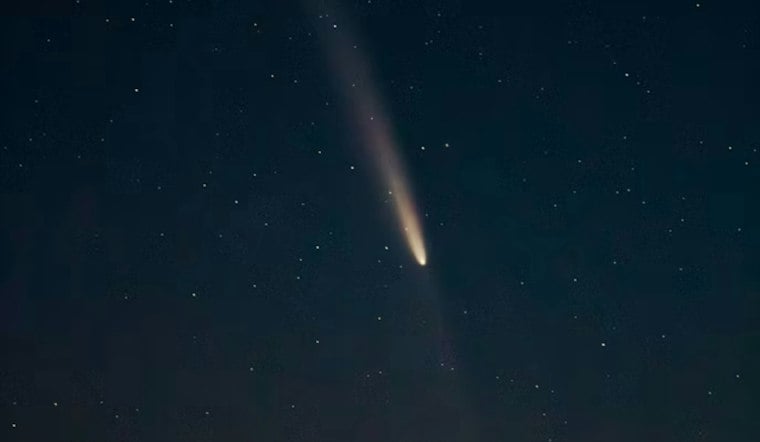
A bright fireball streaked across the Michigan sky Sunday night, spotted independently by weather watchers in Cheboygan, in the northern Lower Peninsula, and Macomb Township, more than 200 miles away in Metro Detroit. The Macomb Weather camera network reported the flash at 8:47:22 p.m., lasting 4.7 seconds and appearing to the northeast, while storm watchers further north reported catching the same event on the Sprays landscape camera before it broke apart somewhere over Lake Huron or Ontario.
According to The Detroit News, the meteor was spotted by weather watcher sites tracking the sky over both locations. NASA CNEOS describes a fireball as an exceptionally bright meteor, spectacular enough to be seen over a very wide area — and Sunday's sighting fits that bill, given the distance between the two vantage points. A fireball is technically a type of meteor, meaning a meteoroid that enters Earth's atmosphere and breaks apart, according to NASA, which also notes that meteors themselves are common occurrences visible on any given night.
Same Streak, Two Distant Towns
The geography here isn't as strange as it might sound. The Michigan Townships Association notes that Cheboygan and Macomb Township sit more than 200 miles apart in a straight line, and high-altitude meteor breakups over Lake Huron can be seen simultaneously across that kind of distance. Because these breakups typically occur 20 to 50 miles above the surface, a single fireball's light can reach observers across a huge swath of the state at once, per the same association data cited in reporting on the event.
This is far from Michigan's first fireball moment of 2026. Back in March, a fireball turned Metro Detroit's night sky briefly into daylight, prompting sonic boom reports across Wayne and Macomb counties, as Hoodline reported at the time. That same month, NASA's Meteoroid Environment Office tracked a separate 1-pound meteoroid, first spotted 42 miles above Hope, Michigan, traveling at 29,000 mph before it disintegrated roughly 23 miles above Saginaw Bay — an object NASA said burned roughly 40 times brighter than Venus. Then in June, the American Meteor Society logged 94 witness reports after a bright fireball lit up the sky across Northern Michigan and Ontario, with sightings from Mackinac Island to Sault Ste. Marie.
What Counts as a Fireball
Not every shooting star qualifies for the fireball label. Astronomical organizations define a fireball as a meteor reaching a peak visual brightness of magnitude -4 or brighter, roughly as bright as Venus in the morning or evening sky. Fireballs often occur over oceans, unpopulated areas, or during daytime without any witnesses at all, meaning clear-view observers who do catch one are treated to a genuine spectacle. The Northern Hemisphere's fireball season, when sightings tend to peak, runs from February through April.
NASA estimates that roughly 48.5 tons of meteoritic material strikes Earth's atmosphere every day, though the vast majority vaporizes as shooting stars or microscopic dust long before reaching the ground. Only a small fraction survives the trip as an actual meteorite, defined simply as a piece of space debris that lands on Earth. So far, 12 meteorites have been found and confirmed to have landed on Michigan soil.
Michigan's Meteorite-Hunting Rules
The state's most famous recent fall happened on January 16, 2018, when a six-foot-wide meteoroid exploded roughly 20 miles above southeastern Michigan with energy equivalent to 100 tons of TNT, triggering a 2.0-magnitude seismic event recorded by the U.S. Geological Survey and scattering confirmed meteorites across Hamburg Township, according to Fox News. NASA's Meteoroid Environment Office uses automated all-sky camera networks and Doppler weather radar to detect these breakups, calculate trajectories, and pinpoint potential fall zones, and radar data proved critical in locating the 2018 fragments.
Anyone inspired to go hunting for pieces after an event like Sunday's should know the rules first. Michigan limits rock, mineral, and fossil collecting on state-owned lands and Great Lakes bottomlands to 25 pounds per person per year for non-commercial hobby use, while collecting on National Park Service land in the state is strictly prohibited. Federal rules under Bureau of Land Management Instruction Memorandum 2012-182 allow casual, permit-free surface collection of meteorites on eligible federal public lands up to 10 pounds per person per year, using only non-motorized, hand-carried tools. Whether any fragments from Sunday's fireball actually reached land or fell into Lake Huron remains unknown, and it's still unclear whether NASA's Meteoroid Environment Office or the American Meteor Society will confirm an exact trajectory for the event.





