

























































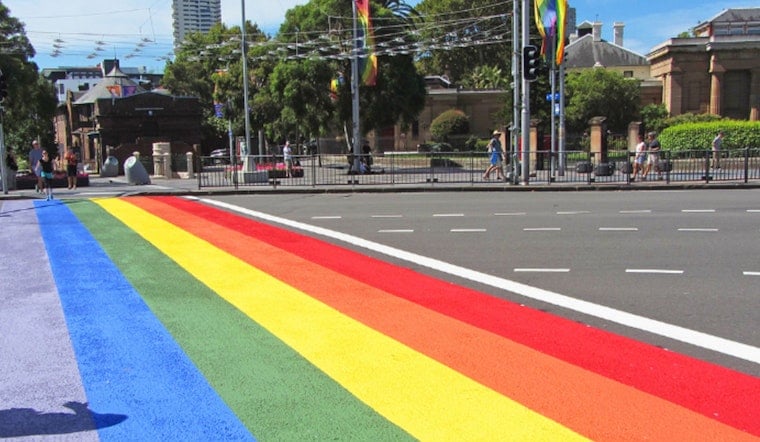
A new 1,700-square-foot mural now covers a wall at Park and Lomax streets in Jacksonville’s Riverside neighborhood, painted by artist Shaun Thurston over three weeks of rain and 8- to 17-hour days as a replacement for the rainbow crosswalks the state forced the city to erase last year. Local community activists put up the piece, titled “The Constellation of Us,” in direct response to Florida officials painting over the crosswalks, and it was unveiled with that name during a community ceremony in Five Points.
According to Action News Jax, the mural showcases a rainbow color spectrum and portrays actual community members, per Riverside Avondale Preservation. Richard Ceriello said of the piece, “This beautiful mural honors the wide spectrum of community members in the unique colorful diversity.” The Florida Department of Transportation and Gov. Ron DeSantis had ordered the rainbow crosswalks painted over in August 2025, and this new artwork sits behind the sidewalk rather than on the roadway itself.
Why the Crosswalks Disappeared
The removal in Five Points was part of a much larger sweep. Complying with FDOT’s pavement art mandate cost Jacksonville taxpayers roughly $21,000 to $22,000 to remove six installations citywide, including three rainbow crosswalks in Five Points, a street mural near Baptist Hospital in San Marco, and crosswalks in Springfield, according to First Coast News. The city faced a September 4, 2025 deadline before FDOT threatened to remove the markings itself and bill Jacksonville for the work.
The mandate traces back to Florida Senate Bill 1662, signed by DeSantis in June 2025, which required strict adherence to traffic control standards and let FDOT withhold state road funding from cities that didn’t comply, per WUSF. FDOT Secretary Jared Perdue issued a memorandum declaring prior pavement art permits invalid, and that same FDOT memo stated that non-standard surface markings can lead to distractions or misunderstandings. The state crackdown also aligned with a July 2025 directive from U.S. Transportation Secretary Sean Duffy, whose federal “SAFE ROADS” program gave governors 60 days to eliminate political messages and non-standard pavement artwork from public highways, as reported by the Associated Press. Federal officials claimed the artwork distracts drivers and interferes with autonomous vehicle sensors.
An Artist’s Response, Not a Loophole
Thurston, who created the mural, said the reaction from the neighborhood as he worked was overwhelmingly positive. “Every single person, 100% of people I interacted with, were supportive and complementary,” he said. He also explained why he took on the project, saying covering over LGBTQ-representing color that made people feel seen likely felt personal. Still, Thurston was careful about how he characterized the state’s underlying rationale, saying, “I didn’t interpret it as anything other than using law to control traffic flow.” The mural was not described as a way to skirt around the governor’s policies.
City Councilman Jimmy Peluso saw the moment differently. He said the mural represents community members representing themselves, and Peluso, who said he follows the issue closely, went further in describing the governor’s broader record. “This governor has made it his mission to go above and beyond and trying to erase certain groups in the state,” Peluso said, adding that DeSantis is using the power of government to erase certain groups in the state. Action News Jax reached out to the governor for comment on Peluso’s remarks. The outlet also noted that DeSantis ordered state bridges restricted to red, white, and blue lighting during summer months in 2024, a restriction that included June, Pride Month.
A Safety Debate With Data on Both Sides
Jacksonville officials have pushed back on the state’s safety rationale using outside research. The 2022 Asphalt Art Safety Study by Bloomberg Philanthropies and Sam Schwartz Consulting found that colorful pavement artwork reduced pedestrian and cyclist crash rates by 50% and overall intersection crash rates by 17%, a figure city officials cited while resisting the crosswalk removal mandate. Colored crosswalks of all types were painted over statewide in mid-2025 because of stated driver and pedestrian safety concerns, even as that Bloomberg-backed data cut against the state’s reasoning.
Part of a Statewide Pattern
Jacksonville’s pivot to private-property art followed a strategy Mayor Donna Deegan’s administration laid out in August 2025: while the city was legally forced to paint over street murals to protect transportation funding, it planned to help local artists relocate public artwork onto private building surfaces off public roadways, according to News4JAX. Deegan called the state requirement a costly reversal of local art investment. Ahead of the mural’s unveiling, local artist Mere Mason had already transformed an abandoned pay phone stand on Park Street into a rainbow sculpture last October, timed to Jacksonville’s River City Pride celebration, as Jacksonville Today reported.
The friction has played out well beyond Jacksonville. In Orlando, state contractors painted over the rainbow crosswalk outside the former Pulse Nightclub, installed to honor the 49 victims of the 2016 mass shooting, which led to public outcry and Florida Highway Patrol arrests of protesters at the site the following month, per the Associated Press. Miami Beach filed a legal petition with Florida’s Division of Administrative Hearings against FDOT’s memorandum, arguing the state imposed binding rules and funding penalties without proper public notice, Central Florida Public Media reported. FDOT’s ban wasn’t limited to LGBTQ symbols either — the state also removed a checkerboard racing flag crosswalk at Daytona International Speedway and a “Back the Blue” street mural outside Tampa Police headquarters, treating all non-standard markings the same regardless of theme.
Why Five Points
Five Points has functioned as a hub for Northeast Florida’s independent retail scene and LGBTQ community since it grew up around the historic 1927 Five Points Theatre, the first movie house in Florida designed for sound pictures. That history is part of why organizers chose Park and Lomax streets for the new mural, positioning “The Constellation of Us” on private property set back behind the sidewalk so it sits outside FDOT’s roadway jurisdiction entirely. The neighborhood has seen other recent shifts, from new ice cream rivals opening nearby to long-running businesses closing shop along the corridor.





.jpg)