

























































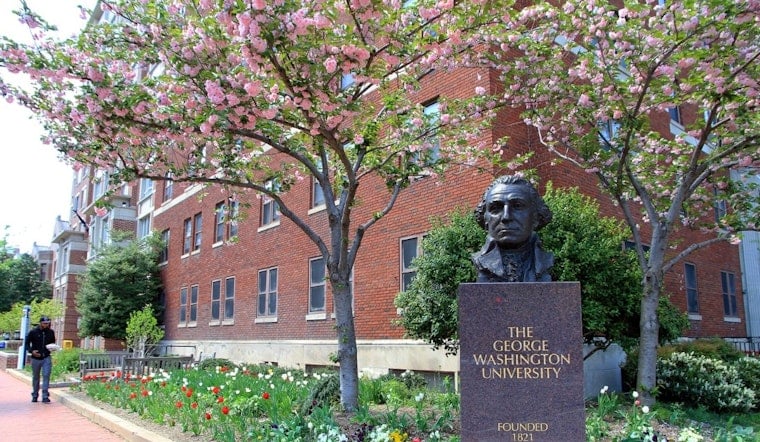
A former George Washington University student who lived in Mitchell Hall says a flooded dorm suite in September 2023 left him hospitalized, forced him to withdraw from school, and caused injuries he calls permanent. Adam Johnson, of Fairfax, Virginia, filed an 11-page negligence complaint in D.C. Superior Court on September 3, days before the three-year window to sue over the incident was set to close.
According to The GW Hatchet, Johnson moved into Mitchell Hall in late August 2023, with his housing assignment coordinated through GW's Disability Support Service office. He noticed water leaking from his air conditioner shortly after moving in and reported both the leak and a nonflushing toilet to GW maintenance staff, but university officials allegedly told him to keep living in the suite and to use communal restrooms in the building instead. Under District of Columbia law, the three-year statute of limitations for personal injury and property damage negligence claims generally runs from the negligent act or occurrence but may run from discovery of harm in some cases, according to Price Benowitz LLP, which places Johnson's filing right at the legal deadline tied to the September 6, 2023, flooding.
A Flood That Reached the Bedroom
The Hatchet's report states that Johnson's suite flooded after he flushed the toilet on September 6, 2023, with floodwater extending into his bedroom. He reported the flooding to GW's on-site repair facilities, but his lawyer argues that university officials failed to immediately repair or clean up the mess. On September 15, Johnson's parents detected a foul mildew or fungus smell in his room. Johnson's parents moved him out of Mitchell Hall on September 15, before his September 16 hospitalization.
Johnson was admitted to a hospital in Fairfax, Virginia, on September 16, 2023, for treatment related to adverse health impacts from the incident, the outlet reports. He later requested medical leave in November 2023 and, per his complaint, was unable to continue his studies because of his injuries. His attorney alleges he sustained serious, debilitating and permanent physical and psychological injuries, and says he continues to incur medical expenses.
Four Counts and a Jury Trial Request
Johnson's lawyer has charged GW with negligence, gross negligence, negligent infliction of emotional distress, and breach of implied warranty of habitability, arguing that the university failed to inspect and maintain plumbing in his room and failed to respond to notice of a plumbing defect in a timely manner. The complaint also describes economic damages tied to personal-property loss, tuition, and costs related to what Johnson describes as a forced withdrawal. He is requesting $5 million in compensatory damages and $5 million in punitive damages, and his lawyer has requested a jury trial. Johnson could not be reached for comment, and his lawyer declined to comment when contacted by the Hatchet; GW officials did not return an immediate request for comment either, per the same report.
The case has an initial scheduling hearing set for December, the outlet notes. D.C. courts operate under a doctrine known as pure contributory negligence, which, according to SetCalc, can completely bar an injured plaintiff from recovering any damages if the plaintiff is found even minimally at fault.
Not the First Mold Fight Over Mitchell Hall
Johnson's lawsuit isn't the first time a Mitchell Hall resident has taken GW to court over unsafe living conditions. In August 2020, former resident Adam Beasley sued the university in D.C. Superior Court, alleging that airborne mold spores and mattress mold in his room caused severe eye and respiratory infections during the summer of 2019, according to The GW Hatchet's earlier reporting. Beasley sought a housing refund after alleging mold levels in his room exceeded safety standards by more than 500 percent. Under District of Columbia Municipal Regulations, residential building operators — including university housing — are legally obligated to keep facilities clean, safe, and sanitary and free from excessive moisture and hazardous mold, a standard that underlies the habitability claims in both lawsuits.
The building itself has a history of mold problems. Mitchell Hall was originally known as All State's Hotel and was designed by architect Waddy B. Wood, according to the D.C. Office of Planning. In 2019, GW officials relocated summer Mitchell Hall residents after mold was found on the fourth and seventh floors, moving displaced students to Thurston Hall for the rest of the term and offering a $525 housing credit.
Complaints Have Continued Into Recent Years
Mold problems at GW have not been confined to Mitchell Hall or to 2019. In September 2021, the university evacuated roughly 175 students from all eight Townhouse Row buildings after water leaks and airborne mold caused flu-like illnesses and sent several students to local hospitals, according to WUSA9. Students were temporarily relocated to hotels while environmental assessors inspected campus housing.
More recently, Mitchell Hall residents reported mold in dorm rooms, kitchens and common spaces in 2024, per the Hatchet. One resident developed a cough and sore throat after moving into her room that year, was later diagnosed by a doctor with a severe mold allergy, and was temporarily relocated to a hotel. The Hatchet reported on those complaints in November 2024.
GW Points to a $30 Million Overhaul
The university has since made a large financial commitment to addressing the issue campus-wide. In July, George Washington University announced it had completed $30 million in campus residence improvements, alongside general construction, roofing repairs, and student lounge upgrades. Mitchell Hall's major renovation was completed in August 2026.
Whether that pending renovation, or the $30 million already spent, will resolve the recurring moisture problems tied to Mitchell Hall's structure remains an open question. For now, Johnson's case adds a new chapter to a building with a documented history of hidden mold, evacuations, and student complaints stretching back years before he ever moved in.




