

























































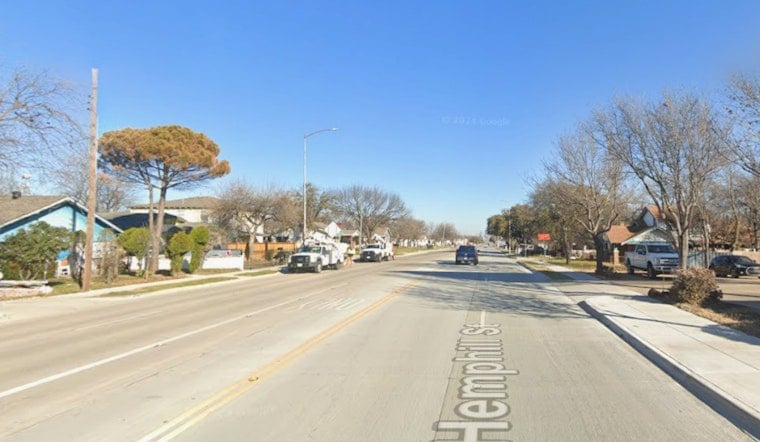
Fort Worth is moving to unwind much of its 2020 Hemphill Street road diet, restoring the corridor to five traffic lanes south of Allen Avenue near the JPS Health Network complex while keeping a slimmer three-lane layout to the north. The hybrid plan, which would strip out dedicated bike lanes, on-street parking, and bus pull-offs along the southern stretch, comes after a city survey found that 85% of respondents wanted the current traffic pattern changed.
City officials presented the survey results at Victory Forest Community Center on August 26, drawing on responses from 2,166 residents and business owners, according to the Fort Worth Report. Nearly 68% of survey respondents preferred fully restoring five lanes, while about 11% backed the hybrid approach and roughly 15% wanted to keep the current three-lane configuration. Martin Phillips, the city's assistant director of transportation management, said the project itself will not change the corridor's underlying infrastructure, per the same report.
The restriping work, expected to begin by April 2027 and cost up to $800,000, would add two northbound lanes, two southbound lanes and a turn lane between Seminary Drive and Allen Avenue. Fort Worth traffic engineer Rajnish Gupta described it as a straightforward restriping project, according to the Fort Worth Report, involving removing roadway paint and aligning traffic signals rather than rebuilding the road. Existing crosswalks will be restriped, but the city has no plan for additional crosswalks, and north of Allen Avenue the corridor will retain two traffic lanes, two bicycle lanes and bus access.
Why the City Revisited a 2020 Road Diet
Hemphill was restriped from Hammond Street to Vickery Boulevard in 2020, cutting the road from five lanes to three while adding street parking and northbound and southbound bicycle lanes, a change intended to manage traffic speed. According to city officials cited by the Fort Worth Report, the 2020 changes improved road safety overall, resulting in fewer crashes and pedestrian fatalities, though bicycle-related crashes ticked up slightly and some serious injuries increased.
District 11 Councilmember Jeanette Martinez, elected in 2023 as Fort Worth's first Latina city council member, pushed for a new transportation study on Hemphill after taking office that June, responding to constituent complaints about congestion and travel delays. The corridor runs through District 9, represented by Elizabeth Beck, and District 11, represented by Martinez, according to city records. Before the survey launched, the Transportation and Public Works Department hosted a community meeting on April 6 that drew about 80 residents and business owners to Victory Forest Community Center, where staff gathered feedback on three traffic scenarios.
Residents Split Over Safety and Speed
Derek Bruce, a 46-year-old south Fort Worth resident who lives a block from Hemphill, occasionally rides his bicycle on the street but does not let his wife or children ride there. He told the Fort Worth Report the hybrid plan will double the number of cars and reduce safety, adding plainly, “It is just not safe.” Bruce said the 2020 changes had reduced speeding cars, noise and crime in the neighborhood.
Paul Mercer, a 69-year-old resident, offered the opposite view, supporting a return to five lanes south of Allen Avenue and telling the outlet that the previous three-lane configuration was dangerous. Neighborhood residents more broadly have questioned whether cyclists and pedestrians — especially students — will remain safe if traffic speeds increase, per the Fort Worth Report's account of the debate. The survey drew participants from Rosemont, Worth Heights, South Hemphill Heights, Ryan Place and Fairmount, and was conducted from June 22 to July 31.
A Corridor Braced for More Traffic
Hemphill carried between 14,000 and nearly 17,000 daily motorists south of Rosedale Street to Seminary Drive in 2025, with up to 16,930 daily motorists recorded on parts of the corridor. Traffic is expected to reach about 20,000 daily motorists by 2030 and roughly 30,000 vehicles by 2045, causing delays during peak drive times as North Texas is expected to gain 4 million more people by 2050. Fort Worth evaluates traffic corridors every three to four years, and a staff report cited by the Fort Worth Report said full restoration of five lanes could deliver the road's strongest long-term performance through 2045, accommodating growth and congestion, while the hybrid scenario would improve operations only in the southern portion and would not eliminate long-term congestion in the northern segment.
Ann Zadeh, executive director of Community Design Fort Worth and a former District 9 city council member, walked a four-mile stretch of Hemphill from Biddison to Berry streets and said the bicycle and parking lanes added in 2020 had made walking more comfortable. She was disappointed by the current proposal, arguing it emphasizes vehicle traffic over alternative transportation modes. Zadeh pointed to Berry Street, which has eight lanes and no buffering for vulnerable pedestrians, as a cautionary example of what heavier vehicle capacity can mean for people outside cars.
Transit Still Serves the Corridor
Even as bus pull-offs are removed south of Allen Avenue, Trinity Metro is preparing to launch its third color-coded bus line in September, rebranding Route 1 as “La Línea Rosa” — a Latin-themed magenta rebrand running from downtown Fort Worth through Hemphill Street to La Gran Plaza. Hemphill will continue to offer bus and rideshare services alongside bicycle lanes on the northern segment, even as the corridor's overall balance of car capacity to multimodal infrastructure shifts.
The debate over Hemphill's lane configuration unfolds against a broader citywide safety backdrop. Fort Worth's Safety Action Plan recorded 68,936 traffic crashes between 2019 and 2023, with 2,589 resulting in death or serious injury, and the Federal Highway Administration has designated Fort Worth a Pedestrian Focus City due to historically high rates of pedestrian crashes and fatalities, according to the Texas Department of Transportation. The city council formally adopted a Vision Zero resolution in November 2019 committing Fort Worth to eliminating traffic fatalities and severe injuries, a policy framework that stands in tension with the Hemphill hybrid plan's emphasis on restoring vehicle capacity. Nationwide, U.S. traffic fatalities fell 12% in 2025 compared to the prior year, according to the Vision Zero Network, as more cities adopted speed-management policies similar to Fort Worth's original 2019 commitment.
The stakes along Hemphill are rising with new residential growth nearby, including the Maren Grove affordable housing complex at 3320 Hemphill St., which includes an on-site 40-child pre-K program, and the planned Livano Victory Forest development — part of a broader building boom on Fort Worth's south side. Under the current plan, the Fort Worth hybrid approach would convert about 72% of the corridor to five lanes, leaving the debate over safety versus speed unresolved as construction approaches its planned start by April 2027.





