

























































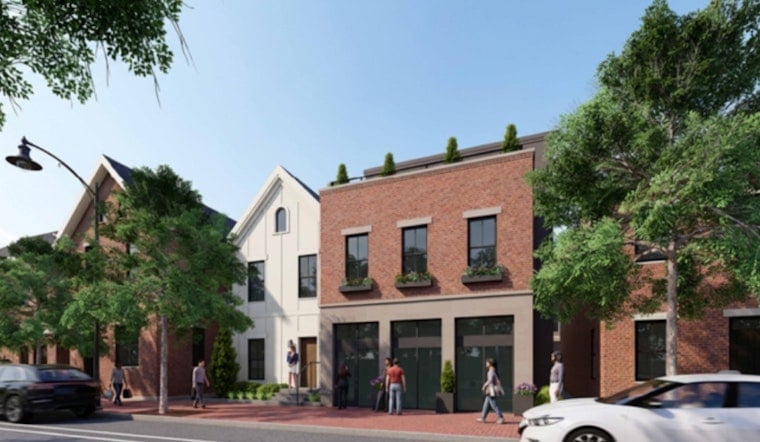
A mixed-use development proposed for East Livingston Avenue in German Village is heading toward what could be a final vote, more than a year after Mershad Development first brought the project before the neighborhood's historic review board. The current version of Cedar Square calls for 52 dwelling units across three stories, with covered parking on the ground floor and a smaller retail component fronting Livingston Avenue. Residents who oppose the project in its current form say it still doesn't fit the scale of the historic district, even after multiple rounds of revisions.
According to NBC4 WCMH-TV, the German Village Commission is set to conduct a final review of Cedar Square at a Wednesday meeting, where members could vote on approval. The application covers properties at 245-277 East Livingston Avenue and calls for demolishing a two-story brick structure while retaining and modifying an adjoining two-story Italianate brick building. The proposal would preserve an existing open-air parking area immediately west of Bendi Wok and keep current parking-lot access at 245 East Livingston Avenue.
The project has changed considerably since it was first floated. NBC4 WCMH-TV reports the original Cedar Square concept included 96 apartments in a four-story building, but Mershad Development has revised the proposal several times, ultimately reducing it to three stories and 52 units. Most of the residential units would sit on the second and third floors, and the project team has increased brick use along the north and south facades, added landscaping along Blenkner Street, and revised the design to reduce visibility of a rooftop patio.
Residents Say the Building Is Still Too Long
Despite those changes, a petition organized by German Village resident Michael Gallaugher and reported by 614NOW had collected over 400 verified signatures opposing the building's continuous footprint as of August. Per the station's report, petition organizers said the proposed Blenkner Street building would create more than 300 feet of continuous building frontage — and 614NOW notes the structure extends roughly 327 feet from east to west, nearly the length of a regulation football field. The petition asks the German Village Commission and the City of Columbus to reject the proposal in its current form, and organizers want a project that more closely follows the neighborhood's traditional scale and development patterns.
By August 18, the petition had grown to more than 750 signatures, the station's report indicates. Organizers say they support redevelopment of the property but are asking that the third story be eliminated and that the developer further address pedestrian access, traffic, and service and delivery activity along the constrained conditions of Blenkner Street and Dixon Alley. Buildings along East Livingston Avenue are capped at 36 feet, and commissioners and residents alike have raised concerns about density, height and compatibility with German Village throughout the review process.
Commission Has Pushed Back Before
The scrutiny isn't new. German Village commissioners have questioned parts of the application at multiple points, even while acknowledging progress on the design. One commissioner said the project remained too tall and too large, according to the same account, while another commissioner said facade changes helped it feel more in scale with its surroundings. Commissioners have also raised concerns about the rooftop patio, lighting, landscaping and building materials, and German Village Commission member Ed Thiell said more work was needed.
The commission has drawn a hard line on height before. According to local meeting coverage on Facebook, the commission previously rejected a variance for a proposed five-story boutique hotel at Livingston Avenue and City Park, enforcing the district's 35-foot height ceiling. Preservation advocates at the time argued that exceeding height limits would set a dangerous precedent for future district developments — a concern echoed by Cedar Square's critics today.
A Regional Housing Crunch Shapes the Debate
The fight over Cedar Square is playing out against a citywide push for more housing. Columbus Mayor Andrew Ginther has cited a regional deficit of 200,000 housing units across all price levels when advocating for increased residential density in growing corridors, including historic neighborhoods, according to WBNS-TV. The Columbus Department of Development has reported the city has only one housing unit for every 2.5 jobs, prompting the “Zone In Columbus” initiative to modernize a 70-year-old zoning code and support 88,000 new housing units over the next decade — the first major overhaul of the city's zoning laws since the 1950s.
City housing officials have noted that commission reviews must balance those regional growth demands against historic preservation. That tension has played out unevenly across German Village's borders: Columbus Business First reported in May that while Northstar Realty had already begun demolition for The Livingston, a five-story, 182-unit mixed-use project near South 9th Street across from Nationwide Children's Hospital, Cedar Square remained stuck in its second year of review before the German Village Commission because it sits inside the historic district.
Why East Livingston Avenue Is the Battleground
German Village's zoning explains why Cedar Square is even possible here. According to the German Village Society, the neighborhood's zoning was converted in the early 1960s from manufacturing and commercial use to high-density residential, and later to a designation restricting most residential construction to single- and two-family homes — everywhere except along the East Livingston Avenue commercial corridor, which remains one of the few zones where multi-unit commercial development is allowed.
That carve-out is a legacy of the district's founding. German Village was designated as Columbus's first city historic district in 1960 and was listed on the National Register of Historic Places in 1974, making it one of the largest privately funded historic restoration districts in the country, per the German Village Society. The German Village Commission and Historic District were formally established under city ordinances in 1963, giving the architectural review board binding legal authority over exterior alterations within its boundaries — authority the commission is now weighing directly against Cedar Square's design.
Public commission records published by the German Village Society show Mershad Development first submitted conceptual plans for the site back in March 2018, seeking demolition of a 1981 two-story brick office building. City of Columbus planning staff have recommended approval of the revised 52-unit plans, according to Citizen Portal, concluding the developer had adequately addressed prior feedback by adding brick cladding, deepening facade recesses and increasing street landscaping. Despite that staff recommendation, commissioners continued the hearing following extensive public testimony — leaving Wednesday's scheduled review as the next test of whether Cedar Square, more than a year into the process, finally clears German Village's historic district standards.





