

























































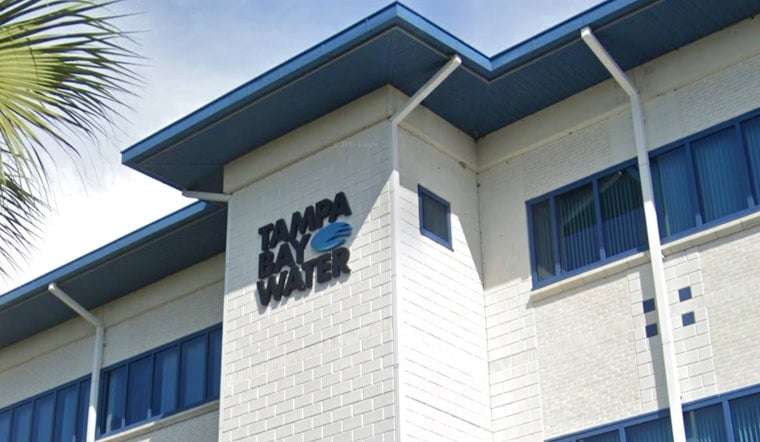
A $21.05 million construction project that connected a new intake pump station to one of Tampa Bay's only desalination facilities has earned a national design-build award, capping an 18-month build that took place inside an active Tampa Electric Company power plant without a single safety incident. The Tampa Bay Water Desalination Intake Pump Station – Phase II project, located in Gibsonton, Florida, was named a 2026 National Design-Build Project/Team Award Merit Winner.
According to a staff report from the Osprey Observer, Tampa Bay Water led the project, which remained on budget throughout construction. Archer Western Construction LLC served as design-builder and general contractor, Wade Trim Inc. provided engineering services, and Black & Veatch Corp. served as owner advisor. The Design-Build Institute of America recognized 32 projects nationwide across 10 categories as part of this year's honors, and additional national recognitions will be announced at the 2026 Design-Build Conference & Expo in Cleveland on November 5.
Building Around a Live Power Plant
Construction took place inside an active Tampa Electric Company power plant, according to the same report, which meant the project team had to work while the utility's own facility was undergoing its own construction work at the same time. Tampa Bay Water collaborated with the design-build team, TECO operations staff, and TECO's contractor throughout the build, with that collaboration including frequent coordination meetings and real-time communication to keep both projects moving without conflict.
Crews also had to address previously unknown utilities discovered during construction and work around existing utilities already in place at the site. Critical electrical systems were elevated above the floodplain as part of the design, a safeguard built to withstand coastal flooding risk. The new intake pump station was designed to meet rising water demand and improve resilience to coastal flooding and extreme weather, and it can supply up to 50 million gallons of seawater per day once fully operational.
Protecting Manatees and the Surrounding Bay
The project team worked near a public manatee viewing area and the surrounding marine environment, requiring construction to include strict environmental controls and monitoring designed to protect the surrounding marine habitat. As part of that environmental commitment, the project team partnered with Clams for Clean Water, a nonprofit organization, to design and construct clam habitats intended to improve water quality in the bay.
That partnership fits into a broader Tampa Bay restoration effort in which a single quahog clam can filter up to 20 gallons of water daily, according to the Salt Strong Alliance, the nonprofit that leads bivalve restoration initiatives across west-central Florida by deploying millions of clams to naturally filter bay waters.
Why the Intake Needed Rebuilding
The push for new intake infrastructure traces back to Tampa Electric Company's plans to retire older cooling water tunnels at its Big Bend Power Station, which forced Tampa Bay Water to build new intake connections tied to TECO's Tunnel 1, according to a report from Tampa Bay Water. The utility had completed Phase 1 of the tunnel connection improvements in December 2021 before moving into the Phase II work now being honored nationally.
The Walsh Group's account of the project notes that the roughly 600 linear feet of 54-inch-diameter fiberglass reinforced plastic piping installed to connect the new pump station to the existing intake system, along with reconfigured electrical infrastructure, represented some of the project's most technically demanding engineering work, as detailed by Walsh Group.
Part of a Larger Regional Water Strategy
The Gibsonton facility sits alongside the Tampa Bay Seawater Desalination Plant, which was completed in late 2007 for $158 million and remains the largest seawater desalination facility in North America, capable of supplying up to 10 percent of the region's total drinking water, per the Southwest Florida Water Management District. Operating at up to 50 million gallons per day of seawater intake, the plant generates up to 25 million gallons per day of drinking water and returns 19 million gallons per day of concentrated brine, which gets diluted up to 70-to-1 with power plant cooling water before it reaches the bay, according to Wastewater Digest.
Tampa Bay Water operates as Florida's largest wholesale water supplier, governed by a nine-member board representing Hillsborough, Pasco, and Pinellas counties along with the cities of Tampa, St. Petersburg, and New Port Richey, serving more than 2.6 million residents. The utility separately approved a $15.5 million Reverse Osmosis Trains Project expected to restore the desalination plant to its full 28 million gallon per day design capacity by late 2027.
Growth across the region continues to drive that capital spending. The Tampa Bay area added more than 123,000 residents between July 2021 and July 2022, and long-term projections estimate the region will need an additional 25 million gallons per day of capacity by 2043. Tampa Bay Water also broke ground in March 2026 on a separate $181 million expansion of its regional surface water treatment plant, aiming to add 12.5 million gallons per day of drinking capacity by 2028 through a public-private partnership with Veolia and CDM Smith.
National Recognition
DBIA Executive Director and CEO Lisa Washington said the national award winners demonstrate what can be accomplished through expertise, innovation and a shared commitment to excellence. The Gibsonton project's selection places it among 32 merit award winners chosen nationwide across 10 categories, with the full slate of teams set to be formally recognized at DBIA's national conference in Cleveland this November.




