

























































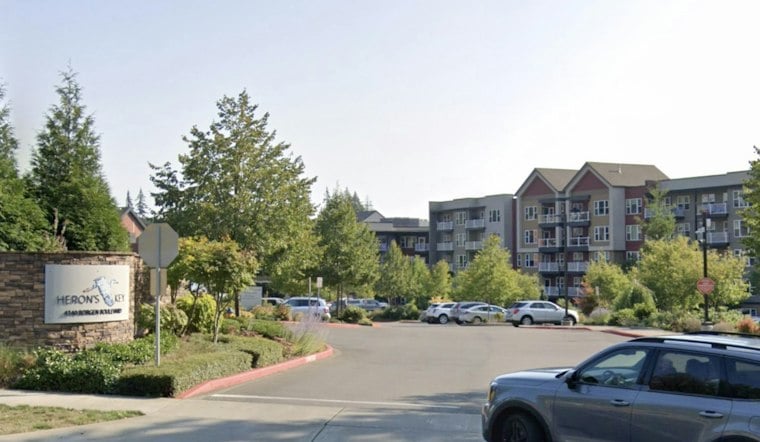
A group of retirees at a Gig Harbor senior community spent seven years and roughly $750,000 turning a pair of utilitarian stormwater ponds into a 15-acre public nature sanctuary complete with a paved, wheelchair-friendly path. The Harbor Hill Environmental Sanctuary sits behind Heron's Key, the senior living campus at 4340 Borgen Blvd., and today draws walkers, physical therapy patients, and wildlife watchers to what used to be a pair of fenced-off detention basins.
The project began in 2018 when Bill Lewallen and fellow residents formed Friends of Harbor Hill Environmental Sanctuary to enhance and preserve the pond environment and create opportunities for passive recreation, according to The News Tribune. Lewallen, who served as the group's president and board chair, brought experience from an earlier career restoring wetlands: he previously helped establish the 50-acre Narbeck Wetland Sanctuary near Paine Field, which was dedicated in 1999 and became one of the first two accredited wetland mitigation banks in Washington state, according to Paine Field. That earlier work earned Lewallen and Snohomish County a Washington State Department of Ecology Environmental Excellence Award in 2008, per a news release cited by the same source.
The Harbor Hill ponds themselves serve a real municipal function, collecting and filtering stormwater runoff from the Harbor Hill neighborhood, Bracera Apartments, and Heron's Key before it reaches the broader watershed, per The News Tribune's reporting. A resident owners association representing those three properties owns the ponds and is responsible for maintaining them as required by the City of Gig Harbor, the paper reports. Harbor WildWatch, which studies the site's ecological role, notes that the two retention ponds detain and filter runoff from Borgen Boulevard, Bracera Apartments, and Heron's Key before it discharges into local watershed systems.
From Gravel Loop to ADA-Compliant Trail
Originally, the ponds were ringed only by a rough gravel path starting on Borgen Boulevard and running alongside Shaw Park, terrain that proved difficult for mobility-impaired residents to navigate. Friends of Harbor Hill Environmental Sanctuary started with a budget of about $230,000 and eventually installed a 15-foot-wide asphalt path stretching roughly a third of a mile around the ponds, according to The News Tribune. Engineering plans for the project called for close to a full linear mile of multi-purpose, ADA-compliant pathways and service roads linking the two ponds to the city's adjacent wetland trail system, according to the American Planning Association Washington Chapter.
The group also added 13 benches and four environmental education signs along the route, and planted native vegetation along the pond banks after consulting with Harbor WildWatch, per The News Tribune. The resident owners association's contracted landscaper agreed to limit mowing of the pond banks and protect plants near the water's edge, the paper reports, helping the site earn certification as a wildlife habitat under the National Wildlife Federation. Heron's Key resident Pat Curtis, who underwent hip replacement surgery and was recovering in a wheelchair as of mid-July, told The News Tribune that the sanctuary walkway and reserve helped her recover and enjoy weather and nature. The site is also used by a Heron's Key physical therapy group, according to the same report.
Funding a Park Without Public Money
Heron's Key residents raised about $750,000 over seven years to fund the sanctuary, with the remainder of the budget coming from grants, including support from Olympic Civic Services and the Key Peninsula-Gig Harbor-Islands Watershed Council, per The News Tribune. Friends of Harbor Hill Environmental Sanctuary signed a fiscal sponsorship contract with the Greater Gig Harbor Foundation, which provided accounting, donation, and fundraising advice, according to Lewallen as cited in the paper. The Greater Gig Harbor Foundation has awarded more than $1 million in total support to local parks, open spaces, and environmental initiatives since 2006, according to the Greater Gig Harbor Foundation.
Lewallen told the paper the project reflected a choice about whether people focus on themselves or help others for future generations. Pierce County Executive Ryan Mello, the Pierce County Council, and the City of Gig Harbor issued a joint proclamation on June 27, 2026, recognizing the founding directors as “Visionary Ambassadors of Community” for converting the mobility-challenged detention ponds into a public park, according to Pierce County.
Handing the Keys to Harbor WildWatch
Having completed its major capital improvements, Friends of Harbor Hill Environmental Sanctuary dissolved effective December 31, 2025, passing management of the sanctuary and its remaining construction funds to Harbor WildWatch for future expenses, according to The News Tribune. Washington State approved the group's Articles of Dissolution, transferring project assets to Harbor WildWatch while establishing a permanent board seat perpetually reserved for a Heron's Key resident, according to Harbor WildWatch. Harbor WildWatch, founded in Gig Harbor in 2004, will now be responsible for environmental education and habitat enhancement at the site, delivering more than 600 environmental education programs annually to over 30,000 residents and students across the Puget Sound region.
The sanctuary's evolution has tracked closely with growth at Heron's Key itself. Emerald Communities opened the 18-acre campus in 2017 as Gig Harbor's first Type A Life Plan Community, now housing more than 350 residents across 194 independent living residences, 36 assisted living units, 13 memory care units, and 30 skilled nursing beds, according to the LCS Living case study. As Hoodline previously reported, Heron's Key announced a $110 million Phase II expansion in March to add 54 independent living homes and new amenities by 2028, growth that continues to reshape the surrounding Harbor Hill neighborhood, a master-planned area developed between 2012 and 2023 with direct connections to Gig Harbor's regional Cushman Trail.
What began as a fenced stormwater basin behind a retirement community is now a fully public sanctuary, open to anyone walking, rolling, or wheeling through north Gig Harbor. Its founders are gone from day-to-day management, but their fundraising, plantings, and paved path remain, now folded into a larger regional conservation network overseen by Harbor WildWatch.





