

























































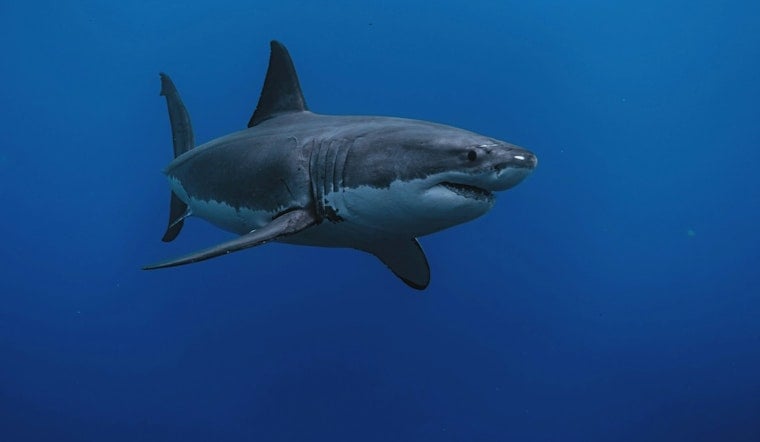
Just offshore from the Hamptons' beach clubs and multimillion-dollar summer homes, newborn great white sharks are swimming in waters now confirmed as one of the world's few documented nurseries for the species. Researchers with the South Fork Natural History Museum's Shark Research and Education Program have spent recent summers capturing, tagging, and releasing young sharks in these shallow coastal waters, building a picture of a population that keeps coming back year after year.
Greg Metzger, lead field biologist for SOFO's shark program and a marine science teacher at Southampton High School, recently captured a young female sand tiger shark off the Hamptons as part of the tagging effort, according to The Independent. Metzger's team attaches electronic tracking equipment to captured sharks and collects tissue samples before release, and the devices measure water temperature and depth as the animals move. He has said sharks are far from the mindless eating machines of popular imagination — a notable observation given that great white pups, which measure around four feet and weigh up to 80 pounds at birth, hunt independently from the moment they're born, per the same account.
Tags Trace a Round Trip From the Hamptons to the Gulf
The tracking devices transmit acoustic signals to coastal monitoring receivers and detach automatically after several months, letting researchers follow where the sharks go once they leave New York waters. Bradley Peterson, a marine scientist at Stony Brook University who works alongside Metzger, has said the tags are detected across the southeastern United States and the Gulf of Mexico before the sharks return to the Hamptons the following year. Tracking data shows the animals traveling as far as North Carolina, Georgia, Florida, and the Gulf, the outlet reports.
The tagging program aims to track local marine life and study the nursery itself, adding to a body of research SOFO has built since 2015. As sharks mature, great whites are believed to migrate farther north toward Cape Cod's dense seal populations, though white sharks don't reach reproductive age until their 20s or later. Great white shark nurseries have also been identified off California, Mexico, and Australia, but the Hamptons site remains one of the few documented anywhere in the world.
A Jaws Connection, and a Recovery Decades in the Making
The Hamptons' shark reputation has a cinematic backstory that long shaped how locals treated the animals: Jaws was set in a fictional Hamptons-style resort town, though the film itself was shot at Martha's Vineyard, Massachusetts. Recreational shark hunting off the Hamptons increased after the movie's release in the 1970s, a wave of fishing pressure that took decades to reverse.
Frank Quevedo, executive director at the South Fork Natural History Museum and Nature Center, has said that improved technology helps explain why more sharks are being seen in Long Island waters today. Protective measures have helped white shark and other species populations begin to recover, though white shark numbers remain below historical levels. Rising water temperatures are also drawing more tropical shark species — including spinner sharks, blacktip sharks, and bull sharks — north into Long Island waters during summer, and young great whites are migrating into New England waters earlier as coastal waters warm.
Long Island's Layered Safety Net
New York has built out layers of oversight to match the growing shark presence. The state Department of Environmental Conservation requires immediate release of prohibited species, including white, dusky, and sand tiger sharks, and bans shore anglers from using metal leaders longer than 18 inches or chumming within 600 feet of shore, according to the New York State Department of Environmental Conservation. Handling these animals isn't simple, either — sand tiger shark skin is durable enough to snap a surgical scalpel, according to The Independent's reporting.
Local authorities have increased shark monitoring efforts and deployed shark-spotting drones along the coastline, part of a broader statewide push that, as reported by WSHU, saw Governor Kathy Hochul expand New York's beach drone program in 2024 to include thermal-imaging models capable of spotting sharks near swimmers. The Town of Hempstead separately expanded its own municipal shark patrol in July, adding jet skis and thermal drones for daily pre-opening sweeps of its Nassau County coastline.
Why the Nursery Exists at All
Part of the explanation for why juvenile great whites cluster here traces back to a fish most beachgoers never think about. Long Island's shallow waters give young great whites access to dense schools of fish, a food source that rebounded after New York banned industrial purse seine netting of Atlantic menhaden, or bunker, in state waters in 2019 under then-Governor Andrew Cuomo. That recovery of the bunker population is widely credited with drawing sharks, whales, and dolphins closer to shore in the years since.
Despite the growing sightings and expanding drone fleets, the numbers remain small. The International Shark Attack File records no fatal shark attacks on Long Island, according to the Florida Museum of Natural History, and its 2025 global summary found just one shark bite recorded in all of New York State, compared with 25 across the entire United States. For now, the Hamptons' most notable shark activity isn't happening in the surf zone at all — it's happening on researchers' laptops, as tagged pups ping receivers from Georgia to the Gulf before turning back toward home.




