

























































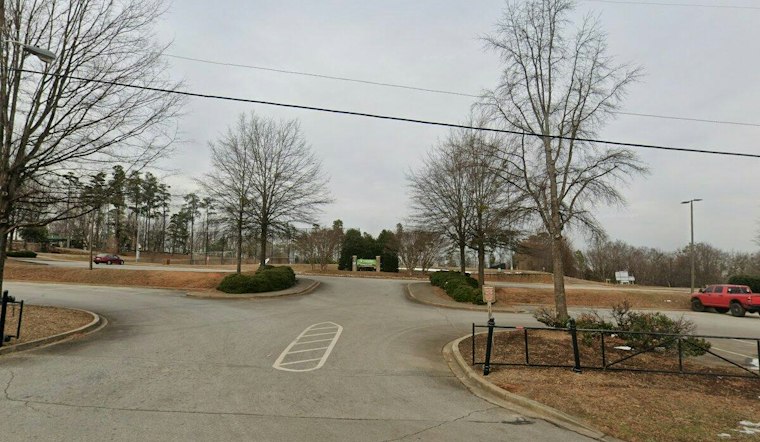
Greenville has planted South Carolina's first microforest, packing 1,500 native trees, shrubs, and understory plants into a plot at Loxley Park in the city's Sherwood Forest neighborhood. The City of Greenville Parks and Recreation Department announced the installation, which used a dense planting technique to establish a forest ecosystem.
A Robin Hood-Themed Park Gets a New Purpose
The planting happened on September 12, according to FOX Carolina News, as a service project tied to the TREE Fund's annual Tour des Trees, a charity bike ride whose cyclists helped plant the site before pedaling on toward Asheville, according to the City of Greenville. Loxley Park is in the city's Sherwood Forest neighborhood. Crews also removed non-native invasive species.
To ready the planting bed, city crews cleared invasive vegetation and prepared enriched soil using biochar and select organics, per the city's account. The preparation work readied the planting bed for the project.
What Is the Miyawaki Method?
The project relies on the Miyawaki method, a technique that stacks compost and simultaneous, high-density planting to jumpstart forest growth. Conceptualized in the 1970s by Japanese botanist Dr. Akira Miyawaki, the approach places multi-layered native species at high densities, according to the SUGi Project. That density lets the resulting forest grow up to 10 times faster than monoculture forests and reach self-sufficiency within two to three years, the group notes, through layered native planting.
Parks staff, landscape architecture firm Earth Design, Inc., TREE Fund representatives, and volunteers worked together to get all 1,500 plants into the ground. TREE Fund president and CEO Paul Putman said the plants work interdependently on each other and that the microforest will be beautiful for the city and the neighborhood. Earth Design, Inc. took part in the planting alongside parks staff, TREE Fund representatives, and volunteers.
Fencing and First-Year Monitoring
The newly planted microforest will be fenced off for its first year, with the barrier meant to protect the young plants from hungry animals while the roots take hold. The first year will give the young plants time to establish.
The TREE Fund offers research grants and offered up to $120,000 in research funding during its fall 2026 cycle alone, according to the TREE Fund. The nonprofit supports scientific research through its grant programs.
Part of a Bigger Canopy Push
The Loxley Park project arrives as Greenville works through its first-ever Urban Forest Comprehensive Plan, launched by the city's Parks and Recreation Department. The initial mapping has identified 13,000 trees on public land so far, and the city expects to count 7,000 more. The effort maps tree type, health, location, and maintenance needs, per the department's Facebook announcement.
Greenville's urban forestry work includes mapping trees on public land.
The microforest planting also lands alongside a separate, unrelated recovery effort: Greenville recently kicked off a five-to-six-week, $1.4 million federal project to pull an estimated 25,000 cubic yards of fallen trees and river debris left behind by Hurricane Helene from the Reedy River watershed, as Hoodline previously reported. That debris removal is funded through the USDA Emergency Watershed Protection Program.
Greenville's new microforest uses a Miyawaki-style approach to urban planting. The Rochester Beacon notes that a microforest can mature in 20 to 30 years rather than 100, a model Loxley Park now brings to the Upstate.





