

























































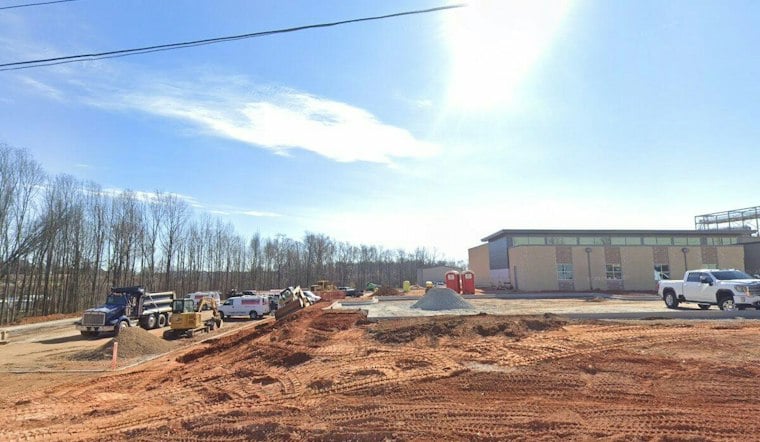
Greer will cut the ribbon Tuesday on a $16 million Public Safety Training Center built to keep the city's police officers and firefighters training close to home instead of driving across South Carolina for practice. The city will host a grand opening ceremony for the Hood Road complex, which includes a 10-lane indoor weapons range and a four-story fire tower designed for live scenarios that used to require travel elsewhere in the state.
Greer Mayor Rick Danner said the opening delivers on the city's promise to make public safety its top priority as the community grows, according to FOX Carolina. Danner said the new facility means first responders can train at home rather than frequently traveling to other parts of the state, a routine that Danner said caused significant expense to taxpayers, per the same report.
The 50-yard, 10-lane indoor range includes tactical walls on three sides that allow for multi-dimensional training, the station's report notes. The complex sits on property that formerly housed a fire station and training tower, a repurposing of municipal land that placed the new center on a 4.7-acre parcel at 1985 Hood Road, according to the City of Greer.
Why the Old Outdoor Range Had to Go
The push for an indoor shooting facility grew out of a practical problem: Greer's outdoor firing range had become boxed in by new residential development. Greer Police Chief Matt Hamby noted that the department pursued the indoor design after housing growth encroached on the old outdoor range, according to the Greenville Journal.
The new range addresses that problem with engineering as much as location. It features an isolated HVAC system designed to filter spent ammunition lead particles from the air, separate from the ventilation serving the rest of the building, and self-healing block wall panels capable of withstanding more than 1,000 rounds, per the City of Greer.
A Fire Tower Built for Real Emergencies
The four-story fire tower gives Greer firefighters room to practice scenarios that once required specialized outside facilities. It includes a removable roof designed for rappelling and confined-space training, interior and exterior stairs, and an elevator shaft, per FOX Carolina. Architecture firm McMillan Pazdan Smith, which programmed and designed the campus, describes the tower as also including live-fire burn rooms, rooftop rope anchors, and reconfigurable spaces for search-and-rescue drills.
The firm designed the campus to support cross-department collaboration, and the facility will support first responders across the Upstate. Beyond the range and tower, the complex holds large seminar and classroom space, breakout rooms, and storage for large emergency vehicles and equipment, which FOX Carolina reports allows for faster deployment.
Tied to a Top Fire Rating and a Bigger Building Boom
The stakes for Greer's public safety infrastructure go beyond convenience. The Greer Fire Department holds an Insurance Services Office Class 1 Public Protection Classification, a top-tier rating held by fewer than 500 fire departments nationwide that helps lower property insurance premiums for local residents and businesses, according to the Greenville Journal.
Construction was funded through $40 million in proceeds from the city's Series 2024 Installment Purchase Revenue Bonds, which fully covered the public safety complex along with a downtown parking garage, per the City of Greer's ForGreer program page.
The training center was the first ForGreer project to break ground under Greer's approximately $100 million capital improvement program, which also includes a $60 million sports complex, a $14 million parking garage, and a $10 million fire station, according to South Carolina Public Radio. City leaders launched the broader initiative to keep pace with Greer's population, which grew from 35,916 residents in 2020 to more than 50,000 by 2025, per the Post and Courier.
Construction on the Hood Road complex formally began after a groundbreaking ceremony on February 14, 2025, where city officials spoke. The finished facility now stands as the first visible marker of a building push meant to keep emergency services scaled to a city that keeps adding new neighborhoods and new residents by the year.





