

























































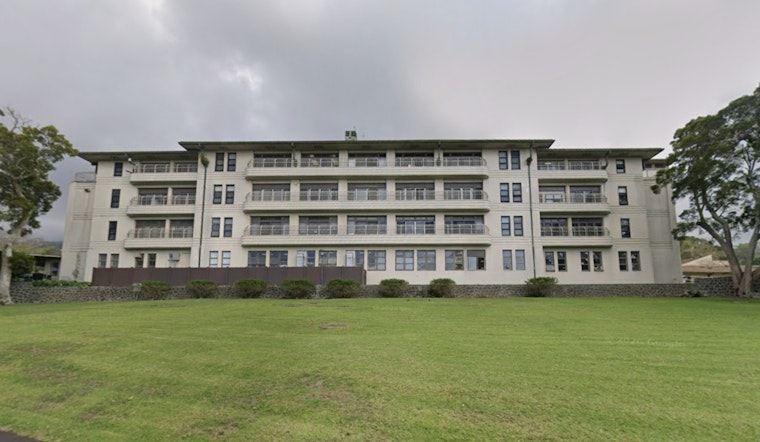
Six months after storm damage forced Kula Hospital to evacuate more than 100 long-term patients, half of the eight residents who were sent all the way to Oʻahu for specialized care are finally back on Maui. The hospital itself remains closed, but the return marks a small but meaningful step for families who watched their loved ones scattered across two islands after March's Kona Low storms tore through Upcountry Maui.
The eight residents belong to Hale Makamae, a wing for people with intellectual disabilities that had to send patients off-island because their care needs couldn't be met elsewhere on Maui. According to Hawaiʻi Public Radio, half of those eight residents returned to Maui last week, with the remaining patients expected back by the end of September. Maui Health said the newly renovated Molokini II building, located adjacent to the main hospital on the Maui Memorial Medical Center campus in Wailuku, will allow Hale Makamae residents to be closer to family and reunite with caregivers.
A Wing Built for the Most Vulnerable
Hale Makamae, whose name translates to “house of the dear ones,” is Hawaiʻi's only dedicated intermediate care facility for individuals with intellectual and developmental disabilities, according to the Hawaii Journalism Initiative. The wing served nine residents before the March evacuation, a population whose specialized needs made the sudden displacement especially fraught. Maui Health renovated a hospital building in Wailuku specifically to give these residents a safe temporary location, the same report notes.
The scale of the original evacuation was staggering for an island with limited post-acute care options. Kula Hospital transferred most of its more than 100 long-term patients to other Maui facilities, while the eight Hale Makamae residents were sent to Oʻahu for the specialized care they required. The Hawaii Journalism Initiative reported that the sudden influx pushed Hale Makua's long-term care facility in Kahului to nearly 95% capacity by April, forcing that facility to hire more than a dozen travel nurses just to keep up with demand — a strain made worse by the fact that Maui County has fewer than 450 total long-term care and rehabilitation beds across all of its facilities.
What the Storm Did to a Century-Old Hospital
The damage traces back to the back-to-back Kona Low storm systems that battered Hawaiʻi in mid-March, dumping nearly 50 inches of rain on Upcountry Maui over a single weekend with localized wind gusts reaching up to 108 mph, according to Aloha State Daily. Rain pooled on a fifth-floor balcony and seeped through window frames into the floors below, and Maui Health leadership reported in May that roughly 65% of the historic five-story building suffered water damage, per Hawaii Public Radio. National building assessment teams that inspected the facility shortly after the storm recommended a full evacuation.
Kula Hospital sustained that significant storm damage and remains closed today, though the adjacent Kula Clinic on the hospital property was unaffected and continues to operate. Maui Health has completed storm damage assessments and has remediation work in progress, per the Hawaiʻi Public Radio report, but the organization has no timeline for when the hospital itself might reopen. Maui Health is working with the State of Hawaiʻi and other partners to evaluate the century-old facility's future.
A Costly Path Forward
The price tag for a full rebuild looms large over those discussions. Governor Josh Green estimated in March that replacing Kula Hospital would cost hundreds of millions of dollars, part of statewide Kona Low repair costs projected to exceed $1 billion, according to Honolulu Civil Beat. State officials have requested federal disaster relief funds to cover up to 90% of overall recovery costs. Emergency officials have also evaluated installing temporary mobile medical tents or a modular urgent care clinic in Upcountry Maui, an idea modeled after the temporary facility built in Lahaina after the 2023 wildfires, the Hawaii Journalism Initiative reported.
Maui Health's leadership has also been in transition during the crisis. Wade Ebersole, the organization's vice president and chief operating officer who previously served as incident commander during the 2023 Maui wildfires, became interim CEO in April following Lynn Fulton's departure, as Hoodline reported. Fulton stepped down to relocate to Illinois, and Ebersole assumed executive authority in May.
A Sanatorium's Long History
Kula Hospital, which operates under Maui Health System, carries more than a century of history in Upcountry Maui. It was founded in 1910 as Kula Sanatorium by Dr. Wilbur Fiske Boggs McConkey to treat tuberculosis patients in the region's dry, high-altitude climate, starting as two canvas-sided shacks before growing into a public critical-access hospital, according to Maui Health. The facility celebrated its 115th anniversary in September 2025, just months before the storms that shut it down. Maui Health System itself was created in July 2017 when Kaiser Permanente assumed management of Maui County's public community hospitals under state privatization legislation signed by former Governor David Ige.
The hospital's fate now sits alongside a broader push in Congress to protect isolated rural facilities. U.S. Representative Jill Tokuda introduced the bipartisan Rural Emergency Hospital Designation Improvement Act, dubbed a bill to save rural hospitals from closure, aimed at helping struggling isolated facilities like Kula Hospital retain key operational funding. Hawaiʻi maintains nine designated Critical Access Hospitals across its islands, and Kula Hospital's uncertain future stands as a stark example of the stakes involved.




