

























































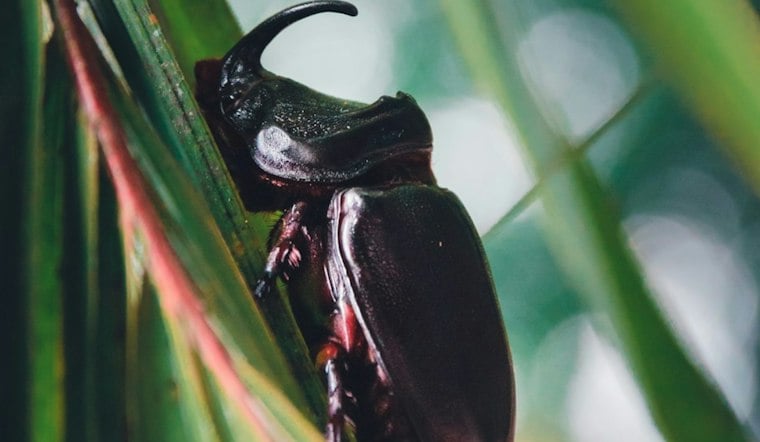
Researchers, resource managers and everyday residents are being invited into the fight against one of Hawai‘i's most destructive invasive pests this week, as the University of Hawai‘i at Mānoa hosts its third annual Coconut Rhinoceros Beetle Science and Management Symposium from September 22 to 24. The gathering comes as the beetle, which chews through the crowns of coconut and native palm trees, continues to spread well beyond the O‘ahu neighborhoods where it was first found nearly thirteen years ago.
The coconut rhinoceros beetle, or CRB, is an invasive pest that has been devastating palm trees and coconut supplies throughout Hawai‘i, according to The Garden Island. The beetle was first detected in the state on O‘ahu. The pest stayed largely confined to O‘ahu for close to a decade before it was also detected in Kaua‘i, West Hawai‘i and Maui, according to the Kauai Invasive Species Committee, which points to human movement of green waste and mulch as the primary way the pest keeps island-hopping.
Sessions at Mānoa, a Free Day in Wahiawā
The symposium's first two days, September 22 and 23, take place at the UH Mānoa Campus Center Ballroom and will feature presentations by state invasive species experts addressing management strategies for the beetle across Hawai‘i and the broader Pacific region, per The Garden Island's report. The first 100 people to register receive a discounted rate. The event wraps with a Community Day on September 24 from 1 to 4 p.m. at UH West O‘ahu, which is free and open to walk-ins, though registration is strongly encouraged.
Community Day follows a morning field trip to Wahiawā, where attendees can observe coconut rhinoceros beetle damage and ongoing replanting initiatives firsthand before heading to the West O‘ahu campus. There, sessions will focus on protecting niu, the Hawaiian word for coconut, and loulu, a palm tree endemic to Hawai‘i, teaching residents how to safeguard their own plants using mulch management, netting and other measures. The afternoon includes discussions with local CRB responders, cultural practitioners and researchers, along with information booths, and attendees can expect an appearance from Chase, the CRB mascot.
Why the Loulu Matters
Beyond the agricultural threat to coconut palms, CRB threatens loulu palms, the archipelago's only endemic palm genus, according to the Kauai Invasive Species Committee. Adult beetles chew boreholes up to two inches deep into the growing crowns of palms to drink sap, leaving distinctive 45-degree V-shaped notches and scalloped cuts on unfolding fronds that can kill a mature tree outright if the growing tip is severed, according to Maui County. Feeding damage can take months to become visible after the initial boring occurs.
A Pest on the Move Across the Islands
The symposium arrives amid a run of unsettling detections and emergency rulemaking across the state. In July, the Hawai‘i Board of Agriculture and Biosecurity approved Interim Rule 26-2, banning the transport of untreated mulch, compost, soil-rooted live plants and coconut fruit from other islands to Maui and Lanai, a measure that took effect July 29 following community petitions after beetles were found near Maui transport hubs, according to Maui Now. That followed Interim Rule 26-1 in March, which established a designated infestation zone in West Hawai‘i and required commercial green waste haulers to sign compliance agreements and complete training with the Big Island Invasive Species Committee or risk fines of up to $10,000, per the Hawai‘i Department of Agriculture and Biosecurity.
Hoodline previously reported on that West Hawai‘i crackdown, and East Hawai‘i has its own scare to reckon with: in July, invasive species workers found a dead female coconut rhinoceros beetle in a trap near Hilo International Airport, raising fears the pest could push into East Hawai‘i's moist, heavily vegetated terrain, as reported by Civil Beat. Trapping and dog-assisted surveys were deployed around Hilo immediately after the catch.
Retail Soil and Legislative Scrutiny
The threat has already reached O‘ahu shoppers directly. Roughly 60 coconut rhinoceros beetle grubs were found inside a commercially packaged bag of potting soil purchased at a Lowe's store in Waipahu, an incident Hoodline covered in its own reporting on contaminated retail soil as a vector for larval dispersal; store management inspected inventory and acknowledged occasional pest entry holes in soil bags. Lawmakers have publicly criticized Department of Agriculture and Biosecurity officials over the department's inspection-discretion policy.
Sanitation practices remain central to the state's containment strategy. Waste processing facilities in West Hawai‘i use heated compost facilities to process organic material before disposal or movement.
Who's Behind the Symposium
The symposium is organized by a multi-agency committee that includes UH Mānoa's College of Tropical Agriculture and Human Resilience, the Big Island Invasive Species Committee, the Pacific Community, the Pacific Regional Invasive Species and Climate Change Management Network, and the state Division of Forestry and Wildlife, known as DLNR-DOFAW. The event is sponsored by the Forest Service International Foundation and DLNR-DOFAW as well. Registration for both the symposium sessions and Community Day is available through the coconut rhinoceros beetle response website, and questions about the event can be directed to [email protected].





