

























































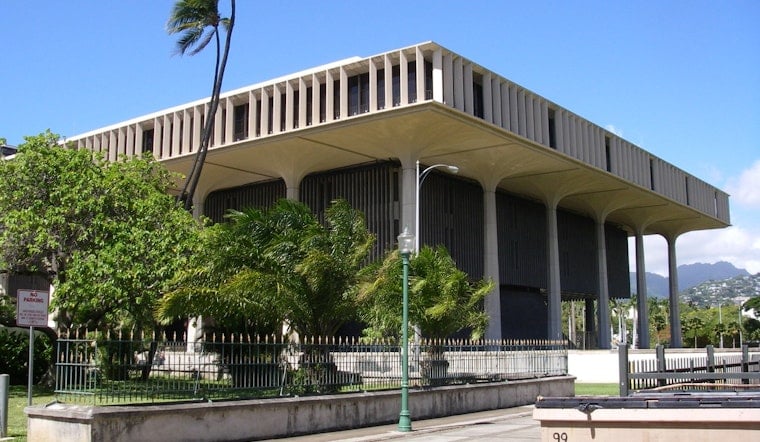
The reflecting pools ringing the Hawaiʻi State Capitol turned into a swamp within roughly a year of the building's 1969 opening, choked by poor aeration that fueled rampant algae growth. More than five decades later, the state has drained those pools for good and is turning the space into a 55,000-square-foot walkable glass promenade built from 6,000 panels, with the design shaped by brushstrokes collected from more than 3,500 residents across the islands.
The transformation is the subject of a new column from Honolulu Civil Beat by Jenny “Jeta” Tang, an interdisciplinary artist and creative technologist based in Honolulu who covers the state's creative communities and cultural landscape. According to Honolulu Civil Beat, Tang — who worked at Silicon Valley AI startups before founding the Dot Kine digital agency — traces how a leaky, algae-plagued water feature designed by architect John Carl Warnecke became a canvas for thousands of hands.
The pools were never a minor maintenance nuisance. Each of the reflecting pools held 380,000 gallons of water, and the system lost roughly 25,000 gallons a day to evaporation alone, per the same account. The state resorted to releasing algae-eating tilapia into the water to control the bloom, but upkeep costs still climbed from about $75,000 a year in 2015 to $100,000 by 2018, eventually reaching $150,000 to $200,000 annually before the pools were drained by 2021.
An Artist Selected From Fifty Submissions
Solomon Enos, a kānaka maoli artist who grew up restoring loʻi in Waiʻanae Valley, was selected from 50 submissions to create the public art now filling that void. Enos traveled across Oʻahu, Kauaʻi, Maui and the Big Island to gather material for the project, collecting individual brushstrokes from participants that will be digitized and fired onto the glass floor panels, according to the column.
Enos has framed the effort as fundamentally communal rather than a singular artistic statement. “The artwork belongs to everyone,” he said, according to the same report, adding that community participation is more valuable to him than a perfect image. The state plans to build what amounts to a permanent walkable ocean around the legislative chambers, replacing the water that once surrounded them with light-filled glass underfoot.
Costs Climb As Bidding Process Stalls
Gordon Wood, who has worked for the Department of Accounting and General Services for 10 years and is retiring Tuesday after a 50-year architecture career, has overseen the project's tangled contracting history. Public bidding is legally required for the Capitol pools project, and an administrative complaint froze the work for nine months before the state restarted the bidding process following a ruling, Tang's column reports.
Those delays have come at a price. The project's estimated cost has climbed from $52 million to as much as $85 million, a dramatic jump from the $33.5 million the Hawaiʻi State Legislature originally appropriated for the pools' waterproofing and glass art installation, according to the Aloha State Daily. Wood said the project could be completed by 2028 if the next contract award goes uncontested, and noted the glass panels themselves will be fabricated in Paderborn, Germany. A bid opening is scheduled for Thursday, with contract finalization expected to take six to eight weeks after a winner is selected — meaning the pools will not open by the end of this year, and construction must stay quiet from January through May whenever the Legislature is in session.
A Pattern Of Rising Estimates
The cost escalation fits a longer pattern of political wrangling over the pools. Back in January 2021, then-Governor David Ige proposed spending $30 million over two years to repair the reflecting pools, a plan that drew public pushback amid pandemic-era budget deficits, as reported by Honolulu Civil Beat. Earlier proposals had even considered installing false pool bottoms before the state settled on the waterless glass concept now underway. For comparison, a 1993 renovation of the Capitol cost $67 million.
The pool project also sits inside a far larger looming crisis. Hawaiʻi Comptroller Keith Regan warned in February 2025 that the 57-year-old Capitol building faces up to $100 million in urgent repairs to outdated electrical, plumbing, and air conditioning systems, a bill that could force a multi-year shutdown of the building, according to the same Civil Beat reporting. Governor Josh Green has already allocated $2 million in planning funds to scout temporary sites for state government in case that renovation forces relocation.
Rooted In The Building's Original Design
Gordon Wood has said Enos's design tells a deeper narrative of the Pacific, one that echoes water-themed art already built into the Capitol's modernist architecture. The building's 1969 open-air courtyard features an original glass mosaic floor mural, “Aquarius” by artist Tadashi Sato, depicting underwater light and aquatic formations — evidence that architects Warnecke and Belt, Lemon & Lo wove natural Hawaiian symbols throughout the structure from the start, per the Docomomo Hawaii archive.
State arts officials have precedent for swapping troubled pool features for permanent glass artwork: at the nearby No. 1 Capitol District Building, artists Doug Young and Carol Bennett converted a leaking former YMCA pool into permanent glass sculptures now on view alongside Capitol Modern. The Hawaiʻi Capitol itself was added to the National Register of Historic Places in December 1978 as part of the 57-acre Hawaiʻi Capital Historic District, a designation that shapes how far the state can alter the building's grounds.
Enos's community-driven approach to Capitol art isn't new for him. He previously worked with the Department of Accounting and General Services on a completed garage mural in Honolulu at the Kalanimoku Building, where 40 community volunteers helped transform parking garage corridor walls under state staff guidance. That project, like the Capitol pools, treated public art as something built with many hands rather than delivered by a single artist alone.





