

























































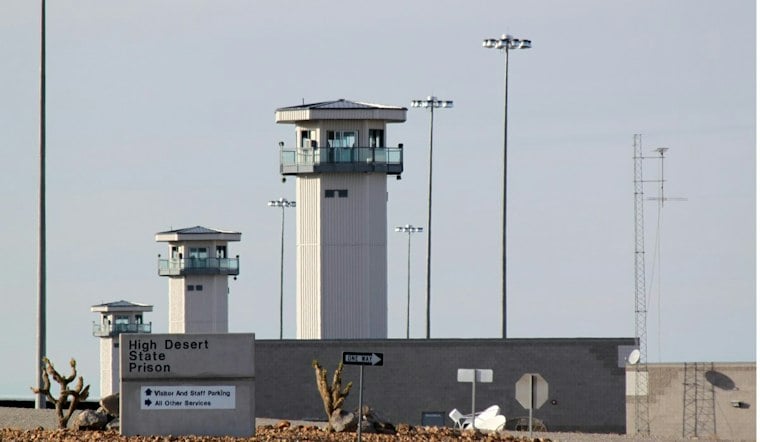
An inmate at High Desert State Prison says nearly four years of bleeding eyes, headaches, dizziness and worsening vision went largely unaddressed by Nevada prison medical staff until it was too late, leaving him blind in one eye and with only limited sight in the other. Brian Daugherty filed a complaint in district court on September 21 against the Nevada Department of Corrections and its medical staff, alleging the delays amounted to a violation of his constitutional rights.
Daugherty, who is serving a five-to-20-year sentence after entering an Alford plea in 2021 on two counts of child sex crimes, was booked into High Desert State Prison in Indian Springs, about 40 miles northwest of Las Vegas, in August 2021. According to the lawsuit as reported by the Las Vegas Review-Journal, Daugherty first requested medical care in May 2022 for bleeding in his left eye and blurriness in his right eye, and NDOC placed him on an eye-clinic waiting list that same month. He continued submitting formal medical-care requests throughout 2022 as his symptoms worsened.
By November 2022, the lawsuit states, an optometrist documented Daugherty's deteriorating vision and made an immediate referral to a retinal specialist. A physician indicated the following month that surgery should be scheduled expeditiously. Despite that urgency, Daugherty did not receive the eye surgery until April 2026 — nearly four years after his first request for care, per the same account.
Grievances Denied as Warden Warned of Rights Violations
The lawsuit says Daugherty filed numerous grievances over the undelivered surgery, and that Frank Dreesen, an associate warden at High Desert State Prison, knew of Daugherty's medical needs but failed to address his grievances despite being responsible for timely responses. In September 2024, Dreesen denied one of those grievances as a duplicate and an abuse of the inmate grievance procedure, according to the complaint.
Notably, then-warden Jeremy Bean had issued a memo to medical providers in August 2024 warning that neglected medical care violates offenders' rights — a warning that, per the lawsuit, did not translate into faster treatment for Daugherty. He now requires ADA accommodations, including a lower floor, no stairs and a lower bunk, and alleges prison staff violated his Eighth Amendment rights by denying care and acting with deliberate indifference. NDOC declined to comment on the pending litigation, per the department.
Daugherty's attorney, Adam Breeden, said the case highlights unconstitutional medical services provided by Nevada to incarcerated people. The lawsuit seeks more than $100,000 in compensatory and punitive damages.
A High Legal Bar and a Familiar Pattern
To prevail on his federal claim, Daugherty must clear a demanding legal standard. Under the U.S. Supreme Court's 1976 ruling in Estelle v. Gamble, an inmate alleging an Eighth Amendment violation must prove prison officials acted with deliberate indifference to serious medical needs — meaning he must show subjective knowledge and disregard of an excessive risk, not simply that malpractice occurred. If he pursues state tort claims instead, Nevada Revised Statutes § 41.035 caps damages against public agencies and state employees at $200,000 per claimant and bars punitive damages entirely, which helps explain why federal civil rights claims are commonly used in these cases.
Daugherty's allegations echo other recent cases out of the same facility. The Nevada Board of Examiners approved a $597,500 settlement in January 2026 to former High Desert inmate Steven Scott, who said prison medical staff delayed his colon cancer diagnosis by two years despite severe rectal bleeding, according to The Nevada Independent. Separately, inmate Julius Ludwig filed a federal Eighth Amendment lawsuit after waiting six years for a doctor-ordered hip replacement, with a federal judge ruling this year that he showed a likelihood of success on the merits.
Statewide Staffing Shortages Behind the Delays
The pattern is tied to broader structural problems. Nevada is among a minority of states where the corrections department directly manages inmate healthcare rather than contracting it out, meaning legal and administrative liability for treatment delays falls directly on state prison officials. A 2025 state-commissioned external audit found that severe medical staffing shortages across NDOC facilities endangered inmate lives, with senior physician positions at some prisons vacant for as long as seven years, prompting officials to declare a critical labor shortage.
Funding gaps compound the problem: Nevada spent just $5,900 per inmate on healthcare in 2026, ranking third-lowest nationally, compared with California's $41,800 per inmate, according to Prison Legal News. The outlet reported that Nevada's total annual per-inmate operational spending of $33,248 was nearly half the national average of $60,989. Inmate deaths across NDOC facilities rose from 46 in 2023 to 55 in 2024 and hit a record 76 in 2025, with state data indicating over half stemmed from unaddressed medical issues.
Nevada lawmakers on the Interim Judiciary Committee pressed NDOC leadership in July over 166 in-custody deaths reported since 2024, questioning whether broad natural-cause classifications were masking systemic healthcare delays, Nevada Current reported. Committee members specifically questioned whether 98 natural-cause classifications concealed neglected illnesses. The scrutiny follows Nevada's record $4.6 million settlement approved last September after High Desert guards allegedly beat inmate Christian Walker and blocked medical staff from providing timely care, a case that also unfolded at the Indian Springs facility.





