

























































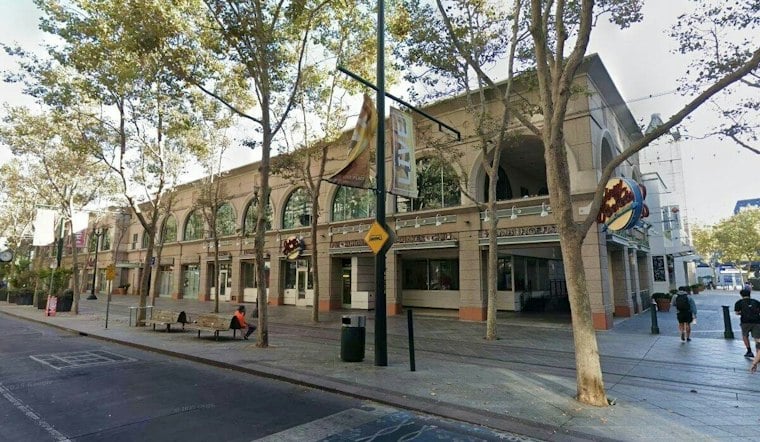
Hines is asking San Jose to evaluate two different kinds of downtown redevelopment at once: the reopening of vacant storefronts at The Pavilion and a major increase in the building’s data-center capacity. The proposal for 150 South First Street would create Paseo Place, with 11 ground-floor spaces totaling about 31,000 square feet along South First Street, Paseo de San Antonio and South Second Street, according to The Mercury News.
That combination gives the project a broader policy significance than a conventional retail renovation. Hines wants restaurants and other retailers in the currently unused spaces, along with exterior upgrades, lighting, signs and public-facing improvements. At the same time, it is seeking to modernize an older data center in the 179,800-square-foot complex and increase available power from 5 megawatts to 40 megawatts, the newspaper reported.
A retail proposal in a downtown with many empty storefronts
The retail component would address a problem that extends beyond The Pavilion. San José Spotlight reported that downtown had more than 70 vacant storefronts at its latest May count. The same report said roughly 24% of San Jose commercial space was empty in the first quarter covered by the city’s downtown progress report. Those figures establish the scale of the surrounding vacancy challenge, but they do not show whether Hines’s spaces will attract long-term tenants or increase pedestrian activity.
The city has also been measuring progress through business recruitment rather than treating any single project as a recovery indicator. San Jose records say the downtown team supported 13 ground-floor businesses during the fiscal year ending June 30, 2026, exceeding its goal of facilitating five new attractions, while acknowledging that substantial work remains on long-vacant storefronts, according to the City of San José.
The infrastructure question is larger than one building
The proposed power increase would place the project within a regional debate over how San Jose should accommodate energy-intensive computing. PG&E materials describe broader transmission and distribution capacity pressures associated with rising load applications, including data centers, and reference a San Jose-area study of clustered demand. Those materials provide regional context, not proof that The Pavilion has secured an interconnection or received utility approval, according to PG&E.
San Jose officials have estimated that a fully functioning data center can generate between $3.4 million and $6.8 million annually in utility and property taxes, a fiscal argument reported by KQED. The estimate helps explain the city’s interest in data-center investment, but it does not resolve questions about power demand, emissions, water use or the public benefits that should accompany a project of this size.
Approval remains the key uncertainty
Hines hopes to use San Jose’s Innovative Project Pathway Program, which the mayor and City Council created for developments viewed as offering an extraordinary public benefit or not fitting readily within existing zoning and general-plan standards. The pathway is a review mechanism, not evidence that Hines’s proposal has been approved. The city has used it for Westbank projects at 300 South First Street and 323 Terraine Street; those projects paired data centers with 1,492 homes, a substantially different public-benefit model from Hines’s retail-and-data-center plan, according to San José Spotlight.
The city is separately developing uniform data-center standards covering issues such as energy sourcing, water consumption, air quality and backup generators. The standards are still being developed and should not be treated as established conditions for Hines. Their existence does, however, indicate the types of impacts officials expect to examine, according to the City of San José.
Hines has not disclosed the project’s financial cost or construction schedule, according to The Real Deal. Until the city identifies the review path, conditions and any community benefits, the proposal remains a test of how San Jose will balance visible downtown activity against the infrastructure and environmental demands of a much larger data center.





