

























































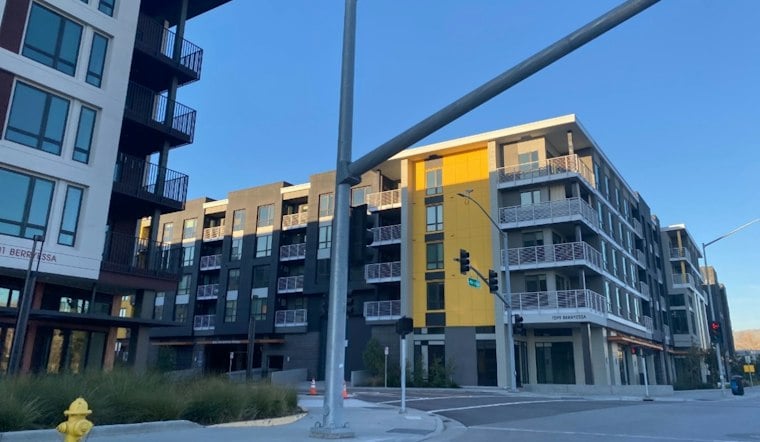
The 2026 Silicon Valley Poll finds a striking gap between Bay Area residents’ attachment to their communities and their plans for the future: three out of four say they feel they belong, and 77% say people like them are welcomed and accepted. At the same time, 46% say they are likely to leave the region within the next few years.
Embold Research surveyed 1,801 Bay Area adults for Joint Venture Silicon Valley and the Bay Area News Group. This is the first year the poll has asked directly about belonging, according to The Mercury News. The share saying they are likely to leave is down from 56% in 2021, but up from 43% last year. Among those who say they may leave, 66% still feel they belong.
Who is most likely to consider leaving?
The poll shows a divide by housing status and financial security. Among renters, 51% say they are likely to leave, compared with 39% of homeowners. The share is 52% among residents who say they cannot consistently cover expenses and save, versus 41% among those who say they can manage their finances comfortably.
Political differences also appear in the responses: 64% of Republicans surveyed say they may leave in the coming years, compared with 36% of Democrats. Meanwhile, 83% of Democrats say they feel they belong, versus 69% of Republicans, according to the poll.
Real People Weighing Real Exits
David Collins, a 53-year-old fifth-generation Californian and electrician, embodies the poll's central contradiction. Collins joined the campaign to stop logging of old-growth redwoods during Redwood Summer in 1990, and today he supports six children ages 13 to 31 while living in a one-bedroom apartment where a renter sleeps in the living room. He's weighing a move out of California, possibly even to the Netherlands, because of affordability. Still, he says he doesn't want to give up on the state.
Gina Bidinger, a 59-year-old business manager who was recently laid off, pays $2,600 a month for a two-bedroom, one-bath apartment in Alameda. She's since looked at a two-bedroom, two-bath apartment in Virginia renting for $900 a month, and a house with a pool in Las Vegas priced at $400,000 — stark contrasts to what her money buys in the Bay Area.
Not everyone in the poll's orbit is leaving, though. Jervani Thompson moved to Berkeley in 2023 to work in tech and teach math, and protested the use of Flock Safety automated license plate readers at Oakland City Council meetings. Thompson relocated to Washington, D.C. earlier this year to pursue a master's degree in applied data science at NYU with a concentration in complex systems, and later worked on satellite systems there — a reminder that departures aren't always driven purely by cost. Meanwhile, 76-year-old Saratoga resident Steve Franzese is weighing downsizing from his four-bedroom home and has looked at real estate in Palm Springs, Lake Tahoe and Scottsdale.
Affordability remains a central pressure
Russell Hancock, president and CEO of Joint Venture Silicon Valley, which commissioned the poll, said housing and the high cost of living are driving people out of the region. He said retail workers and nurses can no longer afford to own homes or even aspire to live in the Bay Area.
Findings from the prior year’s poll point to the same concern: in 2025, 80% of Bay Area residents considered housing affordability a very serious problem. Among those considering leaving, 62% cited the overall cost of living and 47% cited housing costs, according to Palo Alto Online. The share considering a move away fell from 56% in 2022 to 47% in 2024 and 43% in 2025.
Intentions and population change are different measures
The Bay Area's churn mirrors a pattern playing out across California. The state experienced a net population loss of about 150,000 people in 2025, according to Berkeley News, and the Public Policy Institute of California notes the state has lost residents to other states every year since 2001. Since 2015, California has seen net losses of nearly 900,000 people who cited housing as their primary reason for moving, per the Public Policy Institute of California's research.
The financial math behind those departures is stark. Californians who moved out of state had average monthly housing costs of $1,706 in their new neighborhoods, compared with $2,376 in their former California neighborhoods, the Berkeley study found. Former Californians were also 48% more likely to own a home after seven years in their new states. Meanwhile, people moving into California saw their housing expenses jump to an average of $2,418 a month, 38% higher than in their previous homes.
Not all the regional data points toward exodus, however. Every Bay Area county except Napa saw population growth from 2023 to 2024, according to U.S. Census Bureau estimates cited by the Marin Independent Journal. San Francisco's population also began growing again in 2023, even though it has not recovered from pandemic-era losses, the San Francisco Chronicle reported. And when San Franciscans do move, they often don't go far: nine of the top 10 destinations for people leaving the city between 2020 and 2022 were other California counties, six of them within the Bay Area itself.
What migration data can—and can’t—show
The poll measures what respondents say they may do; state estimates track recorded migration and population change. The California Department of Finance estimated a net domestic migration loss of 216,000 people in 2024–2025, while the state’s total population grew by about 19,200 in the year ending July 1, 2025. Those statewide figures do not by themselves show how domestic moves into and out of the nine-county Bay Area changed.
A longer-standing regional planning document identifies some of the pressures behind the poll’s affordability findings, but does not provide a current comparison of housing costs with incomes or availability. The 2017 Plan Bay Area 2040 identified adequate and affordable housing, displacement of long-time residents and transportation capacity as regional challenges.
What's on the Ballot
The affordability debate is also shaping up as a political fight this fall. Proposition 40, which appears on the November ballot, would levy a one-time 5% tax on people with assets valued above $1 billion. California also had a separate ballot measure that would have banned forced prison labor and barred discipline for inmates who refuse such work. The state continues to provide protections for trans youth and immigrants, policies that remain part of the broader civic landscape residents are weighing as they decide whether to stay or go.





