

























































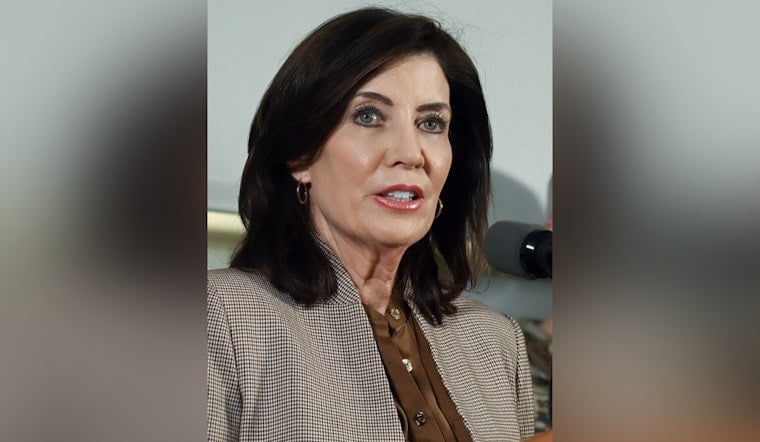
Governor Kathy Hochul has announced $20 million in state funding for community-based organizations that serve young people across 10 New York cities, with each community set to receive $2 million to fund mentoring, mental health services, job training, and other youth programs aimed at reaching kids before they encounter the justice system.
The money flows through Project RISE, a state initiative administered by the New York State Division of Criminal Justice Services that serves youth in Albany, Buffalo, Hempstead, Mount Vernon, Newburgh, Rochester, Syracuse, Troy, Utica, and Yonkers, according to LongIsland.com. Each community has its own steering committee that decides where the $2 million investment will best support youth, families, and neighborhoods, with up to four lead organizations in each city receiving the funding directly. Those lead groups then distribute portions of the money to smaller organizations working on the ground, including Brother 2 Brother, Yonkers PAL, Yonkers Arts, One PASO, Westhab Inc., the Yonkers YMCA, and 914United.
Hochul said the program puts resources directly into communities and reaches young New Yorkers before they encounter the justice system, according to the same report. DCJS Commissioner Rossana Rosado said Project RISE connects youth and families with mentors, mental health services, education, employment, and other opportunities. The program is now in its second round of funding for Hempstead, Troy, and Utica, and its fourth round for Albany, Buffalo, Mount Vernon, Newburgh, Rochester, Syracuse, and Yonkers.
How the Program Chose Its Cities
Project RISE stands for Respond, Invest, Sustain, Empower, and it was launched by New York State in 2022 to build partnerships between established lead organizations and local grassroots groups to address the root causes of gun violence, according to the John Jay College Research and Evaluation Center. DCJS identified the initial 10 target communities using a data-driven model that analyzed American Community Survey demographic and poverty statistics alongside police violent crime and shooting data, according to the New York State Executive Chamber. The goal, per that same announcement, was ensuring funding reached areas with high poverty rates and historical exposure to violence.
The program's re-granting structure means the bulk of Project RISE money never touches a state agency's hands directly. In Syracuse, for instance, the city's $2 million allocation was structured around three lead organizations — On Point for College, which received $1 million, along with the Center for Community Alternatives and Hillside Children's Center, which each received $500,000 — which then re-granted funds to eight smaller grassroots groups, including Rise Above Poverty and the Good Life Youth Foundation, according to the City of Syracuse. In Albany, funding supports programs such as the Albany Community Land Trust Gun Violence Prevention Program, which provides youth entering the workforce with stipends, driver's education, work clothing, and trauma counseling, per the New York State Division of Criminal Justice Services.
Nearly 1,600 Programs, 113,000 Participants
During the funding cycle that ended June 30, Project RISE-funded organizations offered nearly 1,600 programs and events and served slightly more than 113,000 participants across the state, supporting 136 programs and services overall. Those offerings span mentoring, mental health services, restorative practices, arts, athletics, financial literacy, job training, and educational support, and the program also funds organizations helping youth and families address grief and trauma from long-term exposure to violence. DCJS provides training and technical assistance to help build the capacity of grassroots programs, and the agency evaluates each program for accountability and impact.
In its initial funding cycle, Project RISE supported 99 organizations across the state, including 74 small, grassroots programs that had never previously received state grant funding, according to the Queens Gazette. That track record of building administrative capacity among first-time grantees is central to how the program's sub-granting model is designed to work: established organizations shoulder the compliance burden so that newer, smaller nonprofits can focus on direct service.
A Broader Public Safety Push
Hochul has invested nearly $4 billion in public safety since taking office, and the $20 million Project RISE announcement sits within a much larger state commitment to violence prevention. New York's enacted budget for fiscal year 2026-27 allocated $352 million toward gun violence prevention programs, building on $347 million allocated the prior fiscal year, according to the New York State Executive Chamber. Project RISE also operates alongside the state's SNUG street outreach program, which deploys violence interrupters, social workers, and hospital responders across 14 communities to mediate conflicts and prevent retaliatory shootings, according to DCJS budget testimony — a crisis-intervention counterpart to Project RISE's longer-term youth development focus.
State officials have pointed to measurable outcomes across the same cities receiving Project RISE dollars. Shooting incidents involving injury across 28 police departments participating in the state's Gun Involved Violence Elimination initiative dropped 19 percent during the first six months of 2026 compared to the same period last year, while firearm-related homicides fell 48 percent, per the Executive Chamber. During the first quarter of 2026, five GIVE-participating municipalities — including Project RISE recipient cities Utica, Troy, Newburgh, Mount Vernon, and Hempstead — reported zero shooting incidents involving injury. In Buffalo, shooting incidents involving injury decreased 84 percent in early 2026 compared to 2021 levels, reaching 20-year lows, with Buffalo Police recording just 10 shooting incidents with injury through March 2026, according to WGRZ.




