

























































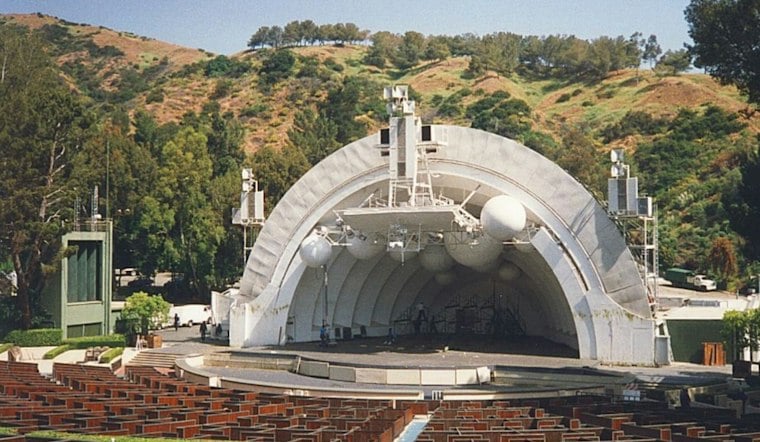
The Hollywood Bowl has upgraded the way sound is distributed across its historic hillside amphitheater, installing artificial intelligence technology that can isolate a singer's voice from drums and guitar amplifiers in real time. The Los Angeles Philharmonic says the system is intended to help audiences across the 17,500-seat venue distinguish individual voices and instruments during live performances.
The technology, called Source Intelligence, comes from French audio manufacturer L-Acoustics and was highlighted in a report from NBC Palm Springs correspondent Steve Patterson. Kelvin Vu, vice president of operations for the Los Angeles Philharmonic, works directly with the sound technology at the Bowl, according to that report. L-Acoustics CEO Laurent Vaissié described the platform as a new way to manage sound in live environments, while the company defines source intelligibility as helping audiences distinguish individual sounds within a larger mix.
How the AI Filters Out Stage Noise
The machine-learning platform can achieve up to 40 decibels of unwanted noise rejection, a thousandfold reduction in background acoustic bleed from instruments like drums and guitar amplifiers, according to the Los Angeles Times. That noise rejection happens without requiring manual adjustments at the mixing console, the newspaper reported. The same Source Intelligence technology is already in use on touring productions featuring The Weeknd, Bruno Mars, Jay-Z and Benson Boone, per NBC Palm Springs.
Those deployment details line up with reporting from TPi Magazine, which found the L1 speaker system that debuted at the Bowl was deployed on Bruno Mars' and Harry Styles' tours, while CS1, rather than L1, provided low end at Coachella and Ultra. Sound provider Clair Global served as a pilot partner testing the L1 and Source Intelligence system in North American stadiums before the technology reached the Bowl, according to TPi Magazine.
New Hardware Built Into the Bowl's Stage
The Hollywood Bowl permanently installed L-Acoustics' flagship L1 line array system along with CS1 cardioid subwoofers, finished in a custom white architectural design to match the venue. The rollout was formally introduced during a May keynote that featured a live performance by The War on Drugs, as reported by L-Acoustics; TPi Magazine reported. The L1 is built on what L-Acoustics calls its Progressive Ultra-Dense Line Source architecture, the outlet noted.
Mechanical redesigns inside the L1 pushed its active radiating factor — the percentage of the array actively producing sound — above 98%, leaving under 14 centimeters of inactive space across a 7-meter-tall array, according to ISP Audio Light Magazine. Traditional touring line arrays typically reach only 80% to 90% on that same measure, the outlet reported, underscoring how much of the new hardware's surface is now doing acoustic work rather than sitting idle.
Evening Out Sound From the Front Row to the Cheap Seats
The upgrade has a very physical effect on what concertgoers actually hear depending on where they sit. The Los Angeles Times reported that the L1 system narrows volume variance across the Bowl to roughly three decibels from the front row to the highest seats, a much tighter spread than traditional line array setups typically produce. Sound engineers told the newspaper that the system's lower distortion lets volume be raised clearly without introducing acoustic harshness.
What the public record says about neighborhood noise
The available public record documents longstanding neighborhood concerns but does not, by itself, spell out a current decibel limit or monitoring program for the Bowl. A June 1, 2020 letter preserved in Los Angeles Department of City Planning records said Hollywood Dell residents had complained about noise from Hollywood Bowl concerts and that Bowl management responded with sound tests and operational adjustments. The correspondence shows how community feedback influenced operations, but it is not a description of the system's present-day rules.
Layered on top of that hardware is L-Acoustics' L-ISA spatial audio system, which wraps the amphitheater in what sound engineers describe as potentially the largest outdoor immersive sound deployment by physical geometry anywhere in the world, according to the Los Angeles Times. L-ISA uses digital reverberation and object panning to recreate concert-hall acoustics in an open-air setting, the paper reported.
A Century-Old Venue Meets a French Physicist's Legacy
The technology traces back to L-Acoustics' founding in 1984 in Marcoussis, France, by quantum physicist Dr. Christian Heil, who applied wave theory physics to live sound reinforcement after hearing acoustic flaws at a 1977 Pink Floyd concert, according to L-Acoustics. Heil went on to develop the industry-standard V-DOSC line array system in 1992, the company noted.
The Bowl itself opened on July 11, 1922, in Bolton Canyon, per World Atlas. The Los Angeles Philharmonic's role at the Bowl is identified in coverage by the outlet.
Keeping the Technology Invisible to the Audience
Fred Vogler, the Bowl's principal sound designer since 2003, has discussed the technology's effects on audiences, the Los Angeles Times reported. Vogler tested the technology across classical orchestral works and pop shows during early 2026 test runs, according to the same report.
That philosophy of unobtrusive engineering echoes what Hoodline has previously reported on the Bowl's evolving hospitality and sound upgrades, including during Dudamel's farewell run and the venue's star-studded summer lineup. The goal, as described by engineers involved with the project, is for concertgoers to simply hear a clearer show — not to notice the algorithm working behind it.





