

























































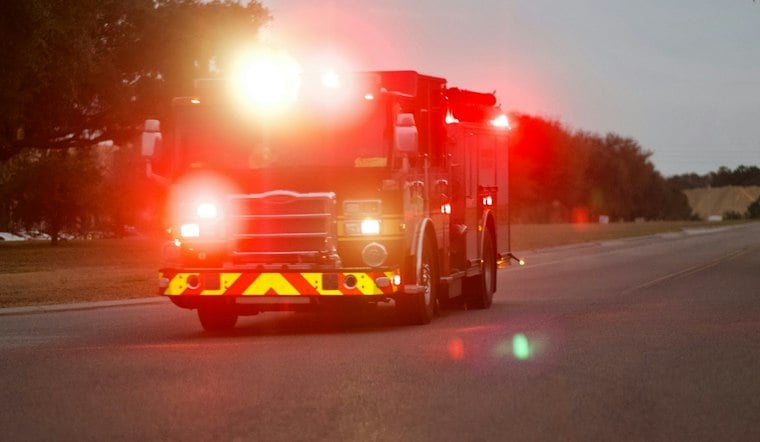
An explosion jolted a Homosassa resident awake late Tuesday night, and by the time firefighters reached South Sorrell Avenue, a lithium-ion battery fire tied to an e-bike charger had already claimed the lives of a dog and a cat inside the home. Citrus County Fire Rescue responded around 10:12 p.m., found heavy smoke and flames tearing through a 1,500-square-foot double-wide manufactured home, and worked to knock the fire down within roughly 20 minutes.
The occupant told crews they discovered the fire where an e-bike battery had been charging, then woke to the explosion and got out of the house, according to Tampa Bay 28. That occupant confirmed everyone had escaped but reported that a dog remained trapped inside, prompting firefighters to enter with a hose line and search for the animal and any other people who might still be in danger. The fire was brought under control by 10:31 p.m. and fully reported out by 10:51 p.m., but firefighters ultimately discovered both a deceased dog and a deceased cat inside, per the same report. The blaze ended up engulfing about 40 percent of the home, which investigators determined was unsafe for further occupancy.
What Firefighters Found at the Scene
Citrus County Fire Rescue determined the fire was unintentional and traced its cause to the e-bike battery charger, according to Tampa Bay 28's account. Firefighters with the department also told WTSP 10 that they extinguished the South Sorrell Avenue fire within 30 minutes of arrival, and that the pattern of structural damage was consistent with a lithium-ion battery fire. The address sits just east of U.S. Route 98 in Homosassa, WTSP 10 reported. Withlacoochee River Electric Cooperative was called in to disconnect electrical service to the residence, and the American Red Cross responded to assist the displaced occupant.
The speed and violence of the incident lines up with how lithium-ion batteries behave once they fail. During thermal runaway, an internal fault or overcharge sends a battery into an uncontrolled self-heating cycle that can exceed 130 to 150 degrees Celsius, venting explosive, toxic gases and generating heat intense enough to reignite even after the initial flames are put out, according to the U.S. Fire Administration. Volatile organic solvents inside the battery's electrolyte act as accelerants during that failure, which is why crews typically need extensive water cooling to fully knock the fire down.
CCFR's Safety Guidance After the Blaze
Citrus County Fire Rescue used the incident to repeat a now-familiar warning: lithium-ion batteries used with incompatible charging equipment can overheat and create a serious fire hazard, and residents should stick to batteries and chargers designed and approved by the device manufacturer, per Tampa Bay 28's reporting. The department also advised anyone confronting a smoking, overheating, or burning lithium-ion battery to get out, stay out, and call 911 rather than trying to fight it themselves. People who safely escape a burning home should not go back for the device, the battery, pets, or personal belongings, CCFR said.
The department further encouraged residents to charge battery-powered devices away from exits and combustible materials, and to avoid leaving batteries charging unattended for extended periods or while sleeping. Anyone whose battery becomes unusually hot, changes shape or color, leaks, produces an odd smell, or makes unusual noises should stop using it immediately, according to the same guidance. CCFR also advised against tossing lithium-ion batteries in household trash or regular recycling bins, and instead directed residents to an appropriate battery recycling or household hazardous waste collection location, warning that even damaged batteries can overheat and create a serious fire hazard on their own.
A National Surge in Battery Fires
The Homosassa fire fits into a fast-growing national pattern. The U.S. Consumer Product Safety Commission reported in April that its staff were aware of 533 micromobility device fatalities nationwide between 2017 and 2024, with annual deaths climbing steadily to 135 in 2024 alone. Non-fatal harm has grown just as fast: emergency department-treated injuries involving e-bikes reached an estimated 34,200 nationwide in 2023, up from roughly 3,400 in 2017, per earlier federal safety analysis from the agency.
Consumer safety advocates have pushed for wider adoption of the UL 2849 testing standard, which evaluates an e-bike's entire electrical system — battery pack, charger, and motor controller together — to verify overcharge protection, short-circuit behavior, and resistance to thermal runaway, according to UL Solutions. That differs from UL 2271, which only certifies individual battery packs on their own. Standard household electrical breakers cannot stop thermal runaway once a cell becomes unstable, which is part of why full-system certification matters.
Risky charging habits remain common. Survey research published by UL's Fire Safety Research Institute found that 49 percent of e-bike owners charge their devices at home in spots that block primary exit paths, while 44 percent of Americans remain unaware of the overheating risks that lead to thermal runaway, according to UL Standards & Engagement. Charging equipment placed near doorways significantly raises the risk of someone getting trapped during a fast-moving fire.
Manufactured Homes and Local Fire History
The Homosassa home's construction is worth noting in context. Federal HUD standards adopted after 1976 significantly improved manufactured housing safety, bringing fire death rates in manufactured homes down to levels comparable with site-built single-family homes, according to a National Fire Protection Association report. Even so, fires in lightweight manufactured structures can still spread rapidly when they aren't confined early.
Citrus County Fire Rescue has had a demanding stretch. The department fielded 2,884 total emergency calls across its 773-square-mile jurisdiction in August alone, including 44 structure, vehicle, and brush fires, Hoodline previously reported on East Banner Lane fire. That same report noted a February 2025 late-night structure fire in Sugarmill Woods that killed a 68-year-old resident after a roof collapse, which triggered a joint investigation by CCFR and the State Fire Marshal. For residents looking to reduce their own risk, the county operates a donation-backed Smoke Alarm Program offering free smoke detectors, replacement batteries, and installation services to income-eligible and physically disabled homeowners.





