

























































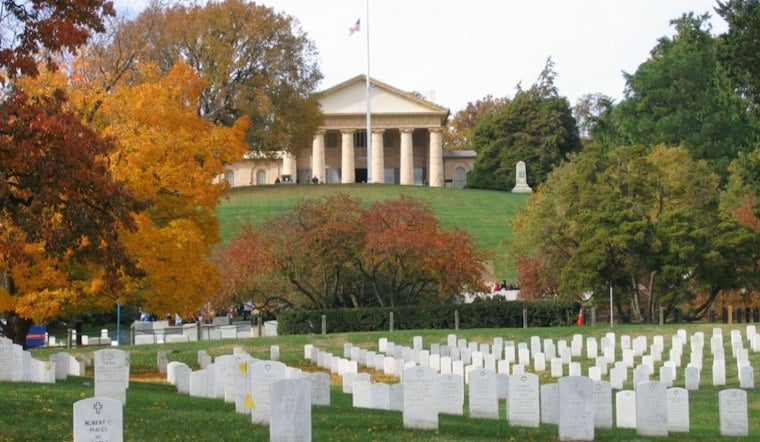
U.S. Army Air Forces Pfc. Weber S. Underwood was just 25 years old when he died on a Japanese-run work detail in the Philippines in June 1942, weeks after surviving the Bataan Death March. 83 years and five months later, the Hopkinsville, Kentucky native has finally been identified, and he'll be buried at Arlington National Cemetery on October 6.
Underwood was a member of the 28th Materiel Squadron, assigned to the 20th Air Base Group, when Japan invaded the Philippine Islands in December 1941, according to WSMV. He was captured when U.S. forces surrendered on the Bataan Peninsula on April 9, 1942, and was forced onto the notorious 65-mile Bataan Death March along with thousands of other American and Filipino troops. He was later held at Cabanatuan POW Camp #1, where more than 2,500 prisoners perished in 1942 alone, the station reports.
Underwood did not survive long after arriving in captivity. He died on June 3, 1942, at the Tayabas Road work detail in Camarines Norte, Luzon, where Japanese forces detached prisoners from main camps to build roads under brutal physical deprivation, according to the Defense POW/MIA Accounting Agency. Other American airmen, including Tech5 Ingwell V. Bartleson and Cpl. Joseph A. L. Richer, also died on that same detail amid fatal outbreaks of malaria and dysentery, per DPAA's historical accounting.
From a Battlefield Grave to an Unknown Headstone
Underwood was originally buried at the Tayabas Road Camp Cemetery. The American Graves Registration Service recovered 40 sets of remains from that site in 1945, followed by 15 more, and a 1948 search turned up seven additional sets, bringing the total to 62, the governor's office said per WSMV's reporting. The remains that could not be identified at the time were interred as Unknowns at the Manila American Cemetery and Memorial, with Underwood's remains designated X-3694 Manila #2.
That cemetery, maintained by the American Battle Monuments Commission, is the largest overseas U.S. World War II burial ground, holding nearly 17,000 graves and more than 36,300 names on its Tablets of the Missing, according to the American Battle Monuments Commission. Underwood's remains rested there, unnamed, for more than seven decades until DPAA disinterred the site in 2023 and 2024 as part of a wider forensic effort.
DNA Science Solves a 1942 Mystery
That effort is known as the Cabanatuan Project, a DPAA initiative begun in 2014 to identify roughly 1,000 unidentified service members from Cabanatuan POW Camp #1. After Underwood's exhumed remains were sent to the agency's laboratory, DPAA scientists used dental and anthropological analysis alongside circumstantial evidence, while Armed Forces Medical Examiner System scientists applied mitochondrial DNA analysis, mitochondrial genome sequencing, and nuclear single-nucleotide polymorphism DNA testing to confirm his identity.
Underwood was officially accounted for on November 21, 2025, but his family was notified only recently, the station reports. Federal protocol requires a full Next-of-Kin briefing before any public identification is released, which is why the announcement came in September 2026, ahead of DPAA's annual POW/MIA Recognition Day observances. His burial is planned for Arlington National Cemetery.
A Rosette, a Half-Staff Order, and a Homecoming Pattern
Underwood remains memorialized on the Walls of the Missing at Manila American Cemetery, but a bronze rosette will now be placed beside his name there. The rosette, crafted as a rosemary wreath encircled by an eight-point compass, is the American Battle Monuments Commission's standard symbol marking that a once-missing service member has finally been accounted for.
Kentucky Governor Andy Beshear has ordered flags flown at half-staff statewide on Underwood's October 6 burial date. Underwood's return follows the recent Kentucky repatriation of Technician Fifth Grade Robert W. Hirst, another Bataan Death March survivor identified through the Cabanatuan Project, reported in Hoodline's story on a medic's long-delayed homecoming.





