

























































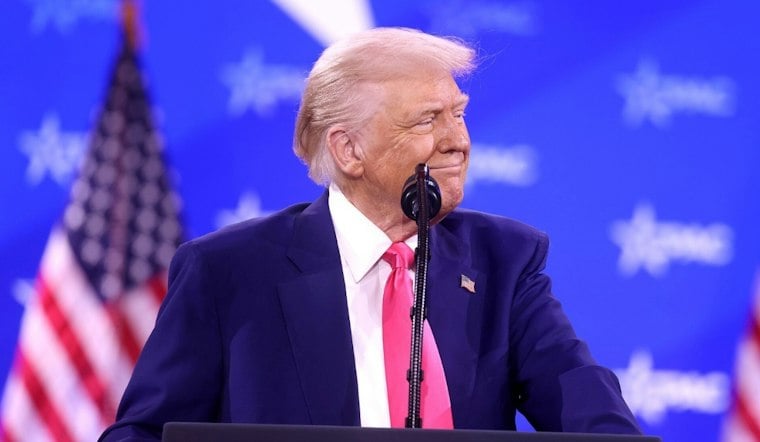
The U.S. House voted 220-204 on Tuesday to approve a resolution directing President Trump to remove American armed forces from hostilities with Iran, marking the third time this year that lawmakers have tried to rein in his war powers. Seven Republicans crossed party lines to back the measure, the most GOP defections yet on the issue.
The resolution, introduced by Rep. Seth Moulton, a Democrat from Massachusetts, directs the president to withdraw U.S. forces from the conflict, according to CBS News. The seven Republicans who voted yes were Thomas Massie of Kentucky, Brian Fitzpatrick of Pennsylvania, Warren Davidson of Ohio, Tom Barrett of Michigan, Mariannette Miller-Meeks of Iowa, Zach Nunn of Iowa and Nancy Mace of South Carolina, per The Hill.
Miller-Meeks, Nunn and Mace were new additions to the anti-war coalition, while Barrett, Fitzpatrick, Davidson and Massie had already supported the two earlier resolutions, CBS News reports. Tuesday's tally represented growing unease within the party: Republican support climbed from four votes in previous House actions to seven this time, according to U.S. News & World Report.
A War That Keeps Outlasting Its Own Timeline
The conflict has now stretched nearly seven months, far beyond what Trump initially predicted would be a four- to five-week campaign, the CBS News report notes. The Pentagon has said Operation Epic Fury, its term for the initial strikes against Iran, ended in May, but the U.S. and Iran have continued to exchange fire since then, and a ceasefire meant to end the war collapsed in July.
Trump has defended his approach, arguing the fighting has degraded Iran's military capabilities, the same report states. Gregory Meeks of New York, the top Democrat on the House Foreign Affairs Committee, offered a sharper assessment, saying the administration has yet to demonstrate that seven months of war produced a lasting strategic resolution to the threats posed by Iran, according to CBS News.
Mounting Costs and an Unclear Path Forward
The financial toll has become a central argument for critics of the war. The Congressional Budget Office estimated the conflict directly cost the United States about $38 billion between February 28 and August 1, per CBS News, while the Pentagon told congressional defense committees the true cost was at least $42 billion as of the previous month, according to The Hill. The CBO projected ongoing costs of roughly $2 billion to $3 billion per month for as long as fighting continues, the same CBS News report states.
The budget office also projected that inflation would run 0.5 percentage points higher than expected heading into 2027 because of the war, according to Click Orlando. More than 50,000 American troops remain deployed to the region after more than six months of fighting, The Hill reports. Meanwhile, global energy prices have stayed elevated, with international benchmark Brent crude rising above $100 per barrel and U.S. crude topping $91 per barrel as the war escalated, according to CNBC.
Two Earlier Votes, Two Different Outcomes
Tuesday's vote drew more Republican support than either of the two previous efforts to limit Trump's war powers, in June and July, CBS News notes. The House and Senate had adopted another Iran war powers resolution in June, though the White House argued against that measure's validity, per the same report. In July, the House approved a separate resolution by a vote of 214-208, with four Republicans — Barrett, Fitzpatrick, Davidson and Massie — joining Democrats, according to NPR. That measure later failed in the Senate by a vote of 47-49, the outlet reported, and the July resolution has not seen any movement in the Senate since.
It remains unclear whether the Senate plans to take up this latest resolution during its final two scheduled weeks of session before the November elections, CBS News reports. The uncertainty leaves the House's repeated votes as largely symbolic rebukes of the president for now, even as the financial and military stakes of the conflict continue to grow.





