

























































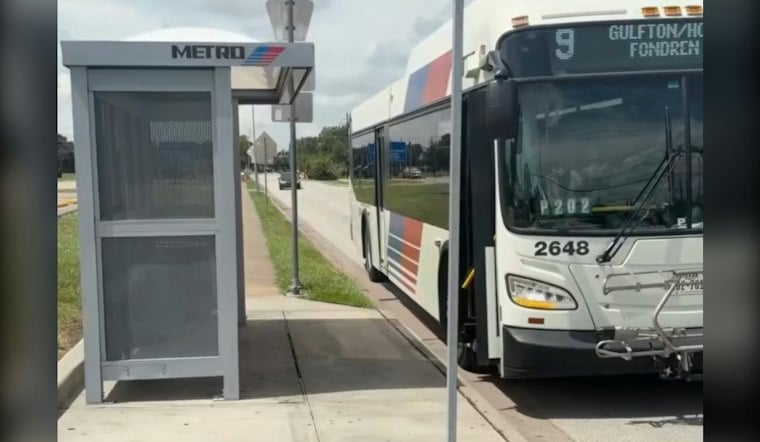
Houston commuters have likely noticed something different at their bus stops lately: shelters with punched-metal side panels instead of solid walls. Houston METRO now operates nearly 95 of these perforated shelters across its service area, part of a design meant to stop hot air from building up inside the structures and to make waiting for the bus a little more bearable.
The design isn't new — it started as a 12-shelter pilot in the Gulfton neighborhood in June 2025, according to Community Impact. Gulfton was picked as the test site because local heat-mapping efforts had flagged it as one of Houston's hottest urban heat islands, with surface temperatures running as much as 14 degrees Fahrenheit hotter than the city's coolest neighborhoods, per Community Impact.
Why Standard Shelters Became the Problem
The push for a redesign traces back to research on how traditional bus shelters actually perform in Gulf Coast heat. A study led by UTHealth Houston researchers and published in Transportation Research Part D found that standard enclosed shelters with acrylic or metal walls can trap solar radiation like ovens, pushing internal temperatures higher than the surrounding outdoor air, according to UTHealth Houston.
That finding reframed what a bus shelter is supposed to do in a city where summer heat is a genuine safety concern for transit riders. METRO's answer was to swap solid walls for perforated metal side screens that allow cross-ventilation, paired with steel framing and solar-powered lighting.
The Cooling Gains Are Real, But Modest
Sensor readings collected inside the pilot shelters showed an observed temperature difference of about one degree Fahrenheit during field testing. It's a real improvement, but a limited one measured against Houston's brutal summer conditions.
That modest number stands in sharp contrast to a separate piece of UTHealth Houston environmental health research from 2025, which found that tree canopy shade at bus stops reduced rider heat stress — measured via Wet Bulb Globe Temperature — by an average of 5.9 degrees Fahrenheit, alongside measurements of several shelter designs. The results suggest that physical shelter redesigns work best as one piece of a broader cooling strategy rather than a standalone fix.
A Broader Push Under New METRO Leadership
The shelter overhaul coincides with Elizabeth Gonzalez Brock serving as the agency's Board Chair.
The need is significant. As of 2024, 2,500 of METRO's 10,000 stops had shelters. METRO has a multi-year capital goal to install or replace 400 bus shelters annually, aiming to add or upgrade 2,000 shelters over five years.
The shelter work also feeds into METRO's BOOST network program, which targets 17 high-ridership bus routes — including the 54 Scott and 82 Westheimer lines — for digital arrival displays, sidewalk improvements, and shelter installations, per METRO Houston's own project listings.
Nearly 95 perforated shelters is a small fraction of METRO's approximately 10,000 total stops, and the modest cooling difference reported for them is far from a cure for Houston's punishing heat. But paired with the agency's broader shelter replacement goals and its BOOST corridor upgrades, the perforated design marks a visible, if incremental, step in how Houston is rethinking what it means to wait for the bus.





