

























































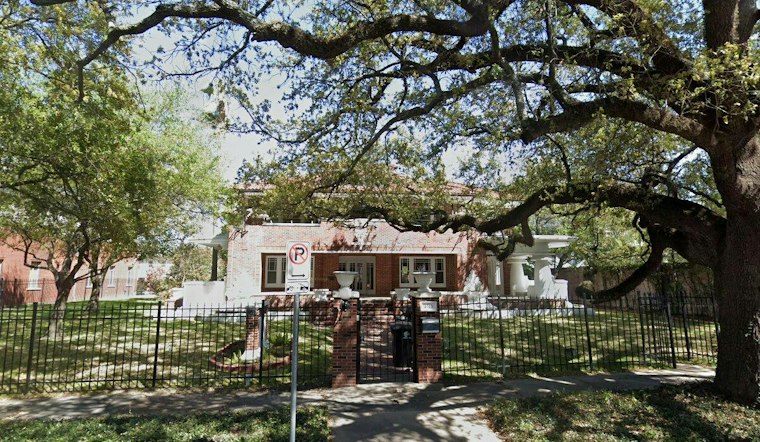
A landmark shaped by architecture and preservation
The Sterling-Berry House at 4515 Yoakum Blvd. is a two-story, 4,546-square-foot mansion on roughly half an acre near Houston’s Montrose and Museum District areas. Built in 1916 for Ross Shaw Sterling, the house was expanded three years later by architect Alfred C. Finn, who added a broad concrete porch, a canopy and an inglenook, according to Chron. Finn also designed the San Jacinto Monument and downtown Houston’s Gulf Building, according to the Texas State Historical Association.
The property is designated a City of Houston Landmark and is listed on the National Register of Historic Places. Municipal preservation requirements call for a Certificate of Appropriateness before exterior alterations, additions or structural changes can proceed. City guidelines also require historic interior shiplap framing to be preserved during renovation work.
What preservation means for a future owner
The house has recently undergone work involving its foundation, floors and roof structures. Its original construction included hollow clay tile blocks on a reinforced-concrete foundation, shiplap structural framing and a red-clay tile hip roof, according to city preservation records. The property is bordered on its south side by Interstate 69/U.S. 59, a prominent constraint for any future owner considering the site.
Approval timeline and neighborhood change
The city’s preservation process can affect both the timing and consequences of exterior work. According to the City of Houston Historic Preservation Manual, a complete Certificate of Appropriateness application must be submitted by noon 22 days before the next Houston Archaeological and Historical Commission meeting, which meets once a month. Work completed without an approved certificate may lead to fines, removal of the work and restoration of the property to its prior appearance. The surrounding area has also been reshaped by transportation and transit. The city says the Montrose line provided streetcar service between the neighborhood and downtown beginning in August 1912, continuing until 1937. Later, construction of U.S. 59 Spur 527 in the early 1960s demolished more than half of the Bute Addition, illustrating how transportation infrastructure changed the historic neighborhood around homes such as the Sterling-Berry House, according to the City of Houston’s history of First Montrose Commons and its account of Audubon Place.
Houston’s preservation ordinance received support from the Texas Supreme Court in 2021. The court held that the ordinance was not a zoning law, rejecting a challenge from homeowners who argued that the rules were unconstitutional zoning, Community Impact reported. The ruling left the city’s system for reviewing compatible exterior changes in place.
From governor’s residence to commercial property
Sterling, who served as Texas governor from 1931 to 1933, co-founded Humble Oil in 1911 and later sold his interest in the company in 1925. Humble Oil was subsequently reorganized and eventually became part of the corporate history associated with Exxon, according to Hoodline. During his governorship, Sterling declared martial law in four East Texas counties in 1931 and used National Guard troops in an effort to halt oil production during a price collapse, according to the Texas State Library.
The building later took the name Sterling-Berry House after Joel H. Berry, a Houston banker, lawyer and civic leader, lived there. Its use subsequently shifted from private residence to law office. The current seller acquired it for a medical practice that never moved into the building, Chron reported.
The current offering
The house is being offered for $3.75 million. Chron reported that the property can accommodate either office or residential use and has parking for as many as 22 vehicles. Justin Comber, an associate director of investments for Marcus & Millichap, is listed in connection with the sale. According to Chron, the seller has asked the broker to seek a buyer who will respect the building’s architecture and historic character.





