

























































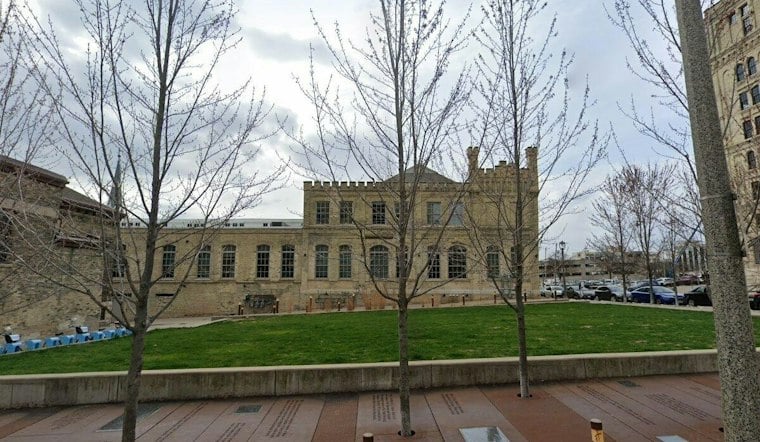
The former Pabst brewery complex is now part of The Brewery District, a mixed-use Milwaukee neighborhood that combines preserved industrial buildings with new construction. Joseph Zilber began the master redevelopment effort in 2006, and more than $300 million has since been invested in the district. The project received Platinum certification through the LEED Neighborhood Development program in 2012, according to The Brewery District.
Public spaces helped mark the transformation. Preservation Park, at 925 W. Juneau Ave., opened in 2017 on part of the former brewing site. The park honors the area’s brewing history, while the surrounding redevelopment includes housing, offices, hotels, restaurants, event spaces and other uses, according to Urban Milwaukee and The Brewery District.
The site before redevelopment
Pabst closed its 22-acre Milwaukee brewing complex in December 1996, ending 152 years of brewing operations there. The shutdown left 28 buildings vacant, while the company shifted production to Stroh Brewing Company’s La Crosse plant and later contracted with Miller Brewing Company, the Los Angeles Times reported. The complex was placed on the National Register of Historic Places in 2001.
The property remained vulnerable to demolition as its buildings deteriorated. Developers bought the $10.3 million complex in September 2002, and the later redevelopment preserved portions of the historic campus while adding new uses, according to the Los Angeles Times and The Brewery District.
Why the buildings mattered
The National Park Service describes the Pabst complex as nationally significant both for its history as one of the largest U.S. breweries and for its late-19th-century brewery architecture, according to National Park Service documentation. That designation helps explain why the vacant, deteriorating buildings presented a preservation challenge as redevelopment plans took shape. Pabst’s reuse also fit a broader Milwaukee pattern. A June 29, 1986, report by The New York Times described the former Schlitz and Blatz brewery complexes being converted into office, commercial and mixed-use properties while retaining their historic architecture. Those earlier projects provided a local precedent for combining brewery preservation with new uses, although the later Pabst redevelopment involved its own sequence of closure, purchase and neighborhood-scale construction.
Haertel’s preservation effort
Jim Haertel and his family were involved before that broader redevelopment took shape. Urban Milwaukee reported that they secured a purchase option on the entire complex on September 11, 2001. Haertel later became the owner and operator of Best Place at the Historic Pabst Brewery, a business located within the former complex, rather than the owner of the full Brewery District.
FOX6 Milwaukee reported that Haertel sent the purchase agreement at 1:30 p.m. on September 11, 2001, after working toward the deal for two and a half years. The outlet also reported that Haertel and his family raised $11 million in one year to buy the site and that the effort was intended to prevent the historic property from being demolished: FOX6 Milwaukee.
The complex’s continuing legacy
Best Place remains associated with the surviving brewery buildings and their history. In August 2025, the business received a $50,000 Backing Historic Small Restaurants grant from American Express and the National Trust for Historic Preservation; it was one of 50 historic small businesses selected nationwide, according to Hoodline.
The result is a site where the former brewery’s architectural and commercial history is incorporated into a newer neighborhood. Haertel’s effort supported the preservation of the buildings associated with Best Place, while the subsequent work by Zilber and other developers reshaped the larger former industrial property as The Brewery District.




