

























































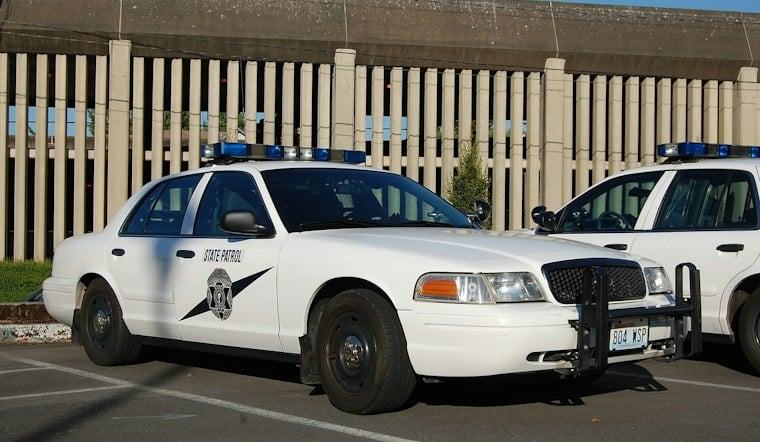
A 109-mph pursuit that began before dawn on Interstate 5 near South 317th Street ended with a fatal crash and, days later, a second-degree murder charge against the driver. King County prosecutors say 24-year-old Sean Nasreldin Abdelrahman was behind the wheel of a silver 2008 Toyota Avalon when it collided with another vehicle following a chase with Washington State Patrol, killing his 23-year-old passenger, Jusstina S. Murrietta.
According to Tacoma Weekly, Washington State Patrol Trooper Patrick Homa was driving southbound on I-5 near the Orillia Road/South 188th Street exit when the Avalon passed him in the HOV lane at what troopers estimated was about 85 mph or more in a posted 60 mph zone. Homa declared a pursuit at 2:32 a.m. on August 23, and the outlet reports the chase reached an estimated 109 mph before Trooper Hencke took the lead at 2:35 a.m. in a fully marked patrol car. The Avalon eventually collided with a 2018 gray Chevrolet Malibu that had moved from the HOV lane into lane 4 and then lane 3, striking the Malibu on the Toyota's driver side; Hencke's patrol car then struck the Malibu as well, per the same account.
Passenger Died at the Scene, Driver Suffered Broken Arm
Murrietta, described in charging documents as a rear-seat passenger, died at the scene, the report states. Nicole Rodriguez, the 24-year-old driver of the Malibu, suffered a broken left arm. Abdelrahman was the Toyota's sole occupant, and Homa detained him after the crash; the trooper reported six of six clues on Abdelrahman's horizontal gaze nystagmus test, and Abdelrahman told investigators he had one drink between 11 p.m. and midnight, according to Tacoma Weekly's account of the charging documents.
King County prosecutors charged Abdelrahman on August 26 with second-degree murder, vehicular homicide, vehicular assault, and attempting to elude a pursuing police vehicle, requesting $500,000 bail. As KING-TV reported on August 27, the murder charge is predicated on the legal theory that Murrietta's death occurred during Abdelrahman's immediate flight from the felony eluding offense. Prosecutors have said Abdelrahman has no known criminal history, and charging information alleges Murrietta was not a participant in the crime. The criminal-case allegations remain unproven, and Abdelrahman is presumed innocent unless convicted.
What the Law Requires — and What Remains Unclear
Under Washington's RCW 46.61.520, vehicular homicide is a Class A felony punishable by up to life in prison and a $50,000 fine when a reckless or impaired driver causes a fatal collision, per the Washington State Legislature. Attempting to elude, charged under RCW 46.61.024, is a Class C felony carrying up to five years in prison, a $10,000 fine, and mandatory license revocation; the statute requires the signaling officer to be in uniform in a vehicle equipped with active lights and sirens, but does not require a marked patrol car for the initial signal. Washington's second-degree felony murder statute, RCW 9A.32.050, allows prosecutors to charge Class A felony murder when a death occurs during flight from an underlying felony such as eluding, without proving intent to kill.
State pursuit policy also requires officers to notify a supervisor immediately once a pursuit begins, consider alternatives to the chase, develop a plan to end it using available intervention options as soon as practicable, and complete an emergency vehicle operator's course; a pursuit must be terminated if those statutory requirements are not met. According to Tacoma Weekly, charging documents establish that Homa notified dispatch and requested a second patrol vehicle equipped with push bars, but the documents do not establish whether the pursuit complied with every statutory requirement.
A Pursuit Law Washington Has Rewritten Three Times Since 2021
Washington has revised its pursuit law three times since 2021, per Tacoma Weekly's reporting. A 2021 law required probable cause of certain violent, sex, or escape offenses, or reasonable suspicion of DUI, plus an imminent threat, before officers could pursue. A 2023 revision lowered that threshold to reasonable suspicion, and Initiative 2113 — which took effect June 6, 2024 — removed the qualifying-offense list altogether. Under the current version of RCW 10.116.060, a pursuit is allowed when there is reasonable suspicion a person violated the law, the pursuit is necessary to identify or apprehend them, they pose a threat to others, and the risk of not apprehending them exceeds the risk of the pursuit itself.
KING 5 News reported in June 2024 that the Washington State Patrol had logged nearly 8,000 incidents of drivers refusing to stop for troopers between 2021 and mid-2024, a surge officials cited when pushing to restore broader pursuit authority. State Patrol data show that trend accelerating: the agency reported 500 pursuits and 3,212 fled incidents in 2022, 586 pursuits and 3,337 fled incidents in 2023, and 958 pursuits and 2,248 fled incidents in 2024, according to Tacoma Weekly's review of state figures. KING 5 also reported that local agency responses to Initiative 2113 have varied, with some municipal departments retaining stricter internal limits while the Thurston County Sheriff's Office expanded pursuits to cover any law violation, including minor traffic infractions.
State Data Shows Most Pursuits Start Over Traffic Stops
A June 2025 study commissioned by the Washington Office of Financial Management and conducted by the University of Washington found that State Patrol pursuits averaged 90.1 mph, with a quarter exceeding 110 mph, and that 64% were initiated over traffic infractions. A 2025 report to the legislature covered 11,062 recorded pursuits from 2019 through part of 2024, per Tacoma Weekly. State Patrol pursuits recorded no charge other than eluding in 55.6% of cases, and 28.2% had unknown outcomes, while local agencies listed zero charges in 57.9% of pursuits, with traffic infractions cited 30.7% of the time, misdemeanors 28.4% of the time, and DUI as the most common misdemeanor reason with 999 local cases.
The same report analyzed 6,801 local agency pursuits — drawn from 113 agencies within a 117-agency sample — finding that 15.2% ended in crashes, injuring 7.6% of suspects, 2.6% of bystanders, 2.5% of passengers, and 2.4% of pursuing officers. The report could not establish how many uninvolved people were killed, marking bystander deaths as unknown in 876 pursuits and passenger deaths as unknown in 877 pursuits, and 18 agencies lacked a death-related data element entirely, per the same account. Two pursuit datasets together listed 27 deaths — 20 suspect drivers, two law enforcement officers, and five passengers or bystanders.
Advocates and Researchers Split Over the Post-2113 Trend
The Washington Coalition for Police Accountability reported in July 2026 that pursuit-related fatalities in the six months after Initiative 2113 took effect matched the total recorded over the prior three years under stricter rules. Criminologist Geoffrey Alpert reported in 2010 that innocent third parties made up 42% of those killed or injured in pursuits, and estimated roughly one fatality per 100 high-speed pursuits, figures cited in Tacoma Weekly's reporting. The federal Bureau of Justice Statistics found an average of 355 people were killed annually in pursuit-related crashes from 1996 through 2015.
Former University of Washington statistics professor Martina Morris, whose research was evaluated by PubliCola in 2023, estimated that about 30% of all pursuits result in a collision. Morris also found 11 pursuit deaths in roughly the 15 months before the 2021 restrictions took hold, compared with two in a similar period afterward, according to Tacoma Weekly. Separately, the Washington Traffic Safety Commission reported 659 traffic deaths statewide in 2025, of which 297 involved an impaired driver — about 45% of that year's total.
Part of a Wider Pattern on Washington Highways
The I-5 case follows a string of high-speed pursuits across the region since Initiative 2113 took effect, including a 96 mph Seattle street chase earlier this month and a 93 mph pursuit that ended in a crash in Federal Way in August. King County has also leaned on aerial support, including its Guardian 1 helicopter, to help end chases without prolonged ground pursuits. Abdelrahman's case now heads toward prosecution as one of the more serious tests yet of how Washington's felony murder doctrine applies to fatal outcomes from police pursuits.





