

























































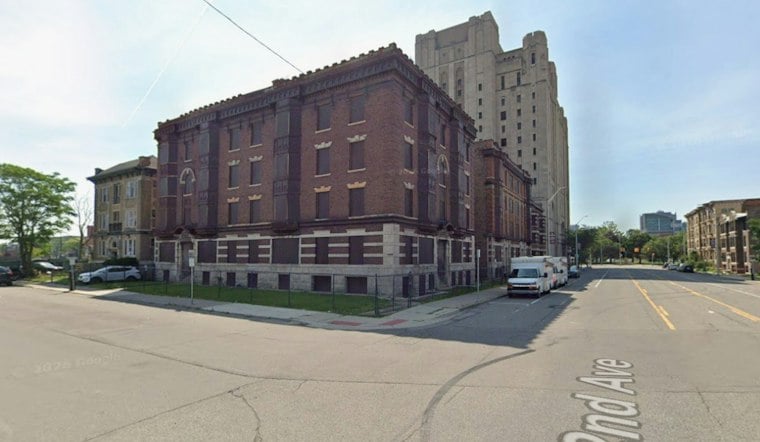
Three long-vacant apartment buildings near Detroit's Masonic Temple are finally getting structural help after sitting boarded up for more than 15 years. The Detroit Historic District Commission voted unanimously on September 9 to approve a plan to protect and stabilize the Manhattan Apartments, the Altadena Apartments, and the Cromwell Flats, all owned by the Ilitch organization through the Line Rock Limited Liability Corporation.
The repair plan, drawn up by Detroit-based Infuz Architects, calls for fixing masonry walls, damaged parapets, and deteriorating roofs, according to the Detroit Free Press. Olympia Development, the Ilitch organization's development arm, says the goal is to prepare the properties for a future rehabilitation and reuse phase, though the company has been clear that no formal redevelopment plans or timeline exist for the trio at this time. Olympia Development says it plans to share further updates as appropriate.
The three buildings sit at 2966 Second Avenue, 2952 Second Avenue, and 2942 Second Avenue, all contributing structures within the Cass Park Historic District, which was added to the National Register of Historic Places on February 2, 2005, and designated a local Detroit historic district in 2016, according to Wikipedia. The Manhattan Apartments reportedly date to 1905, while the Cromwell Flats date to 1905 as well, and the Altadena Apartments were built in 1911.
Jacobethan Facades Behind Decades of Boards
The Manhattan and Altadena buildings share an architectural pedigree: both were designed by Detroit firm Pollmar & Ropes in the Jacobethan style, marked by four-and-a-half-story brown brick facades, green tile spandrels, and three-sided window bays, per research compiled by Jeff Bondono. The Cromwell Flats took a different path — Detroit architect Almon C. Varney designed the three-and-a-half-story structure in 1904, giving it alternating bands of brick and stone rather than the taller Jacobethan look of its neighbors.
Entities tied to the Ilitch family acquired all three buildings around 2009, and they have sat vacant and boarded up ever since, according to a 2015 account from Motor City Muckraker. That means the structures have weathered more than 15 years of decay before this month's stabilization vote — the kind of prolonged vacancy preservationists sometimes call demolition by neglect, since a building can be legally left standing while its condition steadily worsens.
Masonic Temple Neighborhood Has More Ilitch-Owned Vacancies
The three buildings sit near the Detroit Masonic Temple, the 1926 George D. Mason design at 500 Temple Street, recognized as the world's largest Masonic temple and individually listed on the National Register in 1980. The Ilitch organization owns numerous other historic vacant properties around the Masonic Temple, which itself sits near Little Caesars Arena. One of those nearby properties, the old Fort Wayne Hotel — now known as the American Hotel — sits at 408 Temple Street on the same block as the Masonic Temple. Originally built in 1926 as a lodge headquarters and hotel for the Knights of Pythias, the 11-story building was designed by Ellington & Weston, according to background compiled on Wikipedia.
That building's rehab, slated to begin in the fourth quarter of 2026, is part of the broader District Detroit megadevelopment and would convert the structure into an 11-story, 149-unit apartment building. It's one of ten projects within the $1.5 billion District Detroit package that the Michigan Strategic Fund board approved in 2023 alongside $615 million in Transformational Brownfield Plan tax capture subsidies spread over 35 years, according to BridgeDetroit.
Only One District Detroit Project Currently Under Construction
Despite that sizable public incentive package, the District Detroit construction timeline is running behind schedule, with just one of the ten planned projects actively underway. That project is a $186 million, 13-story residential tower at 2205 Cass Avenue, which Grad Tower Shakes Up Downtown reported will provide 313 units leased for 40 years to the University of Michigan for graduate student and faculty housing tied to the future Detroit Center for Innovation.
The incentive structure behind the megadevelopment has already shifted once. In January 2025, the Michigan Strategic Fund modified its District Detroit agreement to eliminate affordable housing requirements for one planned mixed-use office building, citing office market downturns, while keeping the project's overall tax reimbursement cap intact, according to Michigan Public.
Meanwhile, Ilitch-controlled entities continue to operate an extensive parking footprint near their vacant historic holdings — more than 8,500 private spaces across dozens of downtown lots under Olympia Parking, a scale of surface-lot control Hoodline detailed in its coverage of the company's recent Madison Lot acquisition. For now, Olympia Development says its focus with the Manhattan, Altadena and Cromwell buildings is ensuring the long-term integrity of the historic structures, a stabilization-first step that keeps them standing while any decision on their eventual reuse remains unmade.





