

























































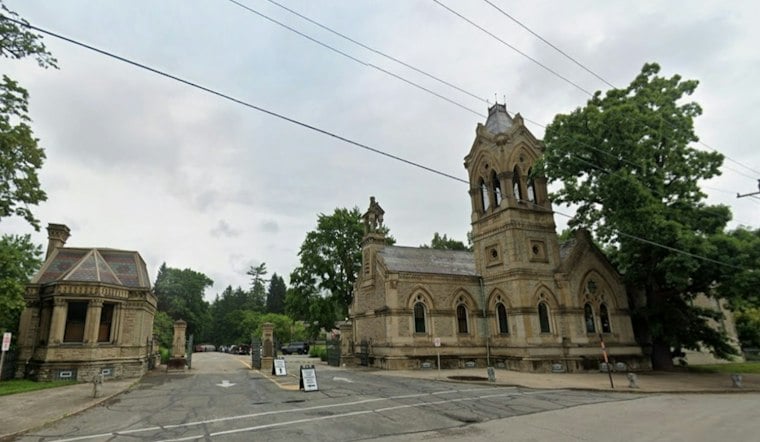
Long before it became one of the largest cemeteries in the United States, Spring Grove was a desperate answer to a public health crisis. During the cholera epidemics of the 1830s and 1840s, Cincinnati was losing around 100 people per day at the outbreaks' worst, according to Spring Grove docent Cheryl Tallman. Among the grieving was businessman Peter Neff, who lost his wife during the city's burial crisis and joined other Cincinnati businessmen determined to build something better than the overcrowded urban graveyards of the era.
That effort became Spring Grove Cemetery and Arboretum, incorporated as a non-denominational cemetery with articles drafted by Salmon P. Chase, the future Ohio governor, U.S. senator, Lincoln-era Treasury secretary and Chief Justice of the United States, as reported by Cincinnati CityBeat. The founders bought 220 acres for the original plot, and the cemetery held its first burial in 1845. Today the grounds at 4521 Spring Grove Ave. have grown to 733 acres, making it the second-largest cemetery by acreage in the United States and, per Atlas Obscura, a property where roughly 450 acres are developed for interments while nearly 300 acres remain available for future use.
A Landscape Design That Changed American Cemeteries Forever
Spring Grove's sprawling, park-like character isn't an accident. Prussian-born horticulturist Adolph Strauch created his revolutionary landscape lawn plan here starting in 1855, placing strict limits on tombstone heights and eliminating private lot fences to open up continuous, pastoral vistas, according to the National Park Service. Strauch also helped transform the site's originally swampy terrain, using a network of lakes to control the natural springs running beneath the grounds — the cemetery now counts 14 lakes across its acreage, per CityBeat's reporting.
By the 1860s, the then-412-acre Spring Grove was widely regarded as the largest cemetery in the world and became the primary international model for what's known as the Lawn-Park Cemetery movement, according to The Cultural Landscape Foundation. Strauch's design standards rippled outward from Cincinnati to reshape professional cemetery management across North America and Europe. He later applied a similar design philosophy to Cincinnati's Mount Storm Park in Clifton, a connection Hoodline explored in its recent piece on Mount Storm Park's expansion plans.
Lincoln's Visit and a Roster of Cincinnati Legends
The grounds have drawn notable visitors since their earliest years. Abraham Lincoln, then a traveling lawyer, visited Spring Grove Cemetery in 1855 while in Cincinnati for a patent case, according to CityBeat's account. Visitors in that era arrived by horse and buggy, and the cemetery's carriage house later became a ticket office once demand grew so heavy that admission had to be restricted during periods of high popularity.
The cemetery's permanent residents read like a roll call of Cincinnati's industrial and civic history. Bernard Kroger, Louis Graeter, Christian Moerlein, Andrew Erkenbrecher, William Procter, James Norris Gamble, John Shillito, Henry Pogue and George McAlpin are all buried at Spring Grove, per the CityBeat report. So is Nicholas Longworth Sr., Cincinnati's first millionaire, whose great-grandson Nicholas Longworth III went on to become Speaker of the U.S. House and married Alice Roosevelt. Ulysses S. Grant's parents and Alphonso Taft, father of future president William Howard Taft, are interred there as well, alongside Salmon P. Chase himself, whose grave reportedly went unmarked for decades.
Civil War Generals and a Field of Concentric Graves
Spring Grove's military history runs especially deep. The cemetery is the final resting place for 41 Civil War generals — 40 Union officers and one Confederate — according to Spring Grove Cemetery & Arboretum. Beyond the generals, the cemetery donated land for Civil War soldiers in 1862, and it now contains 333 Civil War soldiers' graves arranged in concentric circles around upright cannons on three burial mounds, plus more than 5,000 veterans' graves overall, per CityBeat.
The cemetery's abolitionist ties extend further into Cincinnati's civil rights history. Quaker abolitionist Levi Coffin, dubbed the President of the Underground Railroad after helping more than 3,000 freedom seekers escape slavery, died in Cincinnati in 1877 and is interred at Spring Grove, according to The Voice of Black Cincinnati. Coffin had operated a free-labor store in the city during the 1840s and 1850s that refused to sell goods produced by slave labor.
Sphinxes, a Storm-Struck Mausoleum and a Dog Who Never Left
Some of Spring Grove's most striking features are architectural oddities rather than famous names. Congressman William Slocum Groesbeck, who served as an attorney for President Andrew Johnson during his impeachment trial, is entombed in a sphinx-like mausoleum, while the Fleischmann family mausoleum resembles the Parthenon in Greece, according to CityBeat's tour of the grounds. The Dexter mausoleum, a Gothic Revival structure beside one of the cemetery's lakes, features European-cathedral-style flying buttresses and catacombs, though family litigation prevented it from ever being completed as originally envisioned — and lightning once struck its steeple and blasted it into the lake below.
Elsewhere, docents point visitors toward Jacob Fritz's elaborate tree stone, carved with grapes, a Bible, a padlock and chain, an anchor, a snake, a squirrel, a hand holding an ax and a sausage grinder — with the identity of the woman perched atop the monument, whether Germania or Columbia, still debated among Spring Grove's own guides. The cemetery contains about 40 of these tree-shaped monuments in total, which symbolize lives cut short, while extinguished flames represent death, anchors represent faith, and broken chains represent a life's end, per the CityBeat piece. A quieter monument depicting a dog lying down commemorates the death of an 8-year-old boy; visitors still leave dog biscuits and sticks beside it.
A Working Arboretum With Ancient Trees and Lake-Dwelling 'Sharks'
Spring Grove's arboretum holds Level III accreditation from the Morton Arboretum Register, a distinction shared by only two historic cemeteries in the country, and the grounds contain more than 1,200 labeled species of trees, plants and shrubs, according to Spring Grove Cemetery & Arboretum. Among the standouts are a white oak estimated to be around 400 years old, an Ohio champion dawn redwood that arrived at the cemetery around 1948, a cedar of Lebanon, and a national champion September elm.
The grounds also support plenty of living residents. Geese, woodchucks, butterflies, turkeys and swans share the property, and the cemetery's oversized carp have earned an affectionate nickname. “We call them our sharks,” Tallman said, describing the large fish that patrol Spring Grove's lakes. One flower bed alone holds roughly 10,000 tulip bulbs, and the cemetery maintains 45 miles of paved roads winding past its lakes, mausoleums and monuments.
Planning a Visit
Spring Grove's Board of Trustees established the non-profit Spring Grove Heritage Foundation in 1995 to oversee public education, historic preservation and guided tours across the grounds, with walking and tram tours generally running from mid-April through October and covering themes like cemetery history, heritage, and the tree stones scattered throughout the property. The cemetery expanded its operations again in October 1999 by opening Spring Grove Funeral Homes on adjacent property, allowing families to handle end-of-life care, cremation and burial through a single non-profit organization, according to Spring Grove Funeral Homes. As Tallman put it, describing the scope of what's packed into the cemetery's acreage: “You could spend all day here.”





