

























































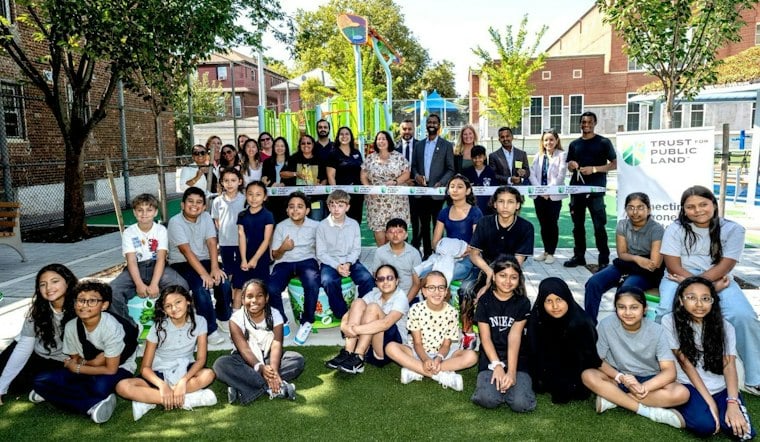
A patch of pavement behind P.S. 69 in Jackson Heights is now a public park after school hours, part of a push to bring green space to one of New York City's most open-space-starved neighborhoods. The schoolyard reopened this month with nature-based play elements, shaded seating and green infrastructure designed to soak up stormwater, and organizers say it will serve more than 56,000 residents who live within a 10-minute walk.
The ribbon-cutting took place on Sept. 16, according to the Long Island Sound Partnership, which reported that the project is expected to manage an estimated 720,000 gallons of stormwater runoff each year. Council Member Shekar Krishnan, who represents the district, said in a statement carried by the same report that he was “proud to invest in transforming the schoolyard at P.S. 69 into a green, welcoming community space.” The project drew funding from the city's Department of Environmental Protection, which contributed $1 million, along with a $408,784 grant from the Long Island Sound Partnership through the Long Island Sound Futures Fund.
The investment lands in a neighborhood that consistently ranks near the bottom of the city's open-space rankings. Per the same account, Jackson Heights ranks 182nd out of 198 mapped residential neighborhoods for access to open space. That tracks with earlier findings from the NYC Independent Budget Office, which found that Jackson Heights, along with Bensonhurst and Borough Park, has as little as two square feet of park space per resident — a disparity the office says has also pushed the city's Open Streets program, now covering 67 miles, into areas with less nearby park space per capita.
A Second Schoolyard Reopens Nearby
The P.S. 69 project follows a similar renovation just blocks away at I.S. 145 Joseph Pulitzer Playground, where a ribbon-cutting was held on a Monday, Sept. 16, according to qns.com. That project, completed in just 10 months, added new trees, a turf soccer pitch, student murals and green infrastructure meant to absorb stormwater, and is expected to serve more than 40,000 residents. It was jointly funded by Queens Borough President Donovan Richards, Krishnan, the Dalio Center for Health Justice at NewYork-Presbyterian and the Long Island Sound Study, and designed with input from students, staff and community members at the school.
According to New York City Council
, the district has student-made murals decorating the newly reworked sites, alongside a new track, jungle gym and picnic tables that the Council helped fund. “In the district with the least green space in NYC, every square foot counts,” the Council wrote in a social media post celebrating the improvements alongside Krishnan.
Part of a Broader Climate and Access Push
The schoolyard conversions are part of a larger movement. The nonprofit Trust for Public Land says it is helping transform 420 schoolyards across 26 states into community spaces, according to The Hechinger Report, which noted that residents in Jackson Heights have access to about two square feet of park space per person within a one-mile walk, compared with more than 141 square feet per resident near Bayside. The outlet also reported that climate-resilient schoolyard designs elsewhere have included porous pavement, green-roofed gazebos and rain gardens meant to reduce runoff and heat.
City lawmakers have been pressing for a fuller accounting of the disparity. Legislation on file with the New York City Council Legistar calls for a study, due no later than May 1, 2027, that would include a list of the 10 community districts with the least green space per capita. Krishnan has pushed on this front before: in 2022, he laid out a five-point parks plan calling for $1 billion in Parks Department funding, 1 million trees planted by 2030, expanded waterfront access and a new Parks Construction Authority, as reported by the Queens Daily Eagle. That same report noted that building a single park in New York City takes an average of seven to eight years — part of why a 1.3-mile stretch of 34th Avenue in the neighborhood was converted into an Open Street during the pandemic, with Krishnan later proposing it become a permanent linear park.
Comparable investments have taken shape elsewhere in the city. A $50 million capital initiative cited by the NYC Mayor's Office pointed to the renovated Jennie Jerome Playground in the Bronx, completed in 2025, which added inclusive play equipment, a spray shower, picnic tables and family seating. In Jackson Heights, residents have also had a say in smaller-scale spending through participatory budgeting, with Cycle 14 recently completed across Jackson Heights, Elmhurst, East Elmhurst and Woodside, according to the Council's own account.





