

























































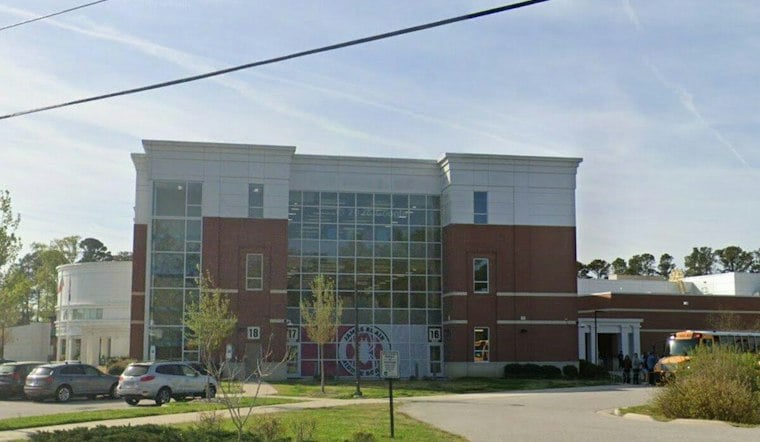
Isabel Rossi, a 14-year-old freshman at Jamestown High School in James City County, is one of 30 finalists in a national STEM competition. Rossi’s study examines how best to place earthquake sensors. She will travel to Washington, D.C., next month to compete for more than $100,000 in prizes.
Rossi is one of 30 finalists in the 2026 Thermo Fisher Scientific Junior Innovators Challenge, according to the Daily Press. Her project, titled Listening in the Right Places: Game Theory and Optimization for Earthquake Sensor Placement, compares methods for positioning earthquake sensors so they can help save lives by detecting early seismic waves and issuing warning alerts, per the same report. Rossi applied a mathematical modeling system commonly used in economics to the problem, exploring both a weighted sum model and Nash bargaining theory as competing approaches, as detailed in a profile published by Society for Science.
A Six-Month Project
The Daily Press reports that Rossi has read her father's Physics Today magazine since sixth grade. She worked on the project for six months and developed it without a teacher or mentor, the paper reports.
Her project considers accuracy and ease of installation and compares a weighted sum model with Nash bargaining theory, drawing on a Los Angeles earthquake-data library. The regional data is maintained in part by the Southern California Seismic Network, which monitors seismic activity across hundreds of stations, according to Seismological Research Letters. The project compares placement strategies; the reported work does not establish how a live alert system would perform. Rossi has said mathematical approaches like hers may be useful in high-risk, hard-to-access areas with limited resources, per the Daily Press.
What sensor placement can—and cannot—show
In California, ShakeAlert combines algorithm estimates of an evolving earthquake’s location and magnitude before broadcasting a result, according to ShakeAlert. That operational alert process is different from Rossi’s study, which modeled sensor placement using historical data and does not demonstrate real-time detection or alert delivery. A separate U.S. Geological Survey-published study of the PLUM early-warning algorithm found slower detection times for older earthquakes in its dataset when station coverage was sparser.
The California data also differs from Virginia’s seismic setting. Virginia Energy’s Geology and Mineral Resources program says most Virginia earthquakes are not associated with a known fault and occur within three distinct seismic zones.
From Top 300 to Top 30
Rossi was nominated for three Junior Innovators Challenge competitions and advanced to the top 300 before reaching this year's top 30, the Daily Press reports. Nationally, Society for Science selected the 30 finalists from entrants across 34 states, Puerto Rico, and Guam, following an initial cut to 300 semifinalists announced September 2, according to the organization's press release. Finalists come from 17 states and Puerto Rico. The network of Society for Science-affiliated local and regional fairs that feeds the national contest reaches roughly 60,000 middle school students nationwide every year, per the same press release.
The Daily Press reports Rossi learned she had reached the top 30 while flying home from Stanford University, where her 18-year-old sister, Eleanor, is a freshman. The Junior Innovators Challenge, run by Society for Science, is restricted to middle school students in grades 6 through 8 who place in the top 10 percent of an affiliated local or regional science fair, according to the organization.
Finals Week and a Family of Educators
The 30 finalists will gather in Washington, D.C., from October 23 to October 28 for Finals Week, competing for the top $25,000 Thermo Fisher Scientific ASCEND Award among other prizes, according to Society for Science. Every finalist also receives a $500 cash prize, the organization notes.
Rossi's science interests took root early. The Daily Press reports that a Matoaka Elementary School teacher connected her with a retired NASA engineer when she was 9, and the pair met weekly to launch rockets. As an eighth grader at James Blair Middle School, Rossi organized the school's MATHCOUNTS team and arranged an annual STEAM night featuring demonstrations and guest speakers, according to the Daily Press.
Trinity Bea described Rossi as an amazing, inquisitive and passionate student, the Daily Press reports. The paper says Rossi takes three advanced math and science classes, including AP Calculus AB, and coaches a middle school mathematics competition team. She has said she is open to a future career in engineering, applied math or medicine, according to the Daily Press.





