

























































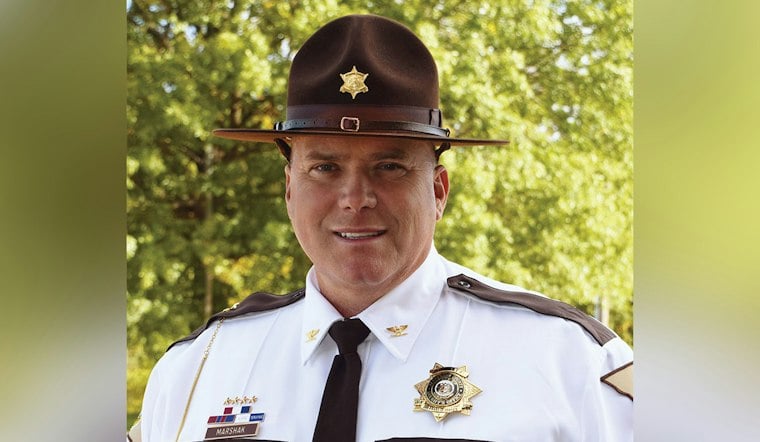
Jefferson County Sheriff Dave Marshak is defending his decision to join Missouri Attorney General Catherine Hanaway's federal lawsuit seeking to strike down registration requirements for suppressors and short-barreled rifles, arguing the move would not hurt local police work. Marshak joined the case as a private citizen rather than in his official capacity as sheriff.
Hanaway and Marshak filed the 34-page complaint Tuesday in the U.S. District Court for the Eastern District of Missouri against the U.S. Department of Justice and the Bureau of Alcohol, Tobacco, Firearms and Explosives, according to the St. Louis Post-Dispatch. The case, filed as State of Missouri ex rel. Catherine L. Hanaway and Dave Marshak v. ATF et al., carries case number 4:26-cv-01430 in federal court, according to the Missouri Attorney General's Office. The suit specifically challenges registration-violation provisions involving silencers and short-barreled rifles, arguing those items are commonly used.
Marshak Says Criminal Penalties, Not Registration, Do the Work
Marshak has said criminal penalties can still enforce firearm rules even without a federal registration system, and he has argued that ending federal firearm registration requirements would not hurt police work, per the Post-Dispatch's reporting. Federal registration requirements function as a mechanism for maintaining an inventory of gun ownership, according to the same report. Marshak has served as Jefferson County Sheriff since taking office in January 2017 following his 2016 election, after a law enforcement career that began in 1991 and included a stint as SWAT Commander, according to the Jefferson County Sheriff's Office. His department oversees a county of more than 220,000 residents.
The Post-Dispatch's report also referenced a 2017 police standoff near Interstate 55 and Highway 61 in Jefferson County that ended with the suspect dead; a photo caption noted the suspect did not fire at police during that incident. The Missouri Attorney General's Office released a photograph of Hanaway at an event in St. Louis alongside the filing.
The Legal Argument: No Tax, No Authority
At the center of the case is Hanaway's argument that Congress's decision to reduce federal taxes on silencers, certain short-barreled firearms and other weapons invalidated the federal government's authority to require their registration. That argument traces back to the National Firearms Act of 1934, which Congress enacted under its Article I taxing power, imposing a $200 tax on making or transferring suppressors and short-barreled firearms — a scheme the U.S. Supreme Court upheld as a constitutional revenue measure in Sonzinsky v. United States in 1937, according to USA Carry.
That constitutional foundation shifted last year. Congress passed the One Big Beautiful Bill Act on July 4, 2025, which reduced the federal tax on most firearms categories — including suppressors, short-barreled rifles, short-barreled shotguns and any other weapons — to zero, effective January 1, 2026, per the Federal Register. With the tax gone, Hanaway's complaint contends the registration scheme built atop it can no longer stand.
A Texas Precedent Already in Motion
Missouri's filing follows a similar ruling out of Texas. U.S. District Judge James Wesley Hendrix found in Silencer Shop Foundation v. ATF on August 5 that zeroing out NFA transfer taxes stripped the statute of its constitutional footing, enjoining ATF registration enforcement for zero-tax items for protected plaintiffs, according to the NRA-ILA. The Department of Justice allowed Judge Hendrix's emergency seven-day stay to expire on August 13 without seeking an appeal, letting members of protected gun-rights organizations begin buying suppressors over the counter without NFA Form 4 registration, the Texas State Rifle Association reported.
The stakes for individual gun owners remain steep while the legal landscape sorts itself out. Under 26 U.S.C. § 5861 and § 5871, possessing or transferring an unregistered NFA firearm remains a federal felony punishable by up to 10 years in prison and fines up to $250,000 for individuals, according to FastBound. The ATF itself anticipated a wave of new applications once the tax dropped: a May 2026 regulatory impact filing projected zero-tax NFA applications would range between 635,836 and 1.14 million in the first year alone under the agency's baseline scenario, per the Federal Register.
Hanaway's Background and the Broader Fight
Hanaway was appointed by Governor Mike Kehoe and sworn in as Missouri's 45th Attorney General on September 8, 2025, becoming the first woman to hold the office after previously serving as U.S. Attorney for the Eastern District of Missouri, according to The Missouri Times. She also previously served as Speaker of the Missouri House of Representatives.
The Missouri case adds to a patchwork of state-level fallout since the Texas ruling. Pennsylvania lawmakers introduced legislation in August to update state statutes that still criminalized suppressors based on federal NFA registration compliance, a move Hoodline covered in its report on the legal limbo facing gun owners there. Whether federal appellate courts will uphold the NFA under other constitutional grounds, such as the Commerce Clause, and how state criminal codes tied to federal registration will resolve any disconnect remain open questions as the Missouri case moves forward.




