

























































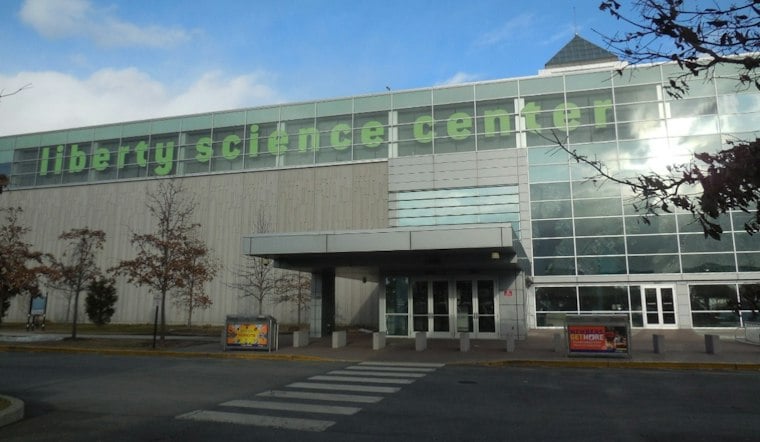
Liberty Science Center broke ground this week on a $40 million expansion that will bring an upside-down hot-air balloon, a shared playground for children and goats, and a memorial garden built around two steel beams from the World Trade Center to the Jersey City institution. The project, called Project Supernova, began construction on Thursday, one day before the 25th anniversary of the September 11 terror attacks.
The groundbreaking, held at the science center's home in Liberty State Park, drew Jersey City Mayor James Solomon, New Jersey Economic Development Authority CEO Evan Weiss, and Liberty Science Center President and CEO Paul Hoffman, according to NJ.com. The outlet reports the expansion is expected to take about 30 months to complete and will add more than 100,000 square feet of new outdoor space to the largest cultural institution in New Jersey, which already draws more than 800,000 visitors and reaches 280,000 students annually.
Funding for the bulk of the project comes through transferable tax credits from the state's Cultural Arts Facilities Expansion program, and Liberty Science Center is the first institution in New Jersey to receive that funding, per the same NJ.com report. That aligns with a broader state push: the New Jersey Economic Development Authority approved $39.8 million in CAFE tax credits for Project Supernova in November 2025, covering 100 percent of the project's eligible costs as part of a $104.8 million statewide cultural infrastructure initiative.
A Memorial Built From Ground Zero Steel
The 9/11 memorial garden will be built around two original World Trade Center beams donated by the Port Authority of New York and New Jersey, the science center's institutional history notes. Those same beams were previously displayed inside the museum's indoor Skyscraper! exhibition, according to Liberty Science Center. The museum played a direct role in the response to the attacks: it served as an emergency medical triage and logistics staging area for first responders in the immediate aftermath, and it helped investigators after the attacks, per the science center's own account.
Elsewhere on the expanded campus, an upside-down hot-air balloon will rest with its basket at the top, an installation created by Argentine artist Leandro Erlich and modeled after the 1783 Montgolfier balloon. The 90-foot structure was strategically engineered to be visible to commuters on the New Jersey Turnpike and to passengers on flights arriving into Newark Liberty International Airport, Liberty Science Center says. The balloon builds on the museum's Big Art program, which formally launched in April 2023 and previously debuted Erlich's optical-illusion piece The Building, a full-scale model of a New York City storefront facade, as reported by 6sqft.
Goats, Otters and a Physics-Based Mini-Golf Course
Perhaps the most unusual addition is a shared playground where children and goats will have parallel play areas, complete with a barn where trained staff will oversee supervised interactions between kids and animals, according to NJ.com's reporting. The expansion will also add a river otter habitat tied to the animals' return to a cleaner Hudson River, and a physics-based mini-golf course that demonstrates a scientific principle at each hole.
The master plan also folds in a rooftop pollinator garden. Identified in some accounts as the Weston Family Pollinator Garden, the green roof is planted with native flora meant to support urban wildlife and to supply a live food source for the museum's resident leaf-cutter ant colony, according to Secret NYC. Liberty Science Center also plans to replace its Our Hudson Home exhibit with the climate-focused River Rising exhibition, building on a component that already opened: the $1.5 million Izzo Family Touch Tank debuted in January 2026 as the first piece of the planned 6,600-square-foot River Rising gallery, using native Hudson River species like horseshoe crabs and sea snails to illustrate climate change impacts.
Planetarium Upgrades and a Bigger Traveling Gallery
The science center also plans to upgrade its Jennifer Chalsty Planetarium and its Wild About Animals habitat, and it intends to move its traveling gallery, which will host blockbuster shows, to a larger first-floor space, per NJ.com. The planetarium first opened in its current form in December 2017 after a $5 million gift converted the museum's former IMAX dome, creating what was then the largest planetarium in the Western Hemisphere with an 89-foot dome screen and an 8K projection system, according to Astronomy Magazine.
Overall, Project Supernova is designed to improve accessibility and sensory inclusion, boost attendance, and showcase cutting-edge science, NJ.com reports. Governor Mikie Sherrill said the expansion is proof that New Jersey's scientific history is still being written, according to the outlet's coverage of the groundbreaking.
A Bigger Campus, With Some Municipal Friction
Project Supernova is one piece of a much larger $450 million master plan for SciTech Scity, a 30-acre innovation campus next to the science center that is also slated to include the 120,000-square-foot Edge Works business incubator and the Scholars Village residential development, according to the New Jersey Economic Development Authority. Not every piece of that vision is moving forward smoothly, however.
In June 2026, Jersey City Mayor Solomon expressed doubts about proceeding with the long-planned $73 million Liberty Science High School at SciTech Scity, citing a $250 million municipal deficit and questioning whether the city could cover roughly $2 million in annual operating costs for the school, according to Jersey Digs. That fiscal uncertainty stands apart from Project Supernova itself, which NJ.com reports is funded largely through the state tax credits and is proceeding on its 30-month construction timeline.




