

























































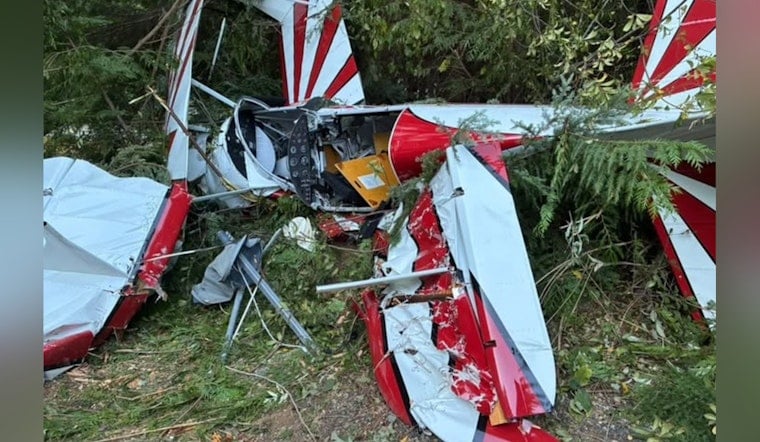
A high-performance aerobatic biplane slammed into a backyard on the 11000 block of 127th Avenue Northeast in Lake Stevens around 6:05 p.m. Sunday, narrowly missing a family, their house, and a propane tank without causing any ground injuries or structural damage. The pilot, the aircraft's sole occupant, was pulled from the wreckage with serious injuries and rushed to a regional trauma center.
Emergency crews with Snohomish County Fire District 22 responded to the crash, according to KIRO 7 News Seattle. Before responders even reached the scene, neighbors had already administered first aid to the trapped pilot, and a Getchell Fire chief officer who happened to be nearby on an unrelated medical call diverted to reach the crash quickly, as reported by Everett Post. Mutual aid also arrived from Snohomish Regional Fire & Rescue, Granite Falls Fire, Marysville Fire District, and Fire District 19.
Pilot Extracted, Stabilized and Hospitalized
The pilot was extracted from the wreckage by emergency crews, stabilized at the scene, and transported to a regional trauma center for treatment, according to KING 5. Authorities confirmed there was no ongoing public safety hazard following the rescue. The station's report notes that the aircraft has been identified as a Pitts Model 12, a two-seat aerobatic biplane with a fabric-covered steel frame typically powered by a 360-to-400-horsepower Russian Vedeneyev radial engine, per the Lynnwood Times.
Pitts Model 12 biplanes are frequently homebuilt from plans or kits rather than manufactured on commercial production lines. The pilot's identity, the flight's origin and destination, and whether the plane was taking off or landing at the time of the crash all remain unknown.
Federal and Local Investigators Open Parallel Probes
The National Transportation Safety Board and the Snohomish County Sheriff's Office have opened parallel investigations into the crash, per the same account. Federal investigators are examining the pilot, the airframe, and the environment, while local police assess any potential criminal elements separately from the NTSB's focus on safety and cause. The NTSB is requesting witness accounts and video be sent to [email protected].
A Residential Runway Built Into the Neighborhood
The crash site sits within Frontier Airpark, a private residential fly-in community established in 1985 along 127th Avenue Northeast in northern Lake Stevens. The airpark, identified by the FAA as WN53, features a 3,800-foot asphalt runway and wide streets connecting more than 100 homes equipped with private aircraft hangars directly to the taxiways, according to AirNav. That layout explains why aircraft operate in such close proximity to homes, families, and backyard utility infrastructure like propane tanks.
This is not the first serious aviation incident tied to the airpark. In September 2014, an experimental Kitfox III crashed during takeoff at Frontier Airpark, killing an 80-year-old student pilot and critically injuring a 66-year-old instructor, with preliminary NTSB findings pointing to an engine power loss during climb, according to HeraldNet. In August 2019, a 64-year-old pilot who lived at Frontier Airpark died when his kit-built Murphy Moose lost control shortly after takeoff in Marysville, with witnesses reporting engine misfires before the aircraft went down.
Part of a Broader Pattern in Snohomish County
The Lake Stevens crash follows other recent general aviation incidents in the county, including a March 2026 crash in which a twin-engine plane veered off the runway at Harvey Field in Snohomish and slammed into a hangar, a story previously covered by Hoodline. Harvey Field is a public-use airport located about 12 nautical miles south of Frontier Airpark. Federal Aviation Administration and NTSB guidance notes that experimental and kit-built aircraft face higher statistical accident rates than factory-built commercial planes, and incidents involving serious injury or substantial airframe damage require immediate federal reporting.
Homebuilt aircraft kits typically require roughly 400 to 2,000 hours of construction before they are ready to fly. As the NTSB and Snohomish County Sheriff's Office continue their separate investigations, key questions remain unanswered, including the pilot's identity, the flight's planned route, and whether the aircraft was arriving or departing when it went down.



