

























































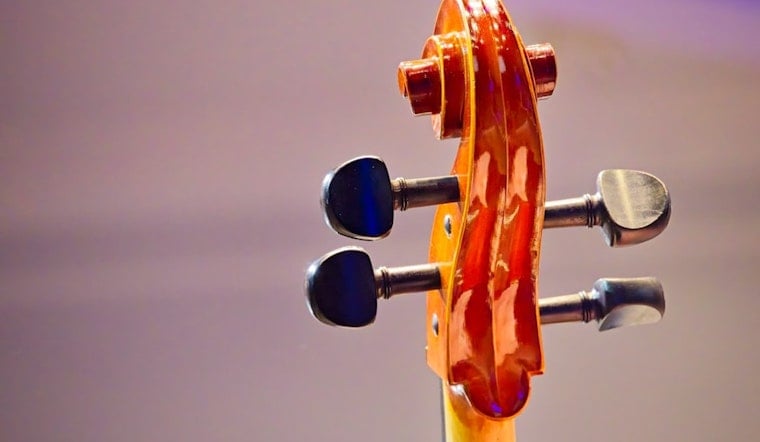
Before Army veteran Leon Allan Loyd went into surgery for the amputation of his legs, his doctor picked up a cello and played Bach. The performance, given by Dr. Paul Kalmansson at Jerry L. Pettis Memorial Veterans' Hospital in Loma Linda, left Loyd with what he described as confidence and faith that he could continue participating in life after losing his legs.
Loyd, a U.S. Army veteran, has a rare disease that required amputation of both legs, and he underwent his first leg amputation a few years ago before his most recent surgery this past August, according to ABC7 Los Angeles. Kalmansson, who works at Loma Linda University Health, offered to play music for Loyd the day before the latest operation, selecting a piece from Johann Sebastian Bach. He performed the Prelude to Bach's G Major suite, a piece he said is specifically about hope, and one he believes inspires that feeling in listeners.
The doctor is no stranger to the instrument or to using it at a patient's bedside. Kalmansson has played the cello for 20 years and studied medicine for a decade, and rather than give up music when he pursued his medical career, he found a way to combine both passions in patient care, earning a master's degree in music before attending medical school, per the same ABC7 account.
A Practice Kalmansson Has Repeated for Dozens of Patients
Playing music before an operation isn't a one-off gesture for Kalmansson, and he has said it isn't even his own original idea. He has performed cello for dozens of surgical patients to help relieve their anxiety and foster a human connection, meaning Loyd was one of many patients he has supported this way. Kalmansson has said that music lets him communicate care for patients in ways words sometimes cannot.
The cello performance transformed the atmosphere before Loyd's surgery, and the veteran described the scene as filled with love and gratitude. Loyd said the performance gave him more strength and hope while he was undergoing the operation. His wife, Sheri Loyd, said her husband called her from the hospital after the performance to express his gratitude.
Video Draws an Emotional Response Online
Loyd's granddaughter posted a video of the cello performance on social media, and the clip received an overwhelming response online. Sheri Loyd said people reacting to the video were crying and amazed by what they saw.
The moment happened inside a hospital with deep roots in the region. Jerry L. Pettis Memorial Veterans' Hospital opened in 1977 and serves as the main medical center for the VA Loma Linda Healthcare System, which delivers health services to more than 78,000 veterans across San Bernardino and Riverside counties, according to VA Loma Linda Health Care. The hospital is named for U.S. Representative Jerry L. Pettis, who represented San Bernardino County in Congress until his death in a 1975 plane crash.
Music as Part of Loma Linda's Whole-Person Care Model
Kalmansson's bedside performances fit within a broader institutional philosophy at Loma Linda University Health, which grounds its clinical model in a formal “whole person care” approach that explicitly directs providers to address emotional and spiritual needs alongside physical treatment, per Loma Linda University Health. That framework helps explain why a clinician would reach for a cello rather than words alone before a life-altering procedure.
The science backs up what Kalmansson has observed with his patients. A 2021 systematic review and meta-analysis published in Open Heart found that music interventions given to adult surgical patients significantly reduce preoperative anxiety and postoperative pain. A 2018 meta-analysis available through NIH's PubMed Central found statistically significant decreases in both anxiety and pain among adults receiving music interventions before, during or after surgery. A more recent randomized controlled trial published in 2026 in Genetics and Molecular Research went further, demonstrating that 20 to 30 minutes of preoperative instrumental music therapy significantly lowers surgical anxiety scores and decreases the amount of anesthetic drugs needed during a procedure.
Even Bach's specific composition carries characteristics that align with its intended effect. The Strad, which analyzes classical repertoire for musicians, has noted that the Prelude from Cello Suite No. 1 in G Major features a continuous arpeggiated, cascading structure that cellists describe as evoking feelings of calm, fluidity, and hope.
A Widespread Struggle Among Veterans
Loyd's amputations reflect a health challenge that extends well beyond his own case. Research published in PLOS ONE in 2022 and again in PMC in 2024 shows that rates of non-traumatic lower extremity amputations among Veterans Health Administration patients remain substantially higher than in the general U.S. population, a disparity largely driven by high rates of diabetes and vascular disease. According to research published on the U.S. Department of Veterans Affairs' rehabilitation research site, the majority of veterans who undergo amputation do so because of vascular diseases such as diabetes or peripheral vascular disease. A study available through the U.S. Department of Veterans Affairs' rehabilitation research site reported that diabetes was present in 72.1% of cases and peripheral vascular disease in 64.2% of cases at the time of amputation. Under Department of Veterans Affairs disability compensation standards, veterans undergoing double lower extremity amputations or suffering complete loss of limb use can receive disability ratings up to 100%, a recognition of just how profoundly the condition reshapes mobility and daily life.
For Loyd, though, the moment before his most recent surgery was less about statistics and more about the strength that came from a familiar melody and a doctor willing to set aside his stethoscope for a bow. As his family and strangers online watched the video and reacted with tears, the performance stood as a small, human counterpoint to a much larger struggle facing thousands of veterans across the country.





