

























































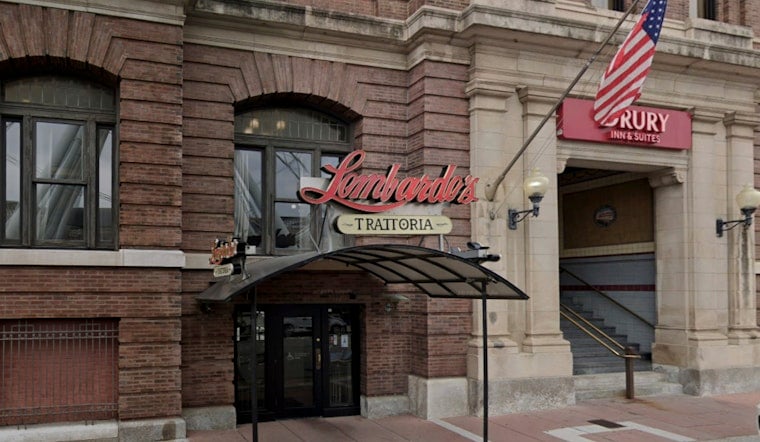
A general manager who spent 16 years working for Lombardo's Trattoria says the Italian restaurant chain fired him over a Facebook post he made the day conservative activist Charlie Kirk was killed. Michael Mormino filed a wrongful-termination lawsuit against Lombardo's on Monday, arguing his dismissal violated Missouri law protecting workers from being fired over their political beliefs.
Mormino had worked for Lombardo's since 2010 and most recently served as general manager of the location on Natural Bridge Road near St. Louis Lambert International Airport, according to the lawsuit as reported by St. Louis Magazine. Kirk was fatally shot while speaking at a Utah university in September 2025, an event that touched off waves of online commentary and, in some cases, workplace fallout across the country. Per the lawsuit, Mormino posted a Facebook message that day criticizing Kirk, though the post did not mention Lombardo's, its staff, or its customers, and it was not made on behalf of the restaurant or using its equipment.
Lombardo's owners nonetheless received a screenshot of the post, the suit alleges, and the restaurant suspended Mormino for two weeks before ultimately firing him. Mormino claims in the filing that he was terminated for his political beliefs in violation of Missouri law, and his lawsuit seeks damages including compensation for lost pay and benefits. The case has landed with St. Louis Circuit Judge Joan Moriarty, per the same account.
An At-Will State Meets a Narrow Legal Exception
Missouri is an at-will employment state, meaning employers generally can fire workers for almost any reason or no reason at all. But Mormino's attorney, Edwin Ernst, is arguing that a public-policy exception applies here — one he says Missouri courts have recognized since the 1960s to protect conduct that public policy would otherwise encourage, the outlet notes.
Ernst points to Missouri's Whistleblower Protection Act, passed by the state legislature in 2017 under Senate Bill 43, which formally codified some of those common-law exceptions into statute. Under the law, found at RSMo § 285.575, a protected employee is one who reports an employer's unlawful act or refuses to carry out an illegal directive — a narrower definition than simply posting a political opinion online. Ernst contends that codifying some at-will exemptions in 2017 does not erase protections that were never written into the statute in the first place, the report states.
Not everyone agrees with that reading. St. Louis attorney Kimberly Seten has pushed back on Ernst's interpretation of Missouri's at-will exemptions, according to the same report, suggesting the legal theory faces real skepticism even among employment lawyers in the city where the case will be heard. The 2017 reforms also raised the bar for plaintiffs, requiring them to show that protected conduct was the motivating factor — not merely a contributing factor — behind a firing, according to Constangy. The same statutory overhaul capped non-economic and punitive damages in these claims at between $50,000 and $500,000 depending on the size of the employer, per Lewis Rice.
A Second St. Louis Case Testing the Same Theory
Mormino's lawsuit isn't the only one built on this argument. Ernst is also representing social media creator Justin Kralemann in a separate wrongful-termination suit against the nonprofit Food Outreach, filed in March. Kralemann says he was fired after posting a video criticizing Enterprise Mobility's leasing of vehicles to Immigration and Customs Enforcement, and his complaint alleges the move came after board-level pressure from an Enterprise Mobility executive who sat on the nonprofit's board, as Hoodline previously reported.
Both Kralemann's and Mormino's cases have ended up before Judge Moriarty, who has yet to rule on Food Outreach's motion to dismiss the Kralemann suit. If that motion is denied, it could offer an early signal of how the same court might treat Ernst's public-policy argument in the Mormino case.
A Pattern Playing Out Nationally
Mormino's firing fits into a broader pattern of workplace disputes stemming from online reaction to Kirk's death. In California, El Dorado County agreed to pay a $75,000 settlement to seal a termination notice after a public health official was placed on leave over Instagram posts about the shooting, with total costs including paid leave reaching roughly $134,000, as Hoodline detailed in its report on the county's settlement. In Florida, a federal judge sanctioned a state wildlife agency supervisor in May for submitting false statements in a First Amendment lawsuit brought by a biologist fired over a Kirk-related social media repost, striking agency declarations that had alleged widespread operational disruption.
Lombardo's has a long history in St. Louis, tracing back to a restaurant that opened in North City in 1934, according to the lawsuit. The Lombardo family later opened the Natural Bridge Road location at the airport in 1993 and opened Carmine's Steakhouse downtown in 2000. Mormino's case will now test whether a legal theory built for reporting illegal conduct can be stretched to cover a personal Facebook post about a national news event — a question with no settled answer yet in Missouri courts.




