

























































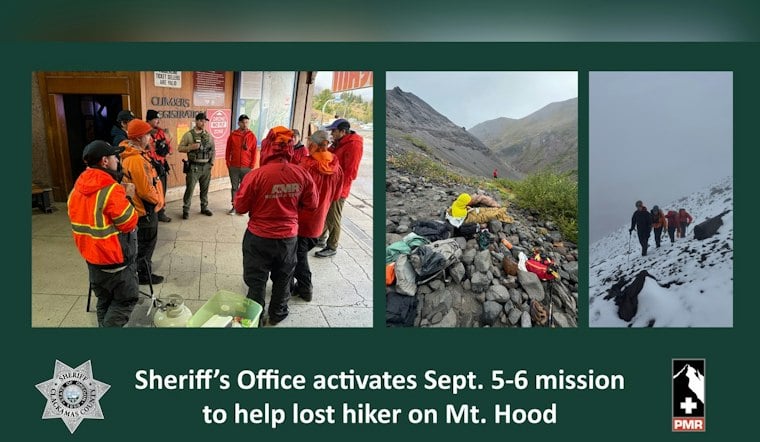
A hiker who climbed 4,000 feet up Mt. Hood's south side got trapped above a waterfall in a remote canyon as clouds rolled in, heavy rain fell, and visibility collapsed on his way back down. He spent hours stranded, uninjured but soaked and cold, before a multi-agency rescue team pulled him to safety nearly 14 hours after crews first mobilized.
A Climb Up, Then a Wrong Turn Down
According to a statement posted by Clackamas Sheriff, the Clackamas County Sheriff's Office received a report Saturday evening, Sept. 5, of a stranded hiker on the south side of Mt. Hood. The man had ascended earlier that day from Timberline Lodge up 4,000 feet to the upper mountain, then veered off course during his descent as incoming clouds, decreasing visibility, and heavy rain closed in, according to the same account. He became stranded at the top of a waterfall in the lower Big Zigzag Canyon, the sheriff's office said.
The hiker was uninjured but very wet and cold, and unable to navigate the complex terrain on his own, per the sheriff's office post. That kind of disorientation is not unusual on this stretch of mountain. U.S. Forest Service climbing guidelines note that descending along the natural fall line from Mount Hood's upper south routes tends to pull climbers west into Zigzag Canyon rather than south toward Timberline Lodge, a hazard known locally as part of the Mt. Hood Triangle.
Volunteers Mobilize Overnight
Sheriff's Office SAR coordinators activated a mission, deploying teams from Portland Mountain Rescue and Clackamas County Search and Rescue, the sheriff's office reported. Volunteers arrived at the Timberline Lodge command post at approximately 4 a.m. Sunday, Sept. 6, and rescuers were able to locate and reach the stranded hiker at approximately 9 a.m. that morning, according to the same post.
Timberline Lodge sits at 6,000 feet on Mount Hood's south slope, meaning the hiker's overnight ordeal played out roughly 4,000 feet above the historic 1937 lodge that served as the rescue's command post. Portland Mountain Rescue, the technical alpine team that reached the hiker, was formed in 1977 as an all-volunteer nonprofit specializing in high-altitude rescue above the timberline, and its volunteers undergo two years of specialized alpine training before deploying on high-angle missions.
Getting Him Out Took Hours More
Even after rescuers reached the hiker, getting him out proved slow going. Due to the steep and treacherous terrain, near-freezing temperatures, low visibility, heavy rain, high winds, and snowfall, extraction of the patient was delayed until more personnel and resources could deploy and arrive on scene, the sheriff's office said. The Timberline Trail corridor through Big Zigzag Canyon features cumulative elevation changes of more than 2,000 feet across steep, rocky drainages and waterfalls, terrain that creates severe fall risks and complicates rope-extraction efforts.
Once additional resources arrived, rescuers escorted the hiker up the canyon and eventually down to Timberline Lodge, arriving at around 6:30 p.m. Sunday, according to the sheriff's office. Exemplary and persistent teamwork among CCSO, PMR, CSAR, the Hood River Crag Rats, and Mountain Wave made the complex mission a successful rescue, the agency said. The Hood River Crag Rats, founded in 1926, are recognized as the oldest dedicated volunteer mountain search-and-rescue organization in North America, while Mountain Wave provides mobile command trucks, radio relays, and satellite tracking support for search-and-rescue agencies across Oregon and Washington.
A Warning About Fog and Fall Lines
Portland Mountain Rescue offered what the sheriff's office called a teachable moment from the mission. “The incident is a reminder of how easy it is to become disoriented descending on Mt. Hood, especially in inclement weather,” the group said, according to the sheriff's office post. “PMR urges backcountry travelers to carry a GPS, compass and paper map, and to consult them frequently when the terrain is unfamiliar.”
This is not an isolated pattern. The Oregon Department of Emergency Management reported in 2022 that alpine search-and-rescue missions in mountainous regions above 5,000 feet had increased 100% over the previous decade, with 99% of rescued individuals living outside the county where they were rescued. State officials have attributed the rise in mountain rescues to visitors exploring unfamiliar terrain without adequate preparation.
Who Pays, and Who Answers the Call
Under Oregon Revised Statute 404.110, the sheriff of each Oregon county holds primary legal responsibility for all search-and-rescue activities within their county's jurisdiction, which is the statutory authority under which CCSO led this multi-agency operation. Separately, ORS 404.270 permits public bodies to seek up to $500 per person in search-and-rescue cost reimbursement, but only if the individual failed to exercise reasonable care or violated applicable laws. Volunteer organizations like Portland Mountain Rescue do not bill victims, a policy meant to keep distressed travelers from delaying calls for emergency help.
The Clackamas County Sheriff's Office restructured its search-and-rescue framework in 2020 to establish a single, sheriff-operated Clackamas County Search and Rescue volunteer division, bringing ground search volunteers directly under the sheriff's office command. It is a structure that has now been tested repeatedly on Mt. Hood, including in a Gresham mountain biker search last year that drew on the same roster of CCSO, CSAR, PMR, Mountain Wave, and the Hood River Crag Rats.





