

























































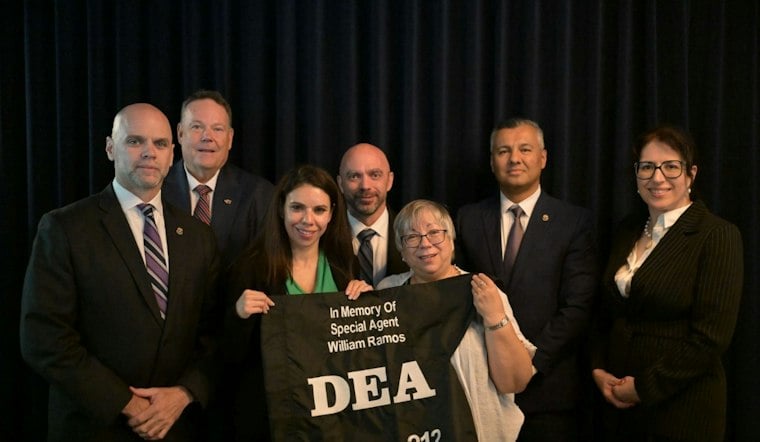
Felipe Molina-Uribe, the man convicted in connection with Ramos's 1986 killing, has been denied parole. DEA leadership attended the hearing to stand with Ramos's family and argue against his release, a moment the agency's Houston Division says was about honoring a fallen officer's legacy as much as it was about the parole decision itself.
According to a post from DEAHouston
, Houston Division Counsel joined Principal Deputy Administrator Dan Salter, along with Miguel Madrigal and Brian Leardo, in supporting the Ramos family at the hearing. DEA leadership reportedly held Special Agent Ramos's guidon flag during the proceedings, a gesture the division described as part of honoring his memory. Salter, who spoke directly before the parole board to advocate that Molina-Uribe remain incarcerated, was designated to serve as the DEA's Principal Deputy Administrator in August 2025, according to
DEAFNA
Salter, who spoke directly before the parole board to advocate that Molina-Uribe remain incarcerated, was designated to serve as the DEA's Principal Deputy Administrator in August 2025, according to
A Deal Gone Deadly in Las Milpas
Ramos, a 30-year-old DEA Special Agent, was fatally shot in the chest on December 31, 1986, during an undercover marijuana buy-arrest operation in the parking lot of Junior's Supermarket in Las Milpas, Texas, near McAllen, according to Justia Law. He was in the middle of a 300-pound marijuana buy when a struggle broke out inside his undercover vehicle during the arrest phase, per the same case record. Las Milpas was the location of the operation.
Before joining the DEA in 1985, Ramos worked as a U.S. Border Patrol agent and a prosecutor in Arizona, according to a report from the Office of Justice Programs. He had served in law enforcement by the time of his death. Immediately after the shooting, Molina-Uribe was placed under armed guard at a local hospital for a leg wound suffered during the arrest struggle, before being formally charged with killing a federal agent, according to reporting cited from a 1987 Washington Post account referenced by the DEA Museum. Backup agents had moved in after observing the signal to make the arrest.
Honors and a Life Sentence
In 1988, the International Narcotics Enforcement Officers Association posthumously awarded Ramos the Medal of Valor, honoring an agent who left behind his wife, Thelma, and two daughters, per the DEA Museum. A memorial transcript honors him as DEA McAllen Special Agent.
Molina-Uribe was convicted in April 1987 of first-degree murder of a federal officer and sentenced to life imprisonment, along with 25-year sentences for the drug counts that ran consecutively and a consecutive five-year sentence for the firearm count; the life sentence ran concurrently with the drug sentences, Justia Law reports. He had pled guilty to the drug charges before being tried and convicted on the murder count.
Decades of Appeals Kept the Case Alive
The case did not end with the original verdict. A federal district court vacated Molina-Uribe's murder conviction in 2003, citing ineffective assistance of trial counsel, but the Fifth Circuit Court of Appeals reversed that decision in August 2005, fully reinstating his conviction and life sentence, according to FindLaw. The appeals court ruled that his trial counsel's performance had met constitutional standards.
Because the murder happened on December 31, 1986 — about ten months before the Sentencing Reform Act of 1984 took effect on November 1, 1987 — Molina-Uribe's case predates that change, FindLaw explains. The Sentencing Reform Act of 1984 took effect on November 1, 1987.
Why the Parole Board Still Hears This Case
Molina-Uribe came before a parole board nearly 40 years after Ramos's death, and DEA leadership appeared at the proceeding to oppose his release.
Parole was denied. For the Ramos family and the DEA colleagues who stood beside them, the outcome kept intact a sentence that has now outlasted multiple appeals and a reversed and reinstated conviction.



