

























































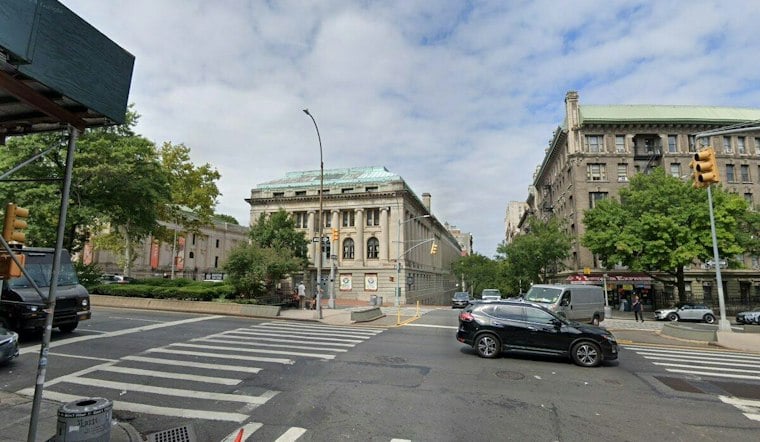
The American Academy of Arts and Letters is putting its Upper Manhattan home to new use. The more than century-old honor society, whose members are elected for life, presents exhibitions and interdisciplinary programs alongside its role as a membership organization.
Founded in 1898 as the National Institute of Arts and Letters, the Academy has 300 membership slots, with members elected for life and new members joining when a place becomes vacant, according to Cultured. Archer M. Huntington established an endowment to support the Academy’s operations.
The Academy’s place on Audubon Terrace
The Academy’s history places its programming in a longer cultural story on Audubon Terrace. According to the American Academy of Arts and Letters, its original Beaux Arts building, designed by member William Mitchell Kendall, was completed in 1923; a second building, designed by member Cass Gilbert, followed in 1930. The Academy’s history also notes that Archer M. Huntington began construction of the Hispanic Society Library and Museum there in 1904, the first of six cultural institutions he brought to the complex over the next 20 years.
The Academy’s Program Takes Shape
Cultured reports that an advisory committee of artists and Academy figures Ann Hamilton, Charles Gaines, Mel Chin, Joan Jonas, and Amy Sillman was convened.
The Academy’s program includes exhibitions.
The format follows projects that have used the building in ways beyond a conventional gallery show. In 2024, Raven Chacon received an early Academy commission and filled the north gallery with birdsong. The building includes a library and members’ room.
The Academy’s Program
Ann Hamilton was among the artists and Academy figures on the advisory committee.
The programming shift is a broader institutional experiment: an organization with lifetime appointments and a fixed 300-seat membership is making room for exhibitions and interdisciplinary programs.



