

























































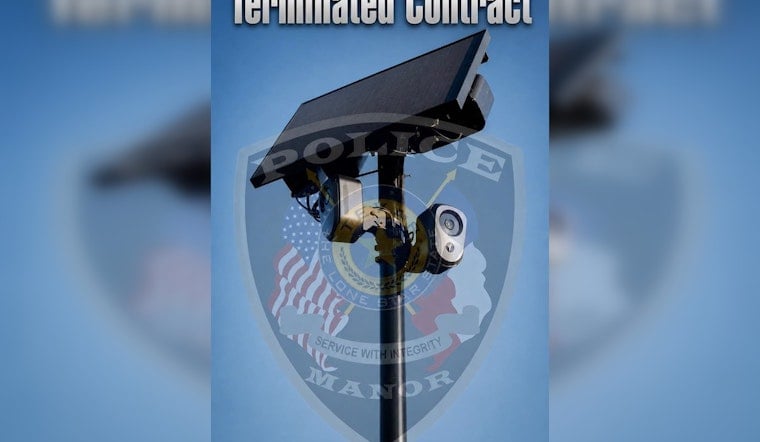
The Manor Police Department has stopped using its Flock Safety license plate cameras, even though the technology helped officers track down three teenagers accused of a two-day shooting spree across Austin earlier this year. Police Chief Ryan Phipps confirmed the decision to the Austin American-Statesman, ending the small Eastern Travis County department's relationship with a surveillance system it credits with helping solve one of the year's most alarming local crime sprees.
The case that put Manor's cameras to the test began in May, when three teenagers, ages 15, 16 and 17, were accused of firing on a dozen homes, vehicles and two Austin fire stations across a dozen locations, according to the Austin American-Statesman. The spree critically injured one person and injured four people total. Manor police received a request to look out for a car linked to the shootings, and their Flock cameras flagged that the suspect vehicle had recently entered the city heading north on FM 973. Austin Mayor Kirk Watson said the license plate readers probably would have helped locate the teenagers faster, and the pursuit that followed, detailed by KXAN, ran along Highway 290 and FM 973 before the suspects crashed in Old Town Manor and fled on foot.
A Statewide Reckoning Catches Up With a Small Department
Despite that success, Manor's roughly 10 Flock cameras — two of which are already nonoperational after vandals destroyed two units — are now offline. The department, located about 15 miles east of Austin, still sees benefits from license plate readers for solving crime, but it is halting its use of the cameras amid a wave of Texas municipalities pulling back from Flock contracts. Manor joins Elgin, Bastrop, San Marcos, Pflugerville and Lago Vista, all of which have voted to terminate or move to stop using their Flock agreements, per the Statesman's reporting.
The retreat follows a broader collapse in public trust in the surveillance vendor. Gov. Greg Abbott ordered state agencies to stop spending money on Flock cameras after an investigation by The Texas Tribune found the Motor Vehicle Crime Prevention Authority had steered at least $30 million into a statewide camera network. That money reportedly came from an estimated $81 million collected through a $1 auto insurance fee the Legislature enacted in 2023 to fight catalytic converter theft — lawmakers who backed that fee say there was no discussion at the time about license plate surveillance.
Misconduct Case Adds Fuel to the Backlash
Abbott's office has explicitly pointed to a misconduct case out of Lufkin as a driver of the statewide pushback. An East Texas police officer was indicted in August on 100 counts after an internal audit found he used his department's Flock system to search his ex-girlfriend's license plate more than 10,000 times, according to reporting cited by the Washington Post. He faces felony charges including tampering with records, abuse of official capacity and misuse of official information.
Nearby, Pflugerville's City Council voted unanimously to shut off its 28 cameras after audit logs revealed 459 outside agencies had conducted more than 1.6 million searches through the city's network, with out-of-state entities querying local cameras at a rate of 315 to 1 compared with local police, as Hoodline previously reported. In Wylie, the city council voted 7-0 to drop its Flock contract after a resident petition drew more than 700 signatures protesting third-party data sharing without local police oversight, acting ahead of a September 13 deadline that would have automatically renewed the deal for another 24 months.
Austin's Earlier Exit Set the Template
Austin ended its own agreement with Flock in June 2025, after a city audit found that 18% of searches conducted on its network failed to meet departmental documentation requirements. The Austin Police Department previously operated nearly 500 license plate reader cameras citywide before the contract lapsed, and the Austin City Council later approved a framework requiring public disclosures about any proposed future use of license plate reader equipment. Austin police have not made proposals to the city for using such equipment since, though the department is evaluating companies that make and sell the technology.
Not every Texas city is walking away. Dallas police credit their camera network with helping solve 27 homicides across 2025 and 2026, even as the Dallas City Council debates canceling its $1.5 million Flock contract following reports that 26 cameras had been vandalized since March and that nearly 1,900 city employees held access to the system. And the pushback isn't confined to Texas: the Florida Department of Transportation ordered all automated license plate readers removed from state highway rights-of-way within 30 days, according to the Electronic Frontier Foundation, revoking existing permits and barring new ones.
At the federal level, U.S. Rep. Keith Self of Texas introduced the PRIVACY Act in July, which would require federal law enforcement agencies to obtain a judicial warrant before accessing state or local license plate reader databases. For Manor, the calculation now mirrors that of its neighbors: a tool that once helped catch teenage shooting suspects has become too politically and legally fraught to keep running, even for a department that says it still sees value in the technology.





