

























































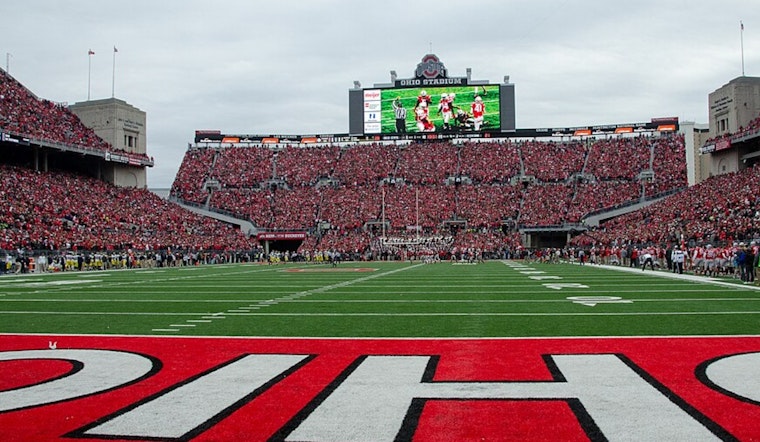
Maurice Clarett, the freshman running back who helped deliver Ohio State's 2002 national championship before his life spiraled into a felony conviction and a prison sentence, has been named the football program's first pregame Victory Bell ringer of the 2026 season. The announcement marks a striking turn for a player once at the center of one of college football's most memorable seasons and, later, one of its most painful cautionary tales.
According to Cleveland.com, Clarett will ring the bell as Ohio State honors its 2002 national championship team, with former head coach Jim Tressel expected to watch. Clarett rushed for 1,237 yards and finished with 18 total touchdowns that season, including 16 rushing scores, as a true freshman on a Buckeyes team that beat Miami in double overtime to win the BCS national title, per the same report. In that Fiesta Bowl, Clarett scored two touchdowns and famously stripped the ball from Sean Taylor after Taylor had intercepted a pass, a play still remembered as one of the game's turning points.
A Pregame Tradition Still Finding Its Footing
The bell Clarett will ring next season is not a small prop. The 2,420-pound Victory Bell sits 150 feet up in the southeast tower of Ohio Stadium, a gift from the graduating classes of 1943, 1944 and 1945, and members of the Alpha Phi Omega service fraternity have rung it for 15 minutes after home wins since a victory over California on October 2, 1954, according to Ohio State Buckeyes athletics history. For most of the bell's existence, it was reserved exclusively for celebrating victories.
That changed last year. Ohio State introduced a new pregame bell-ringer ritual in August 2025 as part of its Tradition Evolved game-day initiative, tapping two-time Heisman winner Archie Griffin as the inaugural ringer for last season's opener. Clarett's selection for 2026 continues that still-young pregame custom, but with a far more complicated personal backstory than Griffin's.
Suspension, Draft Fight and Prison
Clarett never played for Ohio State again after his freshman year. He was suspended for the entire 2003 season for violating NCAA rules, amid allegations that he had accepted improper benefits and had lied to NCAA investigators, per Cleveland.com. He then sued the NFL over its draft eligibility rule requiring players to be three years removed from high school, a case that reached the U.S. Second Circuit Court of Appeals. In May 2004, the appeals court overturned a lower court ruling and held that the NFL's eligibility rule was shielded from antitrust challenge under federal labor law, according to Justia Law.
The Denver Broncos still selected Clarett in the third round, 101st overall, of the 2005 NFL Draft, but the team released him in August 2005 during training camp before he ever appeared in a regular-season or preseason game, according to Pro-Football-Reference.com's draft records. His fall accelerated from there. Clarett spent more than three years in prison after a 2006 arrest, per Cleveland.com, after pleading guilty in Franklin County Common Pleas Court to aggravated robbery and carrying a concealed weapon stemming from a January 2006 robbery and an August 2006 police chase in which officers recovered four loaded weapons from his vehicle, according to Fox News. He received a seven-and-a-half-year sentence with eligibility for early release after three-and-a-half years.
Release, Return to Campus and a New Mission
Franklin County Common Pleas Court granted Clarett early release from Toledo Correctional Institution in April 2010 after he served three-and-a-half years, ordering up to six months in a Columbus halfway house followed by five years of probation, according to 10TV; prosecutors did not oppose the request, citing his positive behavioral record while incarcerated. That July, Ohio State officially readmitted Clarett into its College of Education and Human Ecology so he could pursue his undergraduate degree using credits he had earned while imprisoned, per CBS News. He told the network at the time that he wanted to return to campus quietly, without creating a distraction for the university community.
In 2016, Clarett founded The Red Zone, a Youngstown-based organization that provides addiction recovery support, social work services and school- and community-based mental health services. He has since become a mental health advocate and joined Ryan Day's staff as a mentor during the 2024-25 season, the same year Ohio State made its run to a national title. Day said Clarett is an important part of Ohio State football history and that his impact around the program has been meaningful in recent years, adding that current players have benefited from his honesty, leadership and care, according to Cleveland.com.
Tressel, who coached Ohio State during its 2002 championship season, said Clarett's journey exemplifies resilience, growth and serving others, and that Clarett played a defining role in one of the program's most memorable seasons. Clarett has also expanded his civic footprint in Northeast Ohio, joining the Board of Directors of the Youngstown/Warren Regional Chamber of Commerce in February 2022, and he has written about his path from national high school player of the year to inmate to behavioral health founder in the books Redemption and One and Done, according to the ARCHway Institute, where he serves on the board supporting addiction recovery efforts nationwide.
A Symbolic Return to Where It Fell Apart
Perhaps no moment captures the arc of Clarett's reconciliation with Ohio State better than last year's STAR Award ceremony. When Ohio State's Department of Psychiatry and Behavioral Health honored Clarett with the 2025 STAR Award, the ceremony took place inside the Schottenstein Arena, the same venue where the university had announced his football suspension 22 years earlier in September 2003, according to Ohio State Health & Discovery. Clarett has publicly described that 2003 suspension press conference as the onset of his personal depression.
Now he returns to Ohio Stadium not as a player chasing a comeback on the field, but as a symbol the university has chosen to spotlight before the 2026 season even kicks off. Ohio State says Clarett has helped current players by sharing his perspective, experiences and lessons, and his turn ringing the Victory Bell adds a new chapter to a tradition that, until last year, had never opened its ceremony to anyone before a game had been won.





.jpg)