

























































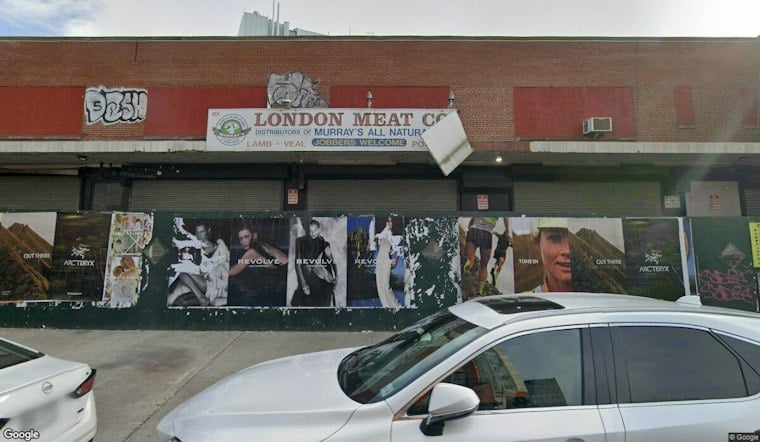
A parking lot at the former Weichsel Beef facility on Washington Street is about to become a stage for picaresque tales of hunger and hustling. High Line Art has announced that artist Georgia Gardner Gray will present Cookie, a new performance following starving grifters and anti-heroes seeking survival in a changing city, staged in the former Weichsel Beef parking lot at 826 Washington Street beneath the elevated park.
The free performance runs three nights, September 30 and October 1 and 2, at 7:30 p.m., according to City Life Org. Cookie is built around a piece called the Lair, a twisted aluminum sculpture resembling a street scaffold, and centers on Gunnar Churchwell, described as a sleazy but charismatic suit salesman who is recruited by an egomaniacal ringleader of a grifting crew of makeshift tailors and travels to Madrid, where the crew lives by one rule: never let them know you are hungry.
The performance draws directly on the picaresque, a literary format developed during Spain's Golden Age that features a clever but poor hero who uses wit and tricks to survive a corrupt society. Cookie pulls from two touchstones of that tradition: the anonymous novella Lazarillo de Tormes and Francisco de Quevedo's novella La vida del buscón, known in English as The Swindler. Per Cambridge University Press, both books center on low-born rogues who use trickery to survive social corruption.
A Curator's Eye for the Site's Own History
Associate Curator Taylor Zakarin, who selected the site for High Line Art, said Cookie uses Manhattan's last meatpacking facility beneath the High Line as a backdrop for a tale of hunger, desperation, and survival. Zakarin added that Gray's work brings an absurd dimension to characters navigating a rapidly changing urban environment, according to the same City Life Org report.
The lot itself carries a history tied to the neighborhood's meat industry. Weichsel Beef's former parking lot is at 826 Washington Street, per The Real Deal. The National Labor Relations Board lists a case involving Weichsel Beef Company and United Food and Commercial Workers Union Local 342.
A Shrinking Meatpacking Industry
The site sits inside what was once the Gansevoort Market Meat Center, created by New York City in 1949 and 1950 to house wholesale meat purveyors between Washington and West Streets. The industry has shrunk, with a few meatpacking companies remaining, according to the Whitney Museum of American Art. It is a decline that mirrors the picaresque genre's own preoccupation with characters scraping by inside a corrupt, shifting economic order.
Gray, born in 1988 in New York, earned her B.F.A. from The Cooper Union for the Advancement of Science and Art in 2011, according to Regen Projects. She now works across painting, performance, and theater, and lives and works between Palma, Spain, and New York. She received the 2018 Lingen Art Prize and has had solo exhibitions at Kunsthalle Lingen in Germany, UKS/Kunstnernes Hus in Oslo, the Longlati Foundation in Shanghai, and, in 2026, Museum der Moderne Salzburg in Austria.
A Recent Exhibition in Los Angeles
In March 2025, she presented her solo exhibition CHRYSALIS at Regen Projects in Los Angeles.
Cookie is free and open to the public, with advance registration encouraged. Free registration will be available on thehighline.org in the coming weeks. Should inclement weather strike, the performance will move to a rain date, with notice added to thehighline.org by noon on the original event day.
A Commissioning Program With Deep Public Support
High Line Art, founded in 2009, commissions and produces site-specific commissions, exhibitions, performances, video programs, and billboard interventions along the park, and is led by Cecilia Alemani. The program's lead support comes from Amanda and Don Mullen, with major support from the Brown Foundation, Inc. of Houston, Charina Endowment Fund, Shelley Fox Aarons, Philip E. Aarons, and Bloomberg Philanthropies.
The High Line itself is a public park on Manhattan's West Side owned by the City of New York and operated by Friends of the High Line, a nonprofit. It runs under a license agreement with NYC Parks, and per the Case Consortium at Columbia University, the organization raises nearly 100 percent of its annual operating budget through private donations. The elevated park is enjoyed by millions, making it one of the most visited stretches of public art in the city.





