

























































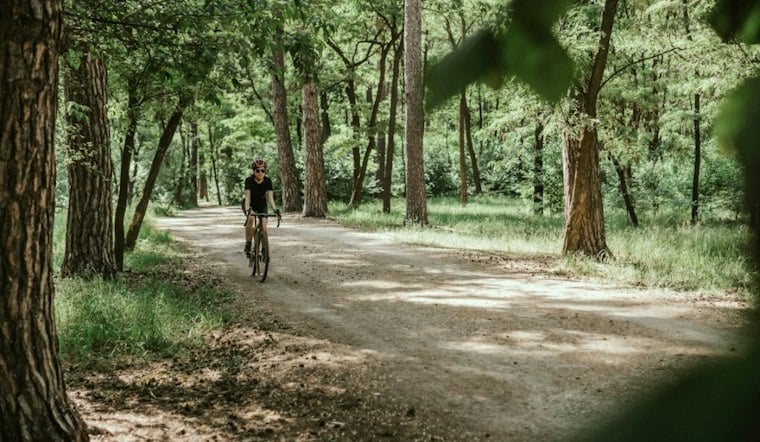
Every walker, jogger, cyclist and e-bike rider on Mecklenburg County's greenways now has to keep it under 20 mph, a new countywide cap officials hope will slow a wave of collisions and near-misses tied to the rapid spread of motorized bikes on shared paths. Park and Recreation crews have already stenciled the 20 mph warning at 136 spots along the Little Sugar Creek Greenway, including one marking at the Belmont Avenue crossing by Alexander Street Park.
The new limit applies to every vehicle using the trails, not just e-bikes, according to k104.7. The push comes as e-bikes and other motorized devices have multiplied on greenways in recent years, per the Charlotte Ledger, sparking growing worries about crashes on paths originally built for walkers moving at a leisurely 3 to 4 mph and cyclists who can move much faster when the way is clear. Mecklenburg County Park and Recreation, which manages upkeep and rules across the greenway network, oversees a system where Little Sugar Creek Greenway threads through several linked trails spanning the region.
Crash Numbers Behind the New Rule
The speed cap didn't come out of nowhere. A September briefing from the Charlotte-Mecklenburg Police Department to the city's public safety committee reported a year-over-year jump of more than 70% in e-bike accidents across the area, a trend detailed in a report on the council's draft e-bike rules. That kind of spike helps explain why county officials are hoping the restriction cuts down on collisions and near-misses involving speedy riders on paths that are often shared by families, dog walkers and commuters alike.
The 20 mph threshold isn't arbitrary — it mirrors the state's own definition of a basic e-bike. Under North Carolina General Statute § 20-4.01(7a), an electric-assisted bicycle is defined as a two- or three-wheeled vehicle with working pedals, a motor capped at 750 watts, and a top motorized speed of 20 mph on level ground, according to eBike Travelers. Municipalities nationwide have installed similar speed caps on trail systems, with some setting the bar lower at 15 mph and others allowing up to 25 mph on wider or less crowded paths.
A Patchwork of Rules Across the Region
Mecklenburg's new cap lands in the middle of a genuinely scattered regional approach to micro-mobility. In neighboring Union County, the Town of Waxhaw went stricter, enacting a 15 mph limit on its own municipal greenways while banning e-bikes and motorized scooters from town sidewalks entirely, per the Town of Waxhaw. Huntersville took a different tack for its streets, adopting a 28 mph cap for e-bikes, a helmet requirement for riders under 18, and a $50 fine for violations, with police there emphasizing public education before ramping up active enforcement, as reported by WSOC-TV.
Charlotte's own city ordinance, § 14-286, already bars e-bikes from Uptown sidewalks, pushing riders onto street lanes or designated multi-use paths — a rule that likely funnels more motorized traffic onto regional greenway corridors in the first place. Hoodline has previously reported on the fragmented landscape taking shape across the county, including Huntersville's helmet and fine rule, alongside separate frameworks like Davidson's Ordinance 70-47 and new device regulations passed in Matthews.
Beyond Behavior Rules, Enforcement Remains Murky
Alongside the speed cap, county Park and Recreation officials released additional safety guidance urging greenway users to take extra care on curves and in busy areas, avoid standing still on the paths, wear only one earphone at a time, and keep pets on short leashes, according to WSOC-TV. Those instructions read more like a public education push than a ticketing regime, and that distinction matters: authorities have not made clear how they intend to actually enforce the new 20 mph restriction on the trails.
The scale of what's covered by the new rule is significant. As of 2025, Mecklenburg County maintained roughly 74 miles of developed greenway trails with another 20 miles under active construction, according to 6AM City, and greenways rank as the single most requested recreational facility among county residents. The Little Sugar Creek Greenway alone forms the 19-mile spine of the Cross Charlotte Trail project, an uninterrupted non-motorized route stretching from North Charlotte to the South Carolina border. The county is also completing 4.2 miles across three new greenway projects this year, including extensions to the Irwin Creek Greenway, Walker Branch and Hoover Creek Greenway, and Briar Creek Greenway, filling in gaps that link suburban neighborhoods to transit hubs.
For now, the 136 stenciled markings along Little Sugar Creek Greenway stand as the most visible sign of the new rule — a behavioral nudge rather than a speed trap. Whether that's enough to slow down the county's fastest riders, or whether dedicated patrols eventually follow, remains an open question local officials have yet to answer.



