

























































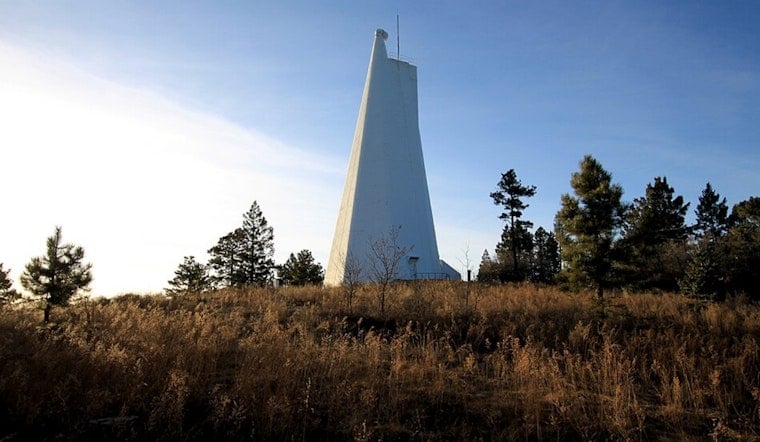
The Richard B. Dunn Solar Telescope, a 265-ton structure that has loomed over the Sacramento Mountains near Sunspot, New Mexico, since 1969, is headed for demolition after federal officials concluded that decades of mercury exposure have made the building impossible to fully clean. The National Science Foundation has confirmed the telescope will come down, even as local advocates push to save the rest of the mountain campus, including its housing, dormitories, fire station, and visitor center.
The telescope's design was unusual from the start: its central optical structure floated in roughly 120 gallons, or about 18,000 pounds, of liquid mercury to allow frictionless rotation as it tracked the sun, according to the National Science Foundation. That mercury-bearing system, installed in the 1960s, worked for decades until a leak was discovered on January 5, 2026. Federal procurement records reviewed by GovTribe show that 11 days later, inspectors found a crack at the weld between a mercury valve and the bottom of the bearing, an emergency condition that could have released all 18,000 pounds of mercury within five minutes had it failed catastrophically.
That discovery prompted the NSF to award a sole-source emergency contract to engineering firm Thornton Tomasetti under federal urgency exemptions, aimed at preventing a massive contamination event in Lincoln National Forest, per the GovTribe filing. Mercury has since been removed from the telescope, according to 2nd Life Media Alamogordo Town News, which reported the leaks occurred over decades and that the NSF has issued three separate updates on the situation.
Why the Building Can't Simply Be Cleaned
An August 2026 engineering summary from Thornton Tomasetti found that crews recovered roughly 2% less liquid mercury than expected after draining what was accessible. The firm concluded that more than 50 years of vapor and micro-leaks had allowed mercury to penetrate steel surfaces and crevices throughout the structure, a process known as amalgamation that causes structural embrittlement and permanent contamination. That finding, the town news outlet's reporting notes, is why the NSF and Thornton Tomasetti determined complete remediation without demolition simply isn't possible.
A separate environmental flag has also surfaced. A July 6 entry in the U.S. Coast Guard's National Response Center database recorded a caller report alleging that an uncleaned mineral oil spill containing PCBs occurred in an observatory shaft around 2016 and was never addressed, per the same outlet's reporting. PCBs were widely used as insulating fluid in older electrical equipment before being banned under federal environmental law, adding another layer to the site's cleanup complexity.
On August 27, the U.S. Forest Service and NSF issued a joint announcement stating the NSF is working with the New Mexico Environment Department on a comprehensive assessment of mercury, lead, asbestos, and mercury vapor condensation before any structural demolition begins. The Forest Service will resume stewardship of the public land once environmental compliance is complete.
A Community Pushes to Save What's Left
Not everyone agrees the whole campus should go. David Dooling, a retired education director at the New Mexico Museum of Space History who lives in nearby High Rolls and runs the Traveling Gizmo Show, has been among the most vocal advocates for preserving Sunspot's non-telescope buildings. Along with Sunspot Community Center leader Heidi Sanchez, Dooling helped form Friends of Sunspot earlier this year, appealing to commissions in Cloudcroft, Alamogordo, and Otero County to pause demolition plans, according to the Cloudcroft Reader.
The Sunspot Community Center has briefed those same commissions on possible ways to repurpose the site, per Alamogordo Town News reporting. Proposals floated to regional leaders include turning the remaining campus into a mixed-use dark-sky astrotourism hub or a science education park focused on forestry and astronomy, ideas that Otero County officials and local business groups see as a potential economic replacement for the scientific jobs the observatory once supported, according to KUNM.
Questions Federal Agencies Won't Answer
Getting straight answers from Washington has proven difficult for reporters and residents alike. Alamogordo Town News says it asked the U.S. Forest Service about remediation timelines before a new site operator moves in, which facilities might be available for repurposing, the status of any public comment period, and how results would be communicated to the public — questions the agency declined to answer regarding ongoing work at Sunspot Solar Observatory. NSF spokesperson Cassandra Eichner told the outlet only that the NSF declines comment, adding that the agency will issue additional updates as new information becomes available.
The outlet also reported that inquiries sent to the Lincoln National Forest's public outreach address, [email protected], have gone unacknowledged, and that past questions sent to NSF's dedicated Sacramento Peak inbox, [email protected], have similarly gone unanswered. The Forest Service has said it plans to explore future opportunities that create public value and honor Sunspot's long-standing legacy, and that it intends to engage local partners and stakeholders about community priorities. Community organizations and individuals have been told they can email [email protected] to stay informed about future discussions.
It also remains unclear whether new scientific instruments installed at the site before the leak have been removed, a question Alamogordo Town News says it posed to officials without receiving an answer. The outlet likewise asked why Sunspot has never been listed on the National Register of Historic Places, another unresolved question hanging over the site's nearly 80-year history.
Decades of History, and a Brush With Conspiracy
Sunspot Solar Observatory dates back to 1947, when the U.S. Air Force established it as a space weather forecasting station meant to monitor solar activity that could disrupt military radio and missile operations near the nearby White Sands Missile Range, according to Source NM. Ownership passed to the NSF in 1976, and site management shifted again in 2017 to a consortium led by New Mexico State University.
The site briefly became a magnet for conspiracy theories in September 2018, when the observatory and a nearby post office were mysteriously evacuated for 11 days under FBI supervision. As The Washington Post later reported, the sudden shutdown, carried out without notifying local police, fueled international speculation about aliens and espionage given the site's proximity to military test ranges — until unsealed federal court records revealed the closure was actually tied to a federal child pornography investigation involving a site janitor.
The Dunn telescope's scientific mission had already been effectively superseded before the mercury leak forced the current reckoning. Its work was largely taken over by the NSF's 4-meter Daniel K. Inouye Solar Telescope on Haleakalā in Maui, which uses adaptive optics systems first tested at Sunspot, according to reporting from The War Zone. That shift in federal priorities toward Hawaii's newer, larger instrument helps explain why New Mexico's aging telescope no longer commanded the funding needed to keep it running, let alone remediate it, once the mercury bearing began to fail.





.jpg)