

























































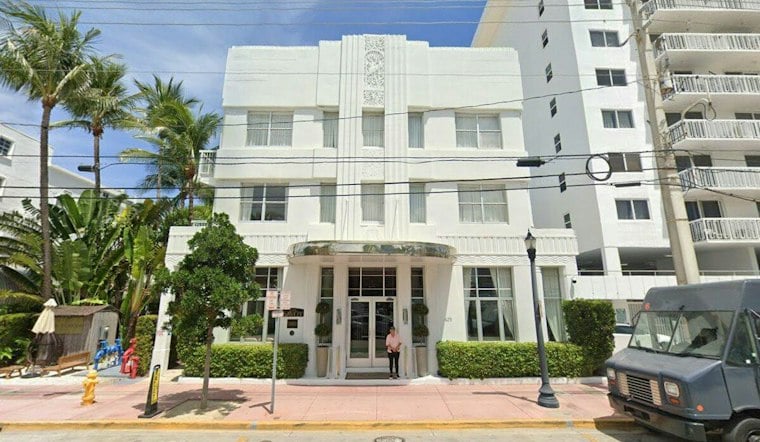
The Savoy Hotel has stood on Ocean Drive in Miami Beach's South of Fifth neighborhood since the 1930s, but the low-rise Art Deco property now faces potential demolition for a 38-story condominium tower — and city officials say state law has left them with no power to stop it.
Real estate investment firm Allied Partners, which purchased the Savoy property at 425 and 455 Ocean Drive in 2005 for $28 million, according to The Real Deal, is behind the proposed project. As reported by WLRN, a demolition letter was sent to Miami Beach officials in April, and the plan calls for razing the Savoy's neighboring building, the Arlington — built in 1941 — entirely, while partly preserving the Savoy structure itself, which dates to 1937 and once appeared on a 1944 postcard of the strip.
Development plans submitted for the site call for a tower reaching up to 480 feet with 150 total residential units, including 90 residences and 60 workforce rental units, along with 76 hotel rooms, a beach club, and pools, according to World Red Eye. The project is designed by Arquitectonica, per the same outlet, combining oceanfront luxury units with the state-mandated workforce housing that made the tower possible in the first place.
Two State Laws, One Vulnerable Hotel
The Savoy's predicament stems from the collision of two Florida preemption statutes passed in consecutive legislative sessions. The 2023 Live Local Act allows developers to bypass many local zoning regulations, and its height preemption provision lets qualifying projects rise as tall as the highest currently allowed building within a one-mile radius of the site — a rule that survived the Legislature's 2024 update to the law, according to Holland & Knight. In exchange, the Live Local Act requires at least 40% of units to remain workforce housing for at least 30 years, per the same account.
The second law, the Resiliency and Safe Structures Act, was passed in 2024 and allows recognized historic properties to be demolished if they fail FEMA flood criteria — a significant threshold given that Miami Beach sits almost entirely in a FEMA flood zone. Governor Ron DeSantis signed the bill, Senate Bill 1526, into law on March 22, 2024, curbing local authority over coastal structures within the Coastal Construction Control Line, as reported by Florida Politics. The measure passed with overwhelming bipartisan support, clearing the House 86–29 and the Senate 36–2, according to HousingWire.
State Senator Bryan Ávila, who represented Hialeah in the Florida Senate, sponsored the Resiliency and Safe Structures Act, and Ávila's law bans local governments from preventing demolition of many nonconforming or unsafe historic structures while also barring officials from requiring preservation of elements of a demolished building. Community activism blocked the bill's passage in 2023, but Ávila filed it again in 2024, when it ultimately became law.
Why Miami Beach's Hands Are Tied
Under the Resiliency and Safe Structures Act, local governments cannot require preservation of elements of a demolished building during the demolition permit review process, according to a report from the Government and Municipal Law Experts. Qualifying Live Local Act developments generally move through administrative review, with zoning review and public hearings skipped, according to Floridian Developer.
Miami Beach Commissioner Alex Fernandez said the law strips the city of authority to stop demolition of historic properties, adding that state preemption limits Miami Beach's ability to review plans. Fernandez had participated in a 2023 protest against the bill before it ultimately passed the following year. In the Legislature, Miami Beach-area Representative Fabian Basabe voted against the bill in the Florida House, and Senator Shevrin Jones voted against it in the Senate, while Senator Ileana Garcia voted in favor.
The Savoy Sits Outside Protected District
The Savoy Hotel is located in South of Fifth, outside the Miami Beach Architectural District, which was listed in the National Register of Historic Places in 1979. Ávila's law exempts historic properties in national register districts recognized before January 1, 2000 — a carve-out that leaves cities including St. Augustine, Key West, Palm Beach, Tampa, Pensacola, West Palm Beach and Panama City largely exempted from the law, but does nothing for properties like the Savoy that fall outside those older district boundaries.
The Savoy is not an isolated case. Other historic Miami Beach properties have also faced potential redevelopment. And in March 2025, demolition applications were submitted for two more historic Miami Beach properties — the 1937 Art Deco Patrician Hotel and the 1941 Neoclassical Revival Coral Reef Hotel on Collins Avenue — under the Resiliency and Safe Structures Act, according to the Miami Design Preservation League.
Preservationists Warn of a Changing Streetscape
Meg Lousteau, executive director of the Miami Beach-based Miami Design Preservation League, warned in 2024 that Ávila's bill could lead to demolition of the Savoy and other historic properties. Lousteau has also cautioned that the combination of Ávila's law and the Live Local Act could change Miami Beach's street-level character altogether, with preservationists noting that multiple historic coastal properties outside pre-2000 National Register districts remain vulnerable under the law.
The Savoy has been closed to the public since it was damaged by Hurricane Irma in 2017, a closure that also spawned earlier legal fights over the property. Allied Partners later filed a $50 million lawsuit over alleged unauthorized demolition and unpermitted work on the Savoy's damaged buildings following the storm, according to The Real Deal. Allied claimed restoration costs were estimated at $30 million alongside $20 million in lost hotel profits after the storm forced parts of the property to close.
Whether that earlier litigation could complicate the current redevelopment approvals remains an open question, as does how city staff will handle the administrative reviews now required under state law, and whether Miami Beach officials will push for statutory carve-outs in future legislative sessions. For now, the Savoy's fate rests largely with an administrative process that leaves little room for the kind of public hearings that once gave residents like Miami Beach resident Ileana Oroza a voice in decisions over the city's historic waterfront.





