

























































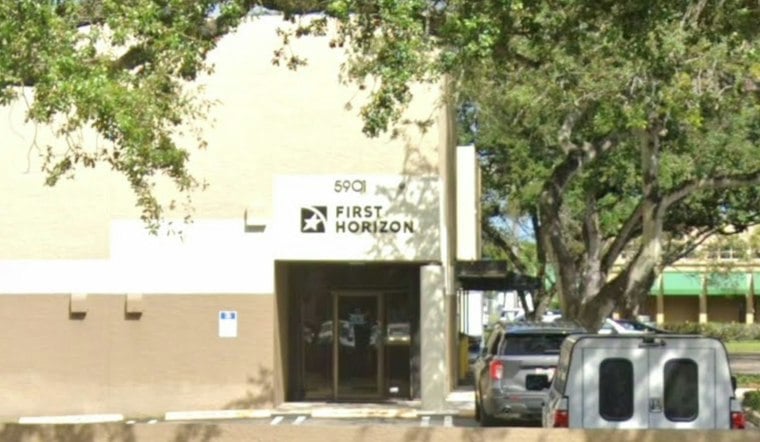
A First Horizon bank teller in Miami Lakes is facing multiple felony charges after investigators say he altered customers’ money orders and pocketed cash from his own drawer, racking up more than $18,000 in losses. Jonathan Escobar, 36, was arrested by Miami-Dade Sheriff’s Office deputies following an internal bank audit that uncovered the alleged scheme.
According to WPLG Local 10, Escobar worked as a teller at the First Horizon branch at 5901 Miami Lakes Drive and had been employed there since June 22. Investigators say he stole four Amscot money orders totaling $4,000 from a victim’s account on September 8, then cashed them and kept the proceeds. The station reports that surveillance video captured the entire transaction.
Cash Drawer Audit Uncovers Bigger Scheme
The alleged theft mechanism went beyond the Amscot money orders. The outlet's report indicates, according to NBC 6 South Florida, Escobar cashed 11 Western Union money orders, each with a face value of just $10, against a single account holder's account, but processed them to reflect $1,000 values before cashing them. Bank personnel audited Escobar's cash drawer on a Friday and found a shortage of $7,657.80, according to the same account.
Investigators later discovered six additional altered money orders, also with an original face value of $10 each, per the station's report. Escobar's transactions caused an additional $11,000 loss on top of the drawer shortage, bringing First Horizon Bank's reported total loss to $18,657.80. The bank reported Escobar as having falsely marked his cash drawer as balanced so the theft would not be detected, the report states.
Suspect Allegedly Returned With a Folder, Then Confessed
Escobar returned to the bank with a folder on a Monday, and according to the report, he admitted to cashing altered money orders against unsuspecting victim accounts and removing money from his cash drawer for personal gain. He faces one count of third-degree grand theft and one count of organized fraud of $20,000 or less in each of two cases stemming from the reported thefts, per arrest reports cited by the outlet.
Under Section 812.014(2)(c) of the Florida Statutes, third-degree grand theft is classified as a third-degree felony for stolen property valued between $750 and $19,999, carrying potential penalties of up to five years in state prison, five years of probation, and a $5,000 fine per count, according to Michael White, a criminal defense attorney. Separately, under Florida Statutes Section 817.034(4)(a)3, known as the Florida Communications Fraud Act, engaging in an ongoing scheme to defraud to obtain property valued under $20,000 is also a third-degree felony punishable by up to five years in prison and a $5,000 fine per offense, per the Florida Senate. Prosecutors may charge separate counts for individual communications or transactions carried out in furtherance of a broader scheme, the Senate notes.
Escobar resides in unincorporated West Little River, an area of roughly 33,000 residents located nine miles north of downtown Miami, according to World Population Review. He was held at the Turner Guilford Knight Correctional Center, a 1,300-bed county detention facility on 7000 NW 41st Street in Miami that serves as the main intake and pre-trial holding center for male arrestees, per JailData.com. His bond was set at $10,000.
How Insider Access Made the Scheme Possible
Banking security research from SQN Banking Systems emphasizes that internal fraud by bank employees poses severe operational risks precisely because tellers understand internal override controls and audit schedules. Financial institutions typically rely on mandatory time off, segregation of duties, and random cash drawer audits to mitigate that kind of risk, the research notes.
The alleged scheme also highlights how routine consumer financial tools become vulnerable when handled internally. Amscot Financial, a Tampa-based provider with more than 220 Florida locations, issues fee-free money orders that are widely used across South Florida and require valid government identification to cash. First Horizon Corporation, the bank at the center of the case, was founded in 1864 and is headquartered in Memphis, Tennessee, operating hundreds of branches across 12 states with more than $80 billion in assets.
The Town of Miami Lakes, where the branch is located, is a 6.5-square-mile master-planned municipality of roughly 30,000 residents and 1,500 local businesses in northwest Miami-Dade County. It remains unclear whether First Horizon has reimbursed the affected account holders or whether additional victim accounts were compromised during Escobar's employment, and formal charges from the Miami-Dade State Attorney's Office have not yet been detailed.





