

























































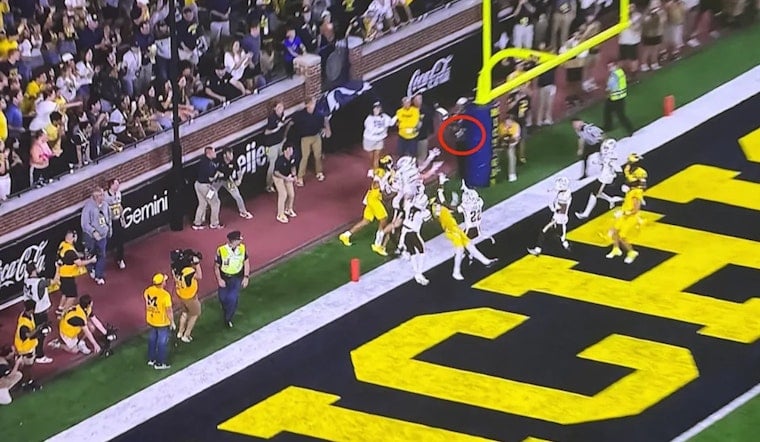
Michigan escaped with a 13-12 win over Western Michigan on a 47-yard Hail Mary from Bryce Underwood to JJ Buchanan, but the finish is still generating national backlash days later after ESPN pundits publicly rejected the Big Ten's explanation for how the winning play even happened. Western Michigan, a 27.5-point underdog that was paid $1.5 million to play the game, came agonizingly close to the biggest win in program history before officials added one second back onto the fourth-quarter clock and handed Michigan one final play.
The controversy has become a referendum on conference transparency as much as on-field officiating. According to The Detroit News, former Lions quarterback Dan Orlovsky said the Big Ten's explanation and evidence felt dishonest, arguing that the game should have been over the moment the clock hit zero and a Western Michigan player touched the ball. Fellow ESPN personality Stephen A. Smith went further, calling the explanation involving two different clocks nonsense and saying he considered the conference's conclusion ridiculous.
The Big Ten explained its decision early Sunday morning, roughly two hours after the game ended, saying the official clock showed one second remaining when the ball touched a Western Michigan player who was out of bounds. That player has been identified as safety Micah Davis, who jumped from an out-of-bounds position before making contact with the loose ball. The conference cited NCAA Football Rule 4-2-3-a, which states a loose ball is dead and out of bounds the instant it touches any player or object on or outside the boundary line, as reported by Awful Announcing.
Two Clocks, Two Different Stories
Orlovsky said game officials and NBC could not get their clocks synchronized, and NBC's own broadcast supported that read. NBC rules analyst Terry McAulay told viewers during the game that the network's inset clock was synced directly to the stadium clock and showed time reaching zero while the ball was still in the air, leaving him unable to explain how the conference's replay center arrived at a different duration. The NBC clock, notably, is not the official clock used by the conference.
The Big Ten's official statement addressed that gap directly, explaining that all broadcast cameras feeding its replay system — including the one trained on the stadium clock — are synchronized using a strobe system 85 minutes before kickoff to align every replay angle. That protocol is how the conference defended trusting its internal command-center footage over the graphic seen by television audiences.
Not everyone in the football world agrees that trust was well placed. FOX Sports rules analyst Mike Pereira said Monday that standard replay protocol across football calls for officials to defer to the broadcast clock visible to home viewers whenever a discrepancy arises, arguing the replay crew erred by relying on the command-center footage instead, according to FOX Sports. Adding to the confusion, both Michigan head coach Kyle Whittingham and Purdue head coach Barry Odom acknowledged this week that they had not previously realized the physical stadium clock fans see inside the venue is not the same official clock monitored by the conference's internal tracking system, per AP News.
Western Michigan Accepts the Ruling, Even as the Sting Lingers
Western Michigan head coach Lance Taylor, Mid-American Conference officials, and Western Michigan president Russ Kavalhuna all accepted the Big Ten's explanation, and Western Michigan accepted the defeat despite the controversial ending. But Taylor's postgame comments revealed his own doubts in the moment. He said that when he looked at the stadium clock during the initial Hail Mary attempt, time had hit zero before his defender touched the ball, though he ultimately deferred to the official ruling and praised his team's effort, according to a report from By The Belt.
The debate over which rulebook applies has also crossed sports. Under National Football League replay rules, the outcome would not have been overturned at all, since NFL protocol requires at least two full seconds remaining on the clock before officials can even grant a review, per The Spun. That contrast has fueled arguments that college football's timing standards remain murkier than fans realized, even among coaches who have spent decades in the sport.
Underwood's Rocky Night Before the Rescue
The finish overshadowed an uneven performance from Michigan's sophomore quarterback. Bryce Underwood completed 12 of 22 passes for 170 yards with one touchdown and one interception, while adding 47 rushing yards and a rushing touchdown, but his two second-half turnovers were converted by Western Michigan into points that put the Wolverines behind, according to statistics compiled by Big Ten Football Junkies on YouTube. Freshman receiver JJ Buchanan made his collegiate debut in the game, finishing with six receptions for 126 yards before hauling in the walk-off 47-yard touchdown as time expired.
The win marked the last Saturday head-coaching debut for Kyle Whittingham at Michigan, who was hired to replace Sherrone Moore following Moore's termination amid off-field controversy — a transition detailed in Hoodline. It capped a chaotic offseason stretch for the program that also included fraud allegations tied to memorabilia sales connected to Underwood, reported earlier this summer in Hoodline's coverage of the HailGate case, following a 2025 season that ended with a bowl loss to Texas under interim leadership after Moore's firing.
For now, the Big Ten is standing by its ruling, and Western Michigan has publicly moved on. But the very fact that Michigan's own new head coach didn't know how the conference's official clock worked, paired with an NBC broadcast that showed something entirely different in real time, has left ESPN's biggest voices unwilling to let the explanation stand unchallenged.


