

























































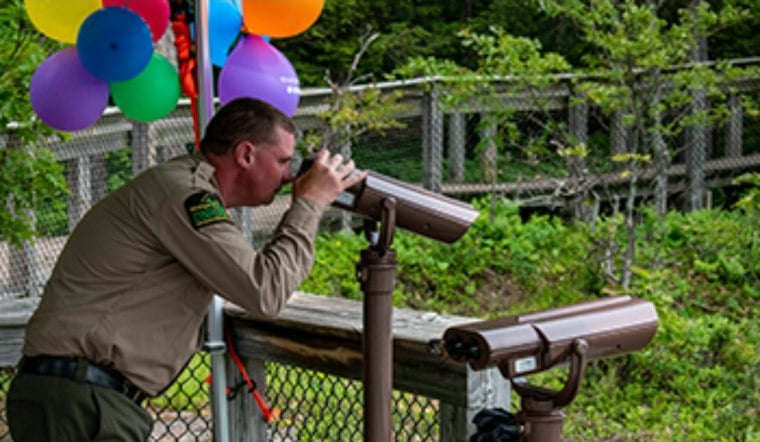
Michigan's fall foliage includes blazing reds, oranges and yellows, but for many visitors, those colors blur into a dull sameness. The Michigan Department of Natural Resources has spent roughly six years quietly addressing that, installing EnChroma-equipped scenic viewers at state parks so people with color vision deficiency can see the season the way most everyone else does.
People with color blindness typically see reds, oranges and yellows as more or less indistinguishable, muting the visual payoff of Michigan's autumn color change, according to CBS News Detroit. The condition affects roughly 1 in 12 men and 1 in 200 women, representing an estimated 425,000 Michigan residents and 13 million people nationwide, per EnChroma. While someone with standard color vision can detect over a million distinct shades, EnChroma notes that people with color vision deficiency perceive only about 10% of those hues.
How the Viewfinders Actually Work
The devices pair weatherized viewfinder hardware from SeeCoast Manufacturing with EnChroma's optical filters, which remove specific light wavelengths where red and green cone signals overlap in the eye, according to a bulletin from the State of Michigan. That filtering boosts color saturation for colorblind viewers without distorting the image for anyone else looking through the same lens — visitors with typical color vision simply notice a bit of extra vibrancy, the state says.
Each unit costs roughly $5,000 to purchase and install, and the DNR is financing the rollout mostly through private donations and local park advocacy groups rather than state tax dollars, CBS News reports. Nonprofit Friends groups raise money to support the program, allowing it to expand without competing for general park funding.
Where the Technology Has Landed So Far
The state's first EnChroma scenic viewers went up in June 2022 at Porcupine Mountains Wilderness State Park in the Upper Peninsula, positioned over the Lake of the Clouds and Summit Peak overlooks, according to the State of Michigan. A third installation followed that October at William G. Milliken State Park in Detroit.
As of this month, EnChroma viewfinders or loaner lenses are available at Porcupine Mountains Wilderness, Highland, Ludington, Maybury, William G. Milliken, Mitchell, Muskegon and Waterloo state parks, per WHMI. The DNR plans to expand next to Brimley State Park, Grand Haven State Park, Island Lake Recreation Area and Rifle River Recreation Area, the outlet reports.
Maybury State Park has taken the concept a step further. Beyond a fixed viewer, the park began lending EnChroma glasses in adult and child sizes in 2026, letting visitors carry the color correction with them along the trails free of charge, according to the Friends of Maybury State Park. The group says local foundations and Rotary organizations funded the loaner program.
Part of a Broader National Push
Michigan's rollout fits into a larger movement among public land managers. EnChroma's Color Accessibility Program has outfitted scenic viewfinders or supplied loaner glasses at more than 50 National Park Service and U.S. Fish and Wildlife Service sites across 20 states, the company says.
Tennessee State Parks has installed EnChroma-adapted SeeCoast viewfinders at seven state parks and other landmarks to make leaf-peeping season accessible to more visitors, according to the Tennessee State Parks Conservancy. Similar efforts have also been reported elsewhere.
Michigan's approach remains location-by-location rather than statewide, with viewers and loaner glasses being added at parks across the state. As more viewfinders and loaner glasses arrive at parks across the state, an increasing share of that autumn crowd will get to see the season's full range of color for the first time.





