

























































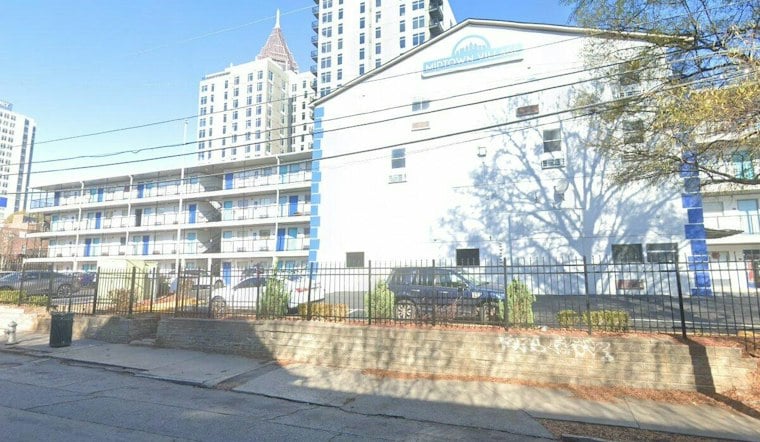
Tenants at Midtown Village Apartments in Atlanta say fungus and mold have spread through their $800-a-month units, and some of them believe the conditions are worsening ongoing health problems. The 160-unit complex at 140 Pine Street NE, a former extended-stay hotel converted into efficiency-style housing, includes 92 units set aside for people living with HIV through a partnership with AID Atlanta, according to AID Atlanta.
One tenant told WSB-TV they found mold behind a dresser and inside air-conditioning units, and said the apartment conditions are not fit for humans. Several tenants interviewed by the station withheld their faces, fearing possible retaliation for speaking out. Some residents at the property are immunocompromised, and one tenant described being shuffled between apartment units while waiting for repairs, reporting difficulty breathing and repeated hospital visits along the way.
That tenant said they now keep an inhaler nearby and conducted testing that they said showed different types of fungi present in the unit. At the time of WSB-TV's reporting, the tenant was living in a third unit temporarily while another was being repaired. Tenants overall reported mold or fungus growth in a range of spots — on doors, in bathrooms, on air-conditioning units, above showers, in kitchens, inside walls, and even on personal belongings, per the station's report.
What the Property Manager Says
Midtown Village is operated by Healthy Housing Foundation, which describes itself as a provider of affordable workforce housing. Management allowed the station to tour the property, where crews found one unit undergoing mold remediation and another where the work had recently been completed. Imara Canady, speaking for the foundation, said Healthy Housing Foundation has owned the property for a couple of years and inherited some of the issues now surfacing.
Canady said management is working with a contractor that handles mold remediation, and the foundation sent tenants a letter reminding them to keep air-conditioning units set above a certain temperature. According to Canady, setting a thermostat too low can create condensation and moisture that lead to mold growth. Tenants have pushed back on that framing, asking management to investigate whether a larger, building-wide issue is driving the fungus rather than individual unit settings.
Inspections, Work Orders and Open Cases
Management said tenants are required to submit formal work orders for problems inside their units, and Canady said the foundation's leadership team conducts a top-to-bottom property inspection every three months. He added that management is now conducting a unit-by-unit examination to look for larger problems, and that Healthy Housing Foundation plans to address any systemic issue that inspection turns up.
Code enforcement has already closed five cases at the property after compliance was reached, including one involving a bathroom with inadequate ventilation, the station's report notes. Three cases remain open, and at least one tenant has a code-enforcement court date scheduled for next month. Healthy Housing Foundation says it is continuing work on reported issues and tenant remediation efforts.
The Legal Backdrop for Georgia Renters
Georgia only recently gave tenants an explicit statutory right to livable housing. House Bill 404, the Safe at Home Act, took effect in July 2024 and established a non-waivable duty of habitability for residential landlords — before that, Georgia was one of the last states without explicit statutory habitability standards, according to the National Low Income Housing Coalition. Even so, state law does not mention mold by name; mold complaints in Georgia must be tied to broader repair duties like HVAC and water-leak maintenance, with code enforcement left to local municipalities rather than state-level mold inspectors, per SafeAir.
Georgia law also does not permit tenants to withhold rent over unresolved mold or maintenance complaints, putting renters at immediate risk of eviction proceedings. Under Georgia Code § 44-7-24, a tenant may establish a prima-facie case of retaliation when specified tenant and landlord actions occur within three months, according to Justia Law. That legal reality is one reason tenants who spoke to WSB-TV chose to hide their identities. Tenants who can show retaliation may seek a civil penalty of one month's rent plus $500.
A National Pattern for the Foundation's Housing
Healthy Housing Foundation is an affordable-housing initiative of the Los Angeles-based AIDS Healthcare Foundation, the world's largest AIDS nonprofit, with annual revenues of $2.2 billion, according to the Los Angeles Times. The parent organization launched Healthy Housing Foundation in 2017 to acquire single-room occupancy hotels and convert them into low-income housing, and AID Atlanta describes Midtown Village as AHF's first property in the Atlanta area.
The Times has documented similar complaints elsewhere in the foundation's portfolio. In September 2024, AIDS Healthcare Foundation agreed to pay $575,000 to settle a class-action lawsuit brought by tenants of its Madison Hotel in Los Angeles, who alleged squalid conditions including pervasive mold, vermin, and plumbing failures. A November 2023 Times investigation into the foundation's national housing operations, which had more than 1,300 residents and properties across the country, documented widespread tenant complaints about unaddressed mold, pest infestations, and delayed maintenance.
The Atlanta complaints also land amid a broader regional habitability crisis. An Atlanta Journal-Constitution investigation documented dangerous dwellings across metro Atlanta where residents face chronic hazards, including unmitigated mold, structural decay, and raw sewage leaks.
Why the Health Stakes Are Higher Here
The stakes are especially acute for a building that houses immunocompromised residents. As Hoodline reported in July, a CDC review of four Atlanta hospitals documented 449 invasive mold cases with a 30% in-hospital mortality rate, underscoring the elevated risk of severe respiratory complications for people with compromised immune systems living near active mold growth. For Midtown Village residents already managing HIV, that clinical backdrop adds urgency to complaints that might otherwise be treated as routine maintenance disputes.




