

























































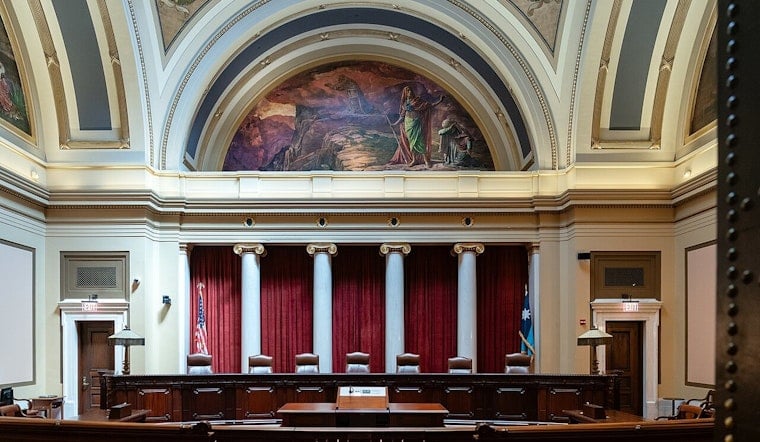
Minnesota's Supreme Court is weighing whether a former librarian at a Twin Cities Catholic high school can proceed with a discrimination lawsuit after she was pushed out of her job for coming out as transgender. The case, centered on librarian and media specialist Reyzl Grace MoChridhe, could reshape how far religious employers can go in claiming immunity from state civil rights law when the employee in question holds a secular, non-ministerial position.
MoChridhe was hired in 2021 as a media specialist and librarian at the Academy of Holy Angels, and she disclosed to school administrators at the time that she was Jewish, according to MPR News. Her employment contract contained no requirements for religious instruction or ministerial duties, the outlet reports, a detail central to her argument that the job was never a religious one to begin with.
In spring 2022, school administrators told MoChridhe she could not continue working at the high school if she proceeded with her gender transition, despite what she described as strong job performance, according to Courthouse News Service. She filed her lawsuit against the Academy of Holy Angels and the Archdiocese of St. Paul and Minneapolis in August 2024, alleging violations of the Minnesota Human Rights Act.
A Policy Rooted in 2019 Church Guidance
The school's decision not to renew MoChridhe's contract relied on the Archdiocese of St. Paul and Minneapolis's 2019 document, “Guiding Principles for Catholic Schools and Religious Education Concerning Human Sexuality and Sexual Identity,” which mandates that all Catholic school personnel adhere to conduct, names, and pronouns matching their biological sex assigned at birth, per the same account from Becket Law. The Minnesota Human Rights Act itself was amended in 1993 to explicitly bar employment discrimination based on gender identity and sexual orientation, making Minnesota one of the earliest states to offer statutory workplace protections for transgender workers, according to Gender Justice.
Lower courts have so far sided entirely with the Archdiocese. On December 1, 2025, the Minnesota Court of Appeals unanimously affirmed a district court's dismissal of MoChridhe's lawsuit, ruling that the First Amendment's church autonomy doctrine bars judicial interference in employment decisions grounded in religious directives, as reported by CBS Minnesota. The Minnesota Supreme Court agreed to grant review of the case in February 2026, setting up the oral arguments held Tuesday.
Dueling Arguments Before the State's Highest Court
During those oral arguments, Gender Justice attorney Greta Wiessner argued that lower courts erred in applying the church autonomy doctrine to dismiss MoChridhe's complaint before any factual discovery took place, according to Courthouse News. Wiessner warned that granting broad immunity for secular roles could allow religious employers to bypass civil rights laws regarding race or marriage as well, not just gender identity.
Becket Law, the religious freedom advocacy group that joined the Archdiocese's defense team in 2025, contends that Catholic schools hold a First Amendment right to require all staff to support Catholic moral teachings as part of their educational mission, according to Becket Law. That argument frames every employee, regardless of job title, as part of the school's broader religious purpose.
Americans United for Separation of Church and State filed an amicus brief in June 2025 taking the opposite position, arguing that church autonomy should not block anti-discrimination lawsuits when claims can be resolved using neutral principles of employment law without a court having to evaluate religious doctrine, according to Americans United for Separation of Church and State.
Stakes Beyond One Library Job
Gender Justice has emphasized that a ruling upholding broad church autonomy for secular jobs could strip anti-discrimination protections from thousands of workers at religiously affiliated hospitals, universities, and social service agencies across the state, not just Catholic schools. The organization's framing underscores why advocacy groups on both sides have mobilized around a single librarian's employment dispute.
The Minnesota Supreme Court has not indicated when it will issue a ruling. Its decision will determine whether MoChridhe's case can move forward into the fact-finding stage that lower courts blocked, or whether the church autonomy doctrine will stand as a categorical bar to her claims.





.jpg)